F. Selleri - Böcker
Visar alla böcker från författaren F. Selleri. Handla med fri frakt och snabb leverans.
11 produkter
11 produkter
852 kr
Skickas inom 10-15 vardagar
Einstein, Podolsky, and Rosen Paradox in Atomic, Nuclear, and Particle Physics
Inbunden, Engelska, 1998
1 064 kr
Skickas inom 10-15 vardagar
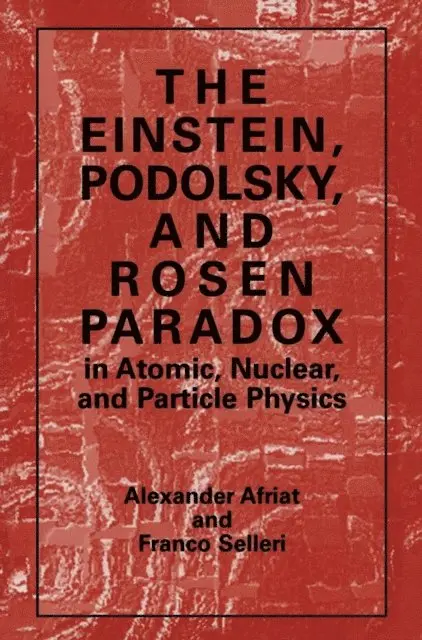
"Paradox" conjures up arrows and tortoises. But it has a speculative, gedanken ring: no one would dream of really conjuring up Achilles to confirm that he catches the tortoise. The paradox of Einstein, Podolsky, and Rosen, however, is capable of empirical test. Attempted experimental resolutions have involved photons, but these are not detected often enough to settle the matter. Kaons are easier to detect and will soon be used to discriminate between quantum mechanics and local realism. The existence ofan objective physical reality,which had disappeared behind the impressive formalism of quantum mechanics, was originally intended to be the central issue of the paradox; locality, like the mathematics used, was just assumed to hold. Quantum mechanics, with its incompatible measurements, was born rather by chance in an atmosphere of great positivistic zeal, in which only the obviously measurable had scientific respectability. Speculation about occult "unobservable" quantities was viewed as vacuous metaphysics, which should surely form no part of a mature scientific attitude. Soon the "unmeasurable, " once only disreputable, vanished altogether. One had first been told not to worry about it; then, as dogma got more carefully defined, one was assured that the unobserved was just not there. This made it easier not to think about it and to avoid hazardous metaphysical temptation.
Del 35 - Fundamental Theories of Physics
Quantum Paradoxes and Physical Reality
Inbunden, Engelska, 1989
2 121 kr
Skickas inom 10-15 vardagar
Although the debate about the true nature of the quantum behavior of atomic systems has never ceased, there are two periods during which it has been particularly intense: the years that saw the founding of quantum mechanics and, increasingly, these modern times. In 1954 Max Born, on accepting the Nobel Prize for his 'fundamental researches in quantum mechanics', recalled the depth of the disagreements that divided celebrated quantum theorists of those days into two camps: . . . when I say that physicists had accepted the way of thinking developed by us at that time, r am not quite correct: there are a few most noteworthy exceptions - namely, among those very workers who have contributed most to the building up of quantum theory. Planck himself belonged to the sceptics until his death. Einstein, de Broglie, and Schriidinger have not ceased to emphasize the unsatisfactory features of quantum mechanics . . . . This dramatic disagreement centered around some of the most funda mental questions in all of science: Do atomic objects exist il1dependently of human observations and, if so, is it possible for man to understand correctly their behavior? By and large, it can be said that the Copenhagen and Gottingen schools - led by Bohr, Heisenberg, and Born, in particula- gave more or less openly pessimistic answers to these questions.
536 kr
Skickas inom 10-15 vardagar
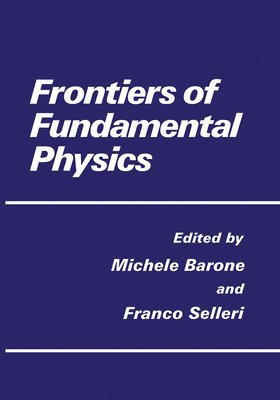
The Olympia conference Frontiers of Fundamental Physics was a gathering of about hundred scientists who carryon their research in conceptually important areas of physical science (they do "fundamental physics"). Most of them were physicists, but also historians and philosophers of science were well represented. An important fraction of the participants could be considered "heretical" because they disagreed with the validity of one or several fundamental assumptions of modern physics. Common to all participants was an excellent scientific level coupled with a remarkable intellectual honesty: we are proud to present to the readers this certainly unique book. Alternative ways of considering fundamental matters should of course be vitally important for the progress of science, unless one wanted to admit that physics at the end of the XXth century has already obtained the final truth, a very unlikely possibility even if one accepted the doubtful idea of the existence of a "final" truth. The merits of the Olympia conference should therefore not be judged a priori in a positive or in a negative way depending on one's refusal or acceptance, respectively, but considered after reading the actual of basic principles of contemporary science, new proposals and evidences there presented. They seem very important to us.
634 kr
Skickas inom 5-8 vardagar
1 064 kr
Skickas inom 10-15 vardagar
If you have two small objects, one here on Earth and the other on the planet Pluto, what would you say of the following statement: No modification of the properties of the object on the earth can take place as a consequence of an interaction of the distant object with a third body also located on Pluto? The opinion that the previous statement is correct is very natural, but modern quantum theory implies that it must be wrong in certain cases. Consider in fact two arbitrary objects separated by such a large distance that they are unable to exert any important mutual influence. It is possible to show rigorously that a measurable physical quantity exists, with a value more than 40% different from the value theoretically predicted by quantum mechanics. Necessarily then, either space is largely an illusion of our senses and it does not exist objectively, or information can be sent from the future to the past, or ... something important has to be changed in modern physics. This is the essence of the Einstein-Podolsky-Rosen (EPR) paradox. A paradox is an argument that derives absurd conclusions by valid deduction from acceptable premises. In the case of the EPR paradox the absurd conclusion is that Bell's observable d should have two different values d = 2.Ji and The "acceptable premises" are the following: 1. All the empirical predictions of the existing quantum theory are correct.
Einstein, Podolsky, and Rosen Paradox in Atomic, Nuclear, and Particle Physics
Häftad, Engelska, 2013
1 064 kr
Skickas inom 10-15 vardagar
"Paradox" conjures up arrows and tortoises. But it has a speculative, gedanken ring: no one would dream of really conjuring up Achilles to confirm that he catches the tortoise. The paradox of Einstein, Podolsky, and Rosen, however, is capable of empirical test. Attempted experimental resolutions have involved photons, but these are not detected often enough to settle the matter. Kaons are easier to detect and will soon be used to discriminate between quantum mechanics and local realism. The existence ofan objective physical reality,which had disappeared behind the impressive formalism of quantum mechanics, was originally intended to be the central issue of the paradox; locality, like the mathematics used, was just assumed to hold. Quantum mechanics, with its incompatible measurements, was born rather by chance in an atmosphere of great positivistic zeal, in which only the obviously measurable had scientific respectability. Speculation about occult "unobservable" quantities was viewed as vacuous metaphysics, which should surely form no part of a mature scientific attitude. Soon the "unmeasurable, " once only disreputable, vanished altogether. One had first been told not to worry about it; then, as dogma got more carefully defined, one was assured that the unobserved was just not there. This made it easier not to think about it and to avoid hazardous metaphysical temptation.
3 748 kr
Skickas inom 10-15 vardagar
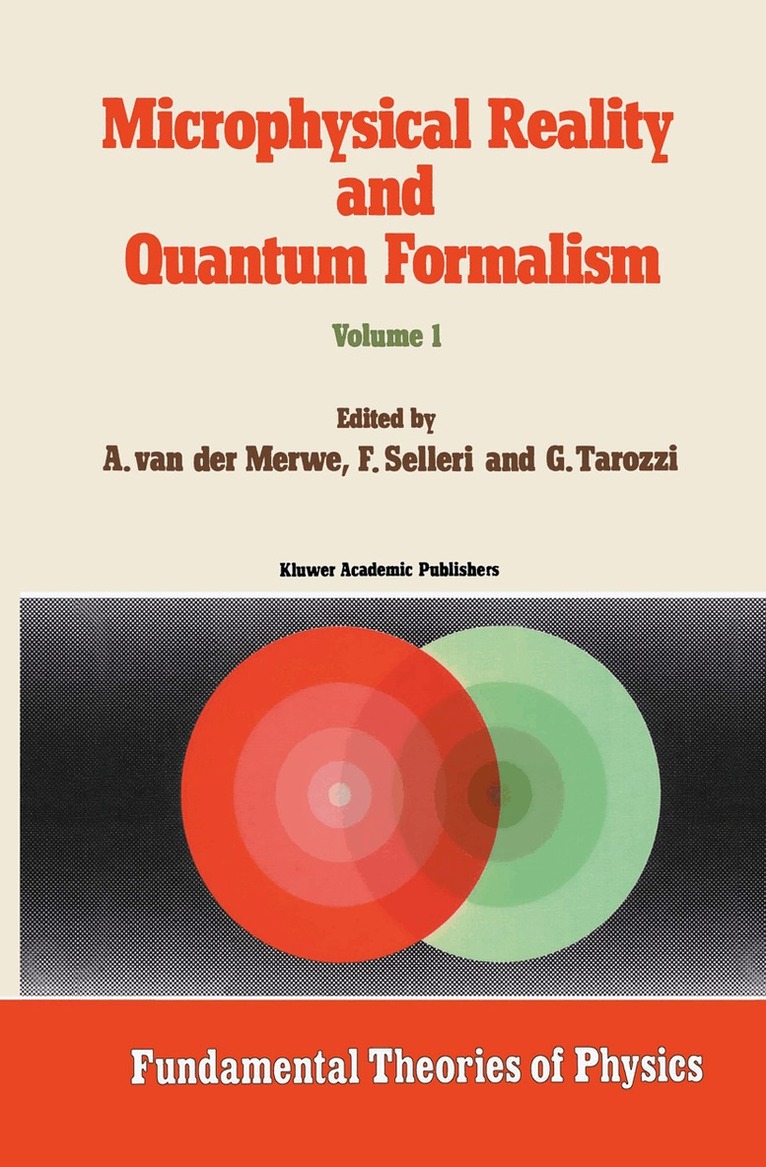
Quantum mechanics has reached maturity as an a wesome scientific theory, and undeniably no experiment has so far produced any result conflic ting with its predictions. Nevertheless, an increasing number of scholars are seriously questioning the limits of this discipline's validity, a fact that is eloquently attested to by the four international conferences devoted to the foundations of quantum theory which were held in 1987 alone - in Joensuu, Vienna, Gdansk, and Delphi, respectively. There is an increa~ing awareness that the founding fathers of quantum mechanics have left behind a theory which, though spectacularly successful in its applications, severely limits our intuitive understanding of the microworld, and that their reasons for doing so were at least partly arbitrary and open to question. The problem of the relationship between the existing quantum theory and objective reality at the atomic and subatomic levels can be tackled in essentially two ways: (i) One may focus attention on the formalism of the theory and attempt to deduce from it a coherent description of our measuring processes and a deeper understanding of the microworld. Oi) Alternatively, one may start from the experimental evidence and/or from models of the objective reality compatible with it and go on to inves tigate whether or not formalization of this knowledge can be accomodated within the broad confines of existing quantum theory.
Del 3 - Fundamental Theories of Physics
Wave-Particle Dualism
A Tribute to Louis de Broglie on his 90th Birthday
Häftad, Engelska, 2012
1 064 kr
Skickas inom 10-15 vardagar
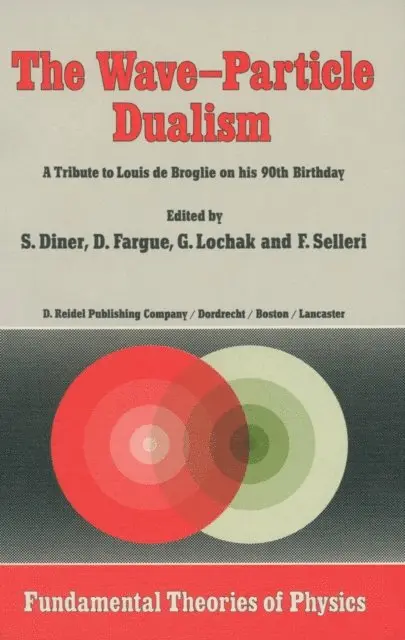
The Louis de Broglie Foundation (which was created in 1973, for the fiftieth anniversary of the discovery of wave mechanics) and the University of Perugia, have offered an international symposium to Louis de Broglie on his 90th birthday. This publication re- presents the Proceedings of this conference which was held in Perugia on April 22-30, 1982. It was an opportunity for the developing of physical conceptions of all origins, which may serve to throw light on the mysterious power of the quantum theory. Quantum Mechanics has reached matu- rity in its formalism and although no experiment yet has come to challenge its predictions, one may question the limits of its va- lidity. In fact the true meaning of this vision of the microphysi- cal world remains the subject of endless debating, at the heart of which lies "the foundational myth" of wave-particle dualism. Albert Einstein and Louis de Broglie are the two discoverers of this fundamental duality, which they always considered as a deep physical reality rather than a phenomenological artifice.During the conference a survey has been given of the essential recent experimental results in corpuscular and quantum optics and the most up-to-date theoretical aspects of the specificity of mi- crophysical phenomena : various interpretations of quantum mecha- nics, "al ternati ve theories" and hidden parameters theories, pro*- babilistic and axiomatic questions and tentative crucial experi- ments. The conference took place in the magnificent atmosphere of the villa Colombella lent to us by the Universita per Stranieri di Perugia.
Del 35 - Fundamental Theories of Physics
Quantum Paradoxes and Physical Reality
Häftad, Engelska, 2011
2 121 kr
Skickas inom 10-15 vardagar
Although the debate about the true nature of the quantum behavior of atomic systems has never ceased, there are two periods during which it has been particularly intense: the years that saw the founding of quantum mechanics and, increasingly, these modern times. In 1954 Max Born, on accepting the Nobel Prize for his 'fundamental researches in quantum mechanics', recalled the depth of the disagreements that divided celebrated quantum theorists of those days into two camps: . . . when I say that physicists had accepted the way of thinking developed by us at that time, r am not quite correct: there are a few most noteworthy exceptions - namely, among those very workers who have contributed most to the building up of quantum theory. Planck himself belonged to the sceptics until his death. Einstein, de Broglie, and Schriidinger have not ceased to emphasize the unsatisfactory features of quantum mechanics . . . . This dramatic disagreement centered around some of the most funda mental questions in all of science: Do atomic objects exist il1dependently of human observations and, if so, is it possible for man to understand correctly their behavior? By and large, it can be said that the Copenhagen and Gottingen schools - led by Bohr, Heisenberg, and Born, in particula- gave more or less openly pessimistic answers to these questions.
4 122 kr
Skickas inom 10-15 vardagar
Quantum mechanics has reached maturity as an a wesome scientific theory, and undeniably no experiment has so far produced any result conflic ting with its predictions. Nevertheless, an increasing number of scholars are seriously questioning the limits of this discipline's validity, a fact that is eloquently attested to by the four international conferences devoted to the foundations of quantum theory which were held in 1987 alone - in Joensuu, Vienna, Gdansk, and Delphi, respectively. There is an increa~ing awareness that the founding fathers of quantum mechanics have left behind a theory which, though spectacularly successful in its applications, severely limits our intuitive understanding of the microworld, and that their reasons for doing so were at least partly arbitrary and open to question. The problem of the relationship between the existing quantum theory and objective reality at the atomic and subatomic levels can be tackled in essentially two ways: (i) One may focus attention on the formalism of the theory and attempt to deduce from it a coherent description of our measuring processes and a deeper understanding of the microworld. Oi) Alternatively, one may start from the experimental evidence and/or from models of the objective reality compatible with it and go on to inves tigate whether or not formalization of this knowledge can be accomodated within the broad confines of existing quantum theory.