Fabien Michel – författare
Visar alla böcker från författaren Fabien Michel. Handla med fri frakt och snabb leverans.
8 produkter
Agent Environments for Multi-Agent Systems IV
4th International Workshop, E4MAS 2014 - 10 Years Later, Paris, France, May 6, 2014, Revised Selected and Invited Papers
Häftad, 2015
545 kr
Lägg i varukorg
This book constitutes the thoroughly refereedpost-workshop proceedings of the 4th International Workshop on Environments forMultiagent Systems, E4MAS 2014 - 10 years later, held in Paris, France, in May2014 as an associated event of AAMAS 2014, the 13th International Conference onAutonomous Agents …
Agent Environments for Multi-Agent Systems IV
4th International Workshop, E4MAS 2014 - 10 Years Later, Paris, France, May 6, 2014, Revised Selected and Invited Papers
E-bok, 2015
672 kr
Lägg i varukorg
This book constitutes the thoroughly refereedpost-workshop proceedings of the 4th International Workshop on Environments forMultiagent Systems, E4MAS 2014 - 10 years later, held in Paris, France, in May2014 as an associated event of AAMAS 2014, the 13th International Conference onAutonomous Agents …
Environments for Multi-Agent Systems
First International Workshop, E4MAS, 2004, New York, NY, July 19, 2004, Revised Selected Papers
Av Danny Weyns, H. Van Dyke Parunak m. fl.
Häftad, 2005
567 kr
Lägg i varukorg
The modern ?eld of multiagent systems has developed from two main lines of earlier research. Its practitioners generally regard it as a form of arti?cial intelligence (AI). Some of its earliest work was reported in a series of workshops in the US dating …
Environments for Multi-Agent Systems
First International Workshop, E4MAS, 2004, New York, NY, July 19, 2004, Revised Selected Papers
Av Fabien Michel, H. Van Dyke Parunak m. fl.
E-bok, 2005
739 kr
Lägg i varukorg
The modern ?eld of multiagent systems has developed from two main lines of earlier research. Its practitioners generally regard it as a form of arti?cial intelligence (AI). Some of its earliest work was reported in a series of workshops in the US dating …
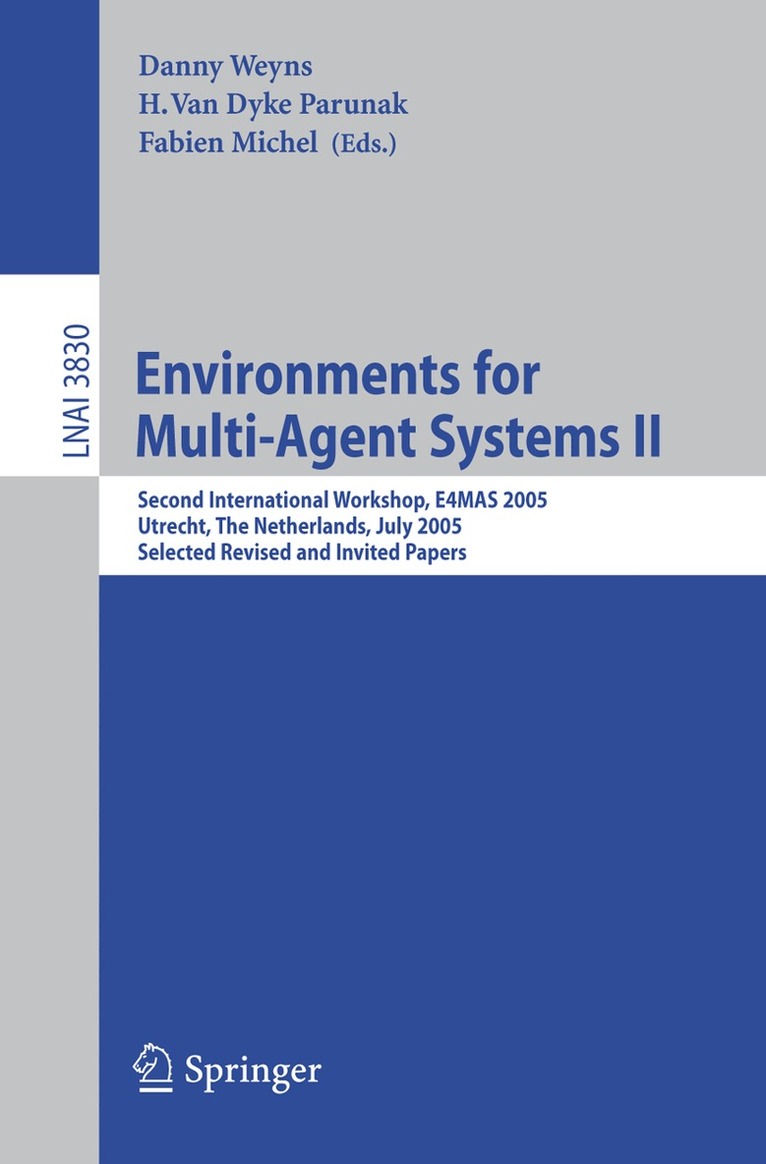
Environments for Multi-Agent Systems II
Second International Workshop, E4MAS 2005, Utrecht, The Netherlands, July 25, 2005, Selected Revised and Invited Papers
Av Danny Weyns, H. Van Dyke Parunak m. fl.
Häftad, 2006
567 kr
Lägg i varukorg
This book constitutes the thoroughly refereed post-proceedings of the Second International Workshop on Environments for Multiagent Systems, E4MAS 2005, held in July 2005. The 16 revised papers presented were carefully reviewed and selected from the lectures given at the workshop. The papers are …
Environments for Multi-Agent Systems II
Second International Workshop, E4MAS 2005, Utrecht, The Netherlands, July 25, 2005, Selected Revised and Invited Papers
Av Fabien Michel, H. Van Dyke Parunak m. fl.
E-bok, 2006
755 kr
Lägg i varukorg
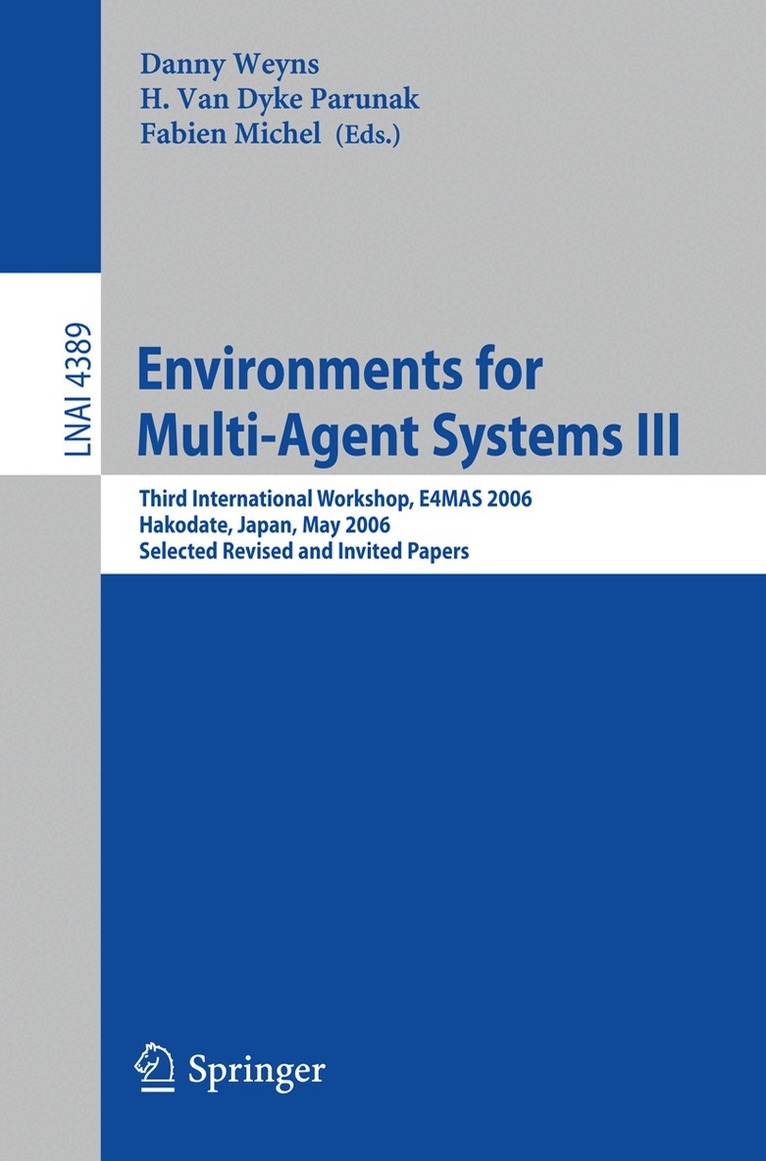
Environments for Multi-Agent Systems III
Third International Workshop, E4MAS 2006, Hakodate, Japan, May 8, 2006, Selected Revised and Invited Papers
Av Danny Weyns, H. Van Dyke Parunak m. fl.
Häftad, 2007
567 kr
Lägg i varukorg
This book constitutes the thoroughly refereed post-proceedings of the Third International Workshop on Environments for Multiagent Systems, E4MAS 2006, held in Hakodate, Japan in May 2006. The 15 revised papers in this volume are organized in topical sections on models, architecture, and design, …
Environments for Multi-Agent Systems III
Third International Workshop, E4MAS 2006, Hakodate, Japan, May 8, 2006, Selected Revised and Invited Papers
Av Fabien Michel, H. Van Dyke Parunak m. fl.
E-bok, 2007
739 kr
Lägg i varukorg