Fabien Petitcolas – författare
Visar alla böcker från författaren Fabien Petitcolas. Handla med fri frakt och snabb leverans.
3 produkter
3 produkter
Inbunden, Engelska, 1999
1 534 kr
Skickas inom 5-8 vardagar
Steganography, a means by which two or more parties may communicate using "invisible" or "subliminal" communication, and watermarking, a means of hiding copyright data in images, are becoming necessary components of commercial multimedia applications that are subject to illegal use. This is a comprehensive survey of steganography and watermarking and their application to modern communications and multimedia. It helps the reader to understand steganography, the history of this previously neglected element of cryptography, the hurdles of international law on strong cryptographic techniques, and a description of the methods you can use to hide information in modern media. Included in this discussion is an overview of "steganalysis", methods which can be used to break stenographic communication. This resource also includes an introduction to and survey of watermarking methods, and discusses this method's similarities to and differences from steganography. The reader should gain a working knowledge of watermarking's pros and cons, and learn the legal implications of watermarking and copyright issues on the Internet.
Häftad, Engelska, 2003
562 kr
Skickas inom 10-15 vardagar
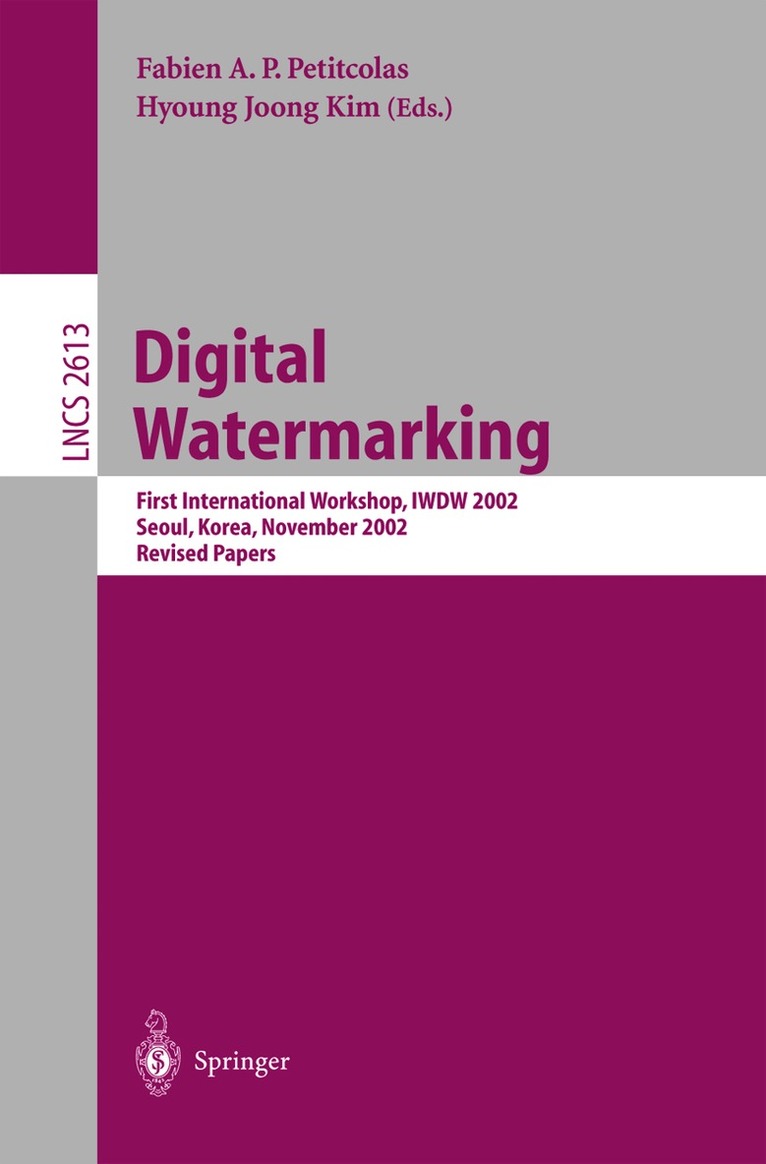
The 1st International Workshop on Digital Watermarking (IWDW), the con- rence covering all aspects of digital watermarking, was held at the Hotel Riviera situated along the beautiful Han River in Seoul, Korea from November 21 to 22, 2002. These proceedings contain 21 papers that were accepted for presentation at the conference. These papers were selected from 67 submissions including 3 invited papers. They went through a thorough review process by the Program Committee and were selected on the basis of excellence and novelty. The following is a brief description of the history of this conference and - viewing process: In August 2001 some members of the Special Interest Group on Multimedia Protection (SIGMP) of the Korea Institute of Information Security and Cryptology (KIISC) agreed to create the IWDW. In November 2001 we set up a Program Committee and solicited papers while asking Springer-Verlag to publish the proceedings of the workshop in their Lecture Notes in Computer Science series. In July 2002 we received 64 submissions from 14 countries using Microsoft’s conference management site (http://cmt. research. microsoft. com/ iwdw2002/). Each submission was assigned a number automatically by the c- ference management tool and the paper was sent to the Program Committee members for their review. We also encouraged di?erent sets of experts to join for fair reviews.
E-bok
PDF, Engelska, 2003708 kr
Läs direkt efter köp
The 1st International Workshop on Digital Watermarking (IWDW), the con- rence covering all aspects of digital watermarking, was held at the Hotel Riviera situated along the beautiful Han River in Seoul, Korea from November 21 to 22, 2002. These proceedings contain 21 papers that were accepted for presentation at the conference. These papers were selected from 67 submissions including 3 invited papers. They went through a thorough review process by the Program Committee and were selected on the basis of excellence and novelty. The following is a brief description of the history of this conference and - viewing process: In August 2001 some members of the Special Interest Group on Multimedia Protection (SIGMP) of the Korea Institute of Information Security and Cryptology (KIISC) agreed to create the IWDW. In November 2001 we set up a Program Committee and solicited papers while asking Springer-Verlag to publish the proceedings of the workshop in their Lecture Notes in Computer Science series. In July 2002 we received 64 submissions from 14 countries using Microsoft’s conference management site (http://cmt. research. microsoft. com/ iwdw2002/). Each submission was assigned a number automatically by the c- ference management tool and the paper was sent to the Program Committee members for their review. We also encouraged di?erent sets of experts to join for fair reviews.