Fanny Soderback - Böcker
Visar alla böcker från författaren Fanny Soderback. Handla med fri frakt och snabb leverans.
5 produkter
5 produkter
1 467 kr
Skickas inom 10-15 vardagar
This exciting collection offers a range of perspectives from some of the most prominent feminist voices of our time, including Rosi Braidotti, Judith Butler, Claire Colebrook, Elizabeth Grosz, and Jack Halberstam.
382 kr
Tillfälligt slut
New and classic essays on Antigone and feminist philosophy.Feminist Readings of Antigone collects the most interesting and provocative feminist work on the figure of Antigone, in particular looking at how she can figure into contemporary debates on the role of women in society. Contributors focus on female subjectivity and sexuality, feminist ethics and politics, questions of race and gender, psychoanalytic theory, kinship, embodiment, and tensions between the private and the public. This collection seeks to explore and spark debate about why Antigone has become such an important figure for feminist thinkers of our time, what we can learn from her, whether a feminist politics turning to this ancient heroine can be progressive or is bound to idealize the past, and why Antigone keeps entering the stage in times of political crisis and struggle in all corners of the world. Fanny Söderbäck has gathered classic work in this field alongside newly written pieces by some of the most important voices in contemporary feminist philosophy. The volume includes essays by Judith Butler, Adriana Cavarero, Tina Chanter, Luce Irigaray, and Julia Kristeva.
1 057 kr
Tillfälligt slut
New and classic essays on Antigone and feminist philosophy.Feminist Readings of Antigone collects the most interesting and provocative feminist work on the figure of Antigone, in particular looking at how she can figure into contemporary debates on the role of women in society. Contributors focus on female subjectivity and sexuality, feminist ethics and politics, questions of race and gender, psychoanalytic theory, kinship, embodiment, and tensions between the private and the public. This collection seeks to explore and spark debate about why Antigone has become such an important figure for feminist thinkers of our time, what we can learn from her, whether a feminist politics turning to this ancient heroine can be progressive or is bound to idealize the past, and why Antigone keeps entering the stage in times of political crisis and struggle in all corners of the world. Fanny Söderbäck has gathered classic work in this field alongside newly written pieces by some of the most important voices in contemporary feminist philosophy. The volume includes essays by Judith Butler, Adriana Cavarero, Tina Chanter, Luce Irigaray, and Julia Kristeva.
1 057 kr
Tillfälligt slut
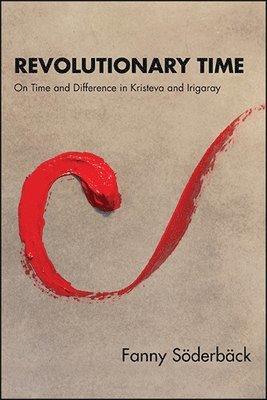
Examines the relationship between time and sexual difference in the work of French feminists Julia Kristeva and Luce Irigaray.This book is the first to examine the relationship between time and sexual difference in the work of Julia Kristeva and Luce Irigaray. Because of their association with reproduction, embodiment, and the survival of the species, women have been confined to the cyclical time of nature-a temporal model that is said to merely repeat itself. Men, on the other hand, have been seen as bearers of linear time and as capable of change and progress. Fanny Söderbäck argues that both these temporal models make change impossible because they either repeat or repress the past. The model of time developed here-revolutionary time-aims at returning to and revitalizing the past so as to make possible a dynamic-embodied present and a future pregnant with change. Söderbäck stages an unprecedented conversation between Kristeva and Irigaray on issues of both time and difference, and engages thinkers such as Simone de Beauvoir, Jacques Derrida, Sigmund Freud, Judith Butler, Hannah Arendt, and Plato along the way.
480 kr
Skickas inom 5-8 vardagar
Examines the relationship between time and sexual difference in the work of French feminists Julia Kristeva and Luce Irigaray.This book is the first to examine the relationship between time and sexual difference in the work of Julia Kristeva and Luce Irigaray. Because of their association with reproduction, embodiment, and the survival of the species, women have been confined to the cyclical time of nature-a temporal model that is said to merely repeat itself. Men, on the other hand, have been seen as bearers of linear time and as capable of change and progress. Fanny Söderbäck argues that both these temporal models make change impossible because they either repeat or repress the past. The model of time developed here-revolutionary time-aims at returning to and revitalizing the past so as to make possible a dynamic-embodied present and a future pregnant with change. Söderbäck stages an unprecedented conversation between Kristeva and Irigaray on issues of both time and difference, and engages thinkers such as Simone de Beauvoir, Jacques Derrida, Sigmund Freud, Judith Butler, Hannah Arendt, and Plato along the way.