Farley Grubb – författare
Visar alla böcker från författaren Farley Grubb. Handla med fri frakt och snabb leverans.
5 produkter
5 produkter
542 kr
Skickas inom 5-8 vardagar
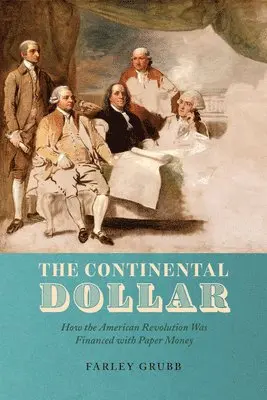
An illuminating history of America’s original credit market. The Continental Dollar is a revelatory history of how the fledgling United States paid for its first war. Farley Grubb upends the common telling of this story, in which the United States printed cross-colony money, called Continentals, to serve as an early fiat currency—a currency that is not tied to a commodity like gold, but rather to a legal authority. As Grubb details, the Continental was not a fiat currency, but a “zero-coupon bond”—a wholly different species of money. As bond payoffs were pushed into the future, the money’s value declined, killing the Continentals’ viability years before the Revolutionary War would officially end. Drawing on decades of exhaustive mining of eighteenth-century records, The Continental Dollar is an essential origin story of the early American monetary system, promising to serve as the benchmark for critical work for decades to come.
586 kr
Skickas inom 5-8 vardagar
In 1773, John Frederick Whitehead and Johann Carl Büttner, two adolescent Germans, were placed on board the same ship headed to colonial America. With few options in Germany, each had been recruited by the labor contractors known popularly as soulsellers—men who traded in human cargo. On arrival in America they were sold to different masters, and, years later, each wrote a memoir of his experiences. These two autobiographies are valuable historical records of immigrant attitudes, perceptions, and goals. Despite their shared voyage to America and similar condition as servants, their backgrounds and personalities differed. Their divergent interpretations of their experiences provide rich firsthand insights into the transatlantic migration process, work and opportunity in colonial America, and the fates of former bound servants.Souls for Sale presents these parallel accounts—Whitehead's published for the first time—to illustrate the condition of German redemptioners and to examine the religious, economic, familial, and literary contexts that shaped their memoirs. The editors provide helpful introductions to the works as well as notes to guide the reader.
2 673 kr
Skickas inom 10-15 vardagar
This book provides the most comprehensive history of German migration to North America for the period 1709 to 1920 than has been done before. Employing state-of-the-art methodological and statistical techniques, the book has two objectives. First he explores how the recruitment and shipping markets for immigrants were set up, determining what the voyage was like in terms of the health outcomes for the passengers, and identifying the characteristics of the immigrants in terms of family, age, and occupational compositions and educational attainments. Secondly he details how immigrant servitude worked, by identifying how important it was to passenger financing, how shippers profited from carrying immigrant servants, how the labor auction treated immigrant servants, and when and why this method of financing passage to America came to an end.
German Immigrant Servant Contracts. Registered at the Port of Philadelphia, 1817-1831
Häftad, Engelska, 2013
249 kr
Skickas inom 5-8 vardagar
933 kr
Skickas inom 10-15 vardagar
This book provides the most comprehensive history of German migration to North America for the period 1709 to 1920 than has been done before. Employing state-of-the-art methodological and statistical techniques, the book has two objectives. First he explores how the recruitment and shipping markets for immigrants were set up, determining what the voyage was like in terms of the health outcomes for the passengers, and identifying the characteristics of the immigrants in terms of family, age, and occupational compositions and educational attainments. Secondly he details how immigrant servitude worked, by identifying how important it was to passenger financing, how shippers profited from carrying immigrant servants, how the labor auction treated immigrant servants, and when and why this method of financing passage to America came to an end.