Farshid Guilak - Böcker
Visar alla böcker från författaren Farshid Guilak. Handla med fri frakt och snabb leverans.
5 produkter
5 produkter
1 624 kr
Skickas inom 10-15 vardagar
Tissue engineering is an exciting new field at the interface of engineering and - ology that uses implanted cells, scaffolds, DNA, proteins, protein fragments, and inductive molecules to repair or replace injured or diseased tissues and organs. Tremendous progress in biological and biomaterial aspects of this field have been accomplished to date, and several engineered tissues are now being used clinically. However, tissue engineers face major challenges in repairing or repl- ing tissues that serve a predominantly biomechanical function. To meet this challenge, the United States National Committee on Biomech- ics in 1998 adopted a new paradigm termed functional tissue engineering (FTE) to emphasize the importance of biomechanical considerations in the design and - velopment of cell and matrix-based implants for soft and hard tissue repair. Functional tissue engineering represents a relevant and exciting new discipline in the field of tissue engineering. Since many tissues, such as those of the muscu- skeletal, cardiovascular, and dental systems, are accustomed to being mecha- cally challenged, tissue-engineered constructs used to replace these tissues after injury or disease must certainly do the same. Of course, tissue engineers must also attempt to return normal biological activity in order for the construct to truly - tegrate with the surrounding tissues. Thus, the term functional can have many meanings, such as restoration of metabolic function. The primary focus of this text is on the role of biomechanical function in tissue engineering.
1 624 kr
Skickas inom 10-15 vardagar
Tissue engineering is an exciting new field at the interface of engineering and - ology that uses implanted cells, scaffolds, DNA, proteins, protein fragments, and inductive molecules to repair or replace injured or diseased tissues and organs. Tremendous progress in biological and biomaterial aspects of this field have been accomplished to date, and several engineered tissues are now being used clinically. However, tissue engineers face major challenges in repairing or repl- ing tissues that serve a predominantly biomechanical function. To meet this challenge, the United States National Committee on Biomech- ics in 1998 adopted a new paradigm termed functional tissue engineering (FTE) to emphasize the importance of biomechanical considerations in the design and - velopment of cell and matrix-based implants for soft and hard tissue repair. Functional tissue engineering represents a relevant and exciting new discipline in the field of tissue engineering. Since many tissues, such as those of the muscu- skeletal, cardiovascular, and dental systems, are accustomed to being mecha- cally challenged, tissue-engineered constructs used to replace these tissues after injury or disease must certainly do the same. Of course, tissue engineers must also attempt to return normal biological activity in order for the construct to truly - tegrate with the surrounding tissues. Thus, the term functional can have many meanings, such as restoration of metabolic function. The primary focus of this text is on the role of biomechanical function in tissue engineering.
1 472 kr
Skickas inom 10-15 vardagar
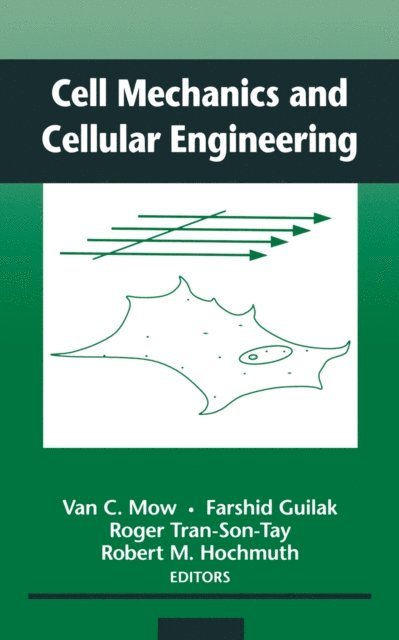
Cell mechanics and cellular engineering may be defined as the application of principles and methods of engineering and life sciences toward fundamental understanding of structure-function relationships in normal and pathological cells and the development of biological substitutes to restore cellular functions. This definition is derived from one developed for tissue engineering at a 1988 NSF workshop. The reader of this volume will see the definition being applied and stretched to study cell and tissue structure-function relationships. The best way to define a field is really to let the investigators describe their areas of study. Perhaps cell mechanics could be compartmentalized by remembering how some of the earliest thinkers wrote about the effects of mechanics on growth. As early as 1638, Galileo hypothesized that gravity and of living mechanical forces place limits on the growth and architecture organisms. It seems only fitting that Robert Hooke, who gave us Hooke's law of elasticity, also gave us the word "cell" in his 1665 text, Micrographid, to designate these elementary entities of life. Julius Wolffs 1899 treatise on the function and form of the trabecular architecture provided an incisive example of the relationship between the structure of the body and the mechanical load it bears. In 1917, D' Arcy Thompson's On Growth and Form revolutionized the analysis of biological processes by introducing cogent physical explanations of the relationships between the structure and function of cells and organisms.
1 624 kr
Skickas inom 10-15 vardagar
Availability of advanced computational technology has fundamentally altered the investigative paradigm in the field of biomechanics. Armed with sophisticated computational tools, researchers are seeking answers to fundamental questions by exploring complex biomechanical phenomena at the molecular, cellular, tissue and organ levels. The computational armamentarium includes such diverse tools as the ab initio quantum mechanical and molecular dynamics methods at the atomistic scales and the finite element, boundary element, meshfree as well as immersed boundary and lattice-Boltzmann methods at the continuum scales. Multiscale methods that link various scales are also being developed. While most applications require forward analysis, e.g., finding deformations and stresses as a result of loading, others involve determination of constitutive parameters based on tissue imaging and inverse analysis. This book provides a glimpse of the diverse and important roles that modern computational technology is playing in various areas of biomechanics including biofluids and mass transfer, cardiovascular mechanics, musculoskeletal mechanics, soft tissue mechanics, and biomolecular mechanics.
1 624 kr
Skickas inom 10-15 vardagar
Availability of advanced computational technology has fundamentally altered the investigative paradigm in the field of biomechanics. Armed with sophisticated computational tools, researchers are seeking answers to fundamental questions by exploring complex biomechanical phenomena at the molecular, cellular, tissue and organ levels. The computational armamentarium includes such diverse tools as the ab initio quantum mechanical and molecular dynamics methods at the atomistic scales and the finite element, boundary element, meshfree as well as immersed boundary and lattice-Boltzmann methods at the continuum scales. Multiscale methods that link various scales are also being developed. While most applications require forward analysis, e.g., finding deformations and stresses as a result of loading, others involve determination of constitutive parameters based on tissue imaging and inverse analysis. This book provides a glimpse of the diverse and important roles that modern computational technology is playing in various areas of biomechanics including biofluids and mass transfer, cardiovascular mechanics, musculoskeletal mechanics, soft tissue mechanics, and biomolecular mechanics.