Fausto O. Sarmiento – författare
Visar alla böcker från författaren Fausto O. Sarmiento. Handla med fri frakt och snabb leverans.
5 produkter
5 produkter
3 641 kr
Skickas inom 7-10 vardagar
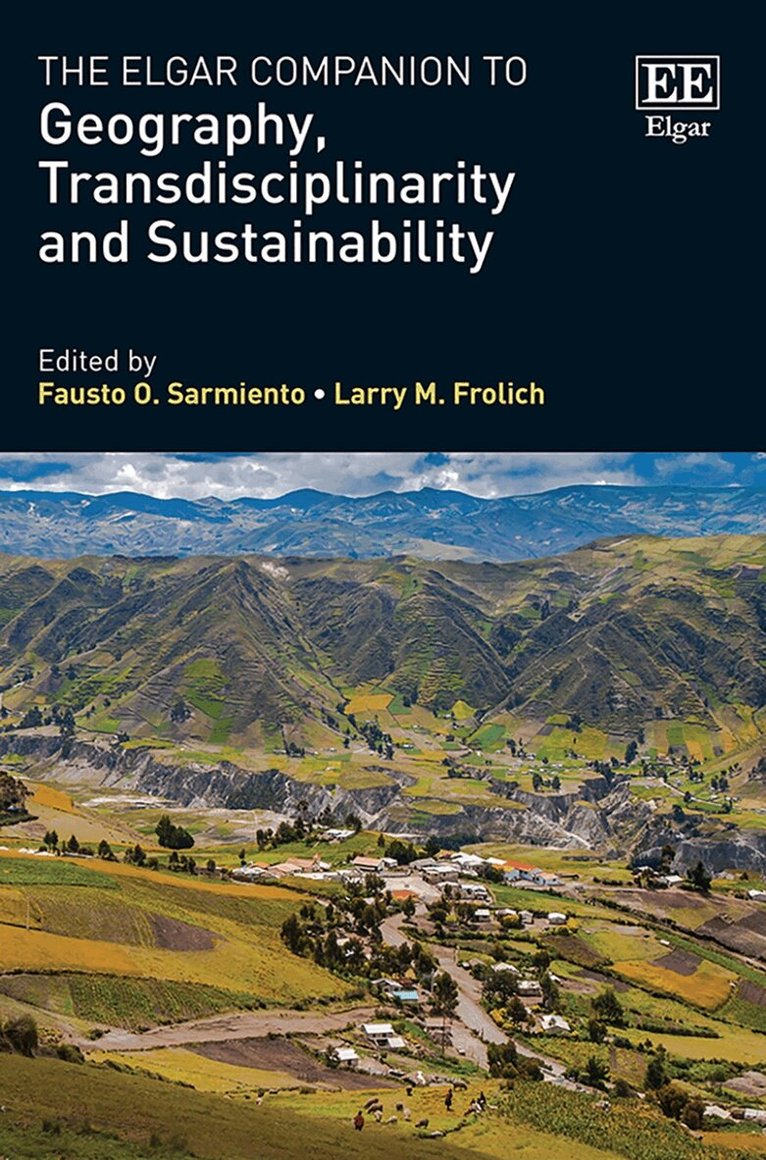
Offering a cutting-edge, transdisciplinary approach to bio-physical and bio-cultural scales of sustainability, this Companion explores diverse understandings of the what, how, why and where questions of sustainability. It examines the key notion of how to optimize human quality of life whilst minimizing environmental suffering.Integrating a range of disciplines through the social sciences, natural sciences and arts and humanities, this Companion focuses on the human component of sustainability, using a place-based and life-scape approach to environmental questions. Chapters analyze critical topics including: urbanization and city life, environmental conservation and rural landscapes, long-term interactions with natural life, climate change and the importance of mountain regions. Looking beyond an economic analysis of sustainability and well-being, this Companion incorporates cross-cutting social, cultural, judicial and spiritual dimensions of sustainability and regenerative development.With a combination of international case studies and an interdisciplinary framework for understanding the topic, this will be an interesting read for those studying sustainability from a range of disciplinary bases including ecological economists, human ecologists and geographers. It will also be beneficial to urban planners and ecologists interested in how the profoundly impactful evolutionary trend towards the urban environment is impacting human geographies around the world. Contributors include: B. Antaki, J. Balsiger, A. Barreau, S. Boillat, B. Boley, A. Borsdorf, F. Boyer, M. Bush, J.B. Campbell, M. Carré, R. Cheddadi, T.J. Christoffel, B. Debarbieux , M.E. Donoso-Correa, N. Dudley, W. Dunbar, F. Ficetola, L. François, L.M. Frolich, E. Guevara, J.A. González, A. Haller, C.P. Harden, D. Harmon, A.-J. Henrot, S.L. Hitchner, G.A. Holdridge, K. Huang, J.T. Ibarra, K. Ichikawa, E.A. Macdonald, C. Mena, C. Merchant, A. Michaels, C. Monterrubio-Solís, E. Müller, M. Navarro, H. Norberg-Hodge, M. Oliva, S. Padgett-Vasquez, S.E. Pilaar Birch, D. Quiroga, J.K. Reap, L.M. Resler, A. Rhoujjati, R. Rozzi, F.O. Sarmiento, J.W. Schelhas, Y. Shao, C. Stadel, P. Taberlet, K. Taylor, S.J. Walsh, K.R. Young, Z. Zheng, F.M. Zimmermann, S. Zimmermann-Janschitz
2 117 kr
Skickas inom 10-15 vardagar
This book introduces an innovative approach to sustainable and regenerative mountain development. Transdisciplinary to biophysical and biocultural scales, it provides answers to the "what, when, how, why, and where" that researchers question on mountains, including the most challenging: So What! Forwarding thinking in its treatment of core subjects, this decolonial, non-hegemonic volume inaugurates the Series with contributions of seasoned montologists, and invites the reader to an engaging excursion to ascend the rugged topography of paradigms, with the scaffolding hike of ambitious curiosity typical of mountain explorers.Chapter 8 is available open access under a Creative Commons Attribution 4.0 International License via link.springer.com.
2 117 kr
Skickas inom 10-15 vardagar
This book introduces an innovative approach to sustainable and regenerative mountain development. Transdisciplinary to biophysical and biocultural scales, it provides answers to the "what, when, how, why, and where" that researchers question on mountains, including the most challenging: So What! Forwarding thinking in its treatment of core subjects, this decolonial, non-hegemonic volume inaugurates the Series with contributions of seasoned montologists, and invites the reader to an engaging excursion to ascend the rugged topography of paradigms, with the scaffolding hike of ambitious curiosity typical of mountain explorers.Chapter 8 is available open access under a Creative Commons Attribution 4.0 International License via link.springer.com.
2 117 kr
Skickas inom 10-15 vardagar
This book is the second volume in a series on montology dedicated to the transdisciplinary reflection of mountain research, considering the diversity of views on mountains and their problemata in the context of rapid technological development and unprecedented accumulation and dissemination of information around the world.
2 117 kr
Skickas inom 10-15 vardagar
This book is the second volume in a series on montology dedicated to the transdisciplinary reflection of mountain research, considering the diversity of views on mountains and their problemata in the context of rapid technological development and unprecedented accumulation and dissemination of information around the world. The necessity for a new orderly and structured lexicon arose from the need to critically reassess the colonial past in the development of mountain territories, the development of a new and alternative understanding of mountain topics in the light of decolonized epistemology. The creation of coordinated and ordered terms for the main parts of mountain research creates the basis for an unorthodox understanding of the ontology of mountains and helps to better understand the complex cultural and natural essence of mountain socio-ecological systems. At the same time, a local episteme of mountains, considering local values, small scales, and vernacular visions are of particular importance, which must be taken into account in the current terminology.The purpose of the book is to provide methodological support for montology as a convergent and transdisciplinary science of mountains, based on the harmonization of its terminological base. The book pays special attention to onomastics, toponymy, standardization and other nuances of terms used in mountain research. According to this goal, three dozen articles in a relatively small format (about 3 pages) vividly, attractively and innovatively reflect the modern view of one or more related terms. Articles include definition(s) of the term, description of etymology, onomastics or toponymy used, examples of local characteristics compared to traditional sources, possible vernacular terms. Articles are grouped into four main areas: 1) Basic glossary of montology terminology, 2) Towards mountain socio-ecological systems, 3) Innovative disciplinary systemic realm, 4) Mountain classifications, onomastics, critical toponomy and rediscovery of meaning.The authors of the articles are leading experts in the field of mountain research from around the world. The book is intended for scientists, experts and teachers. It is provided with an annotated list of the most important montology terms.