Federico D'Onofrio - Böcker
Visar alla böcker från författaren Federico D'Onofrio. Handla med fri frakt och snabb leverans.
3 produkter
3 produkter
Observing Agriculture in Early Twentieth-Century Italy
Agricultural economists and statistics
Häftad, Engelska, 2022
648 kr
Skickas inom 10-15 vardagar
Agricultural Economists in Early Twentieth-Century Italy describes how Italian agricultural economists collected information about the economy of Italy, between the Giolittian and the Fascist era. The book carefully describes three main forms of economic observation: enquiries, statistics, and farm surveys. For each of these forms of observation, the main participants to the investigation are discussed with their respective agendas, alongside the purposes of the investigation, and its practical constraints. This work introduces the concept of "stakeholder statistics", and stresses the two-way relation between the observer and the observed in the co-production of observational knowledge. Practices of observation developed together with agricultural economics as a discipline and a profession. The study of forms of investigation therefore shed light on the constitution of a coherent and self-conscious group of agricultural economists in Italy, and the scientific and methodological alliances they forged with agricultural economists elsewhere in Europe. Thanks to ambitious research projects, Ghino Valenti in the Giolittian period, and Arrigo Serpieri, after the First World War, led the transformation of Italian agricultural economists from agents of estate owners, to social and economic experts in the service of the Italian state. The group of agricultural economists who gathered around Serpieri played an important role in supplying the ideology of the agricultural elites with economic content, especially after the First World War, along lines that resemble the development of agrarian ideologies in other countries of Central Europe. This work discusses how observation entered the political debate on agricultural policies of the Fascist regime, namely the so-called Ruralismo.
Observing Agriculture in Early Twentieth-Century Italy
Agricultural economists and statistics
Inbunden, Engelska, 2016
2 307 kr
Skickas inom 10-15 vardagar
Agricultural Economists in Early Twentieth-Century Italy describes how Italian agricultural economists collected information about the economy of Italy, between the Giolittian and the Fascist era. The book carefully describes three main forms of economic observation: enquiries, statistics, and farm surveys. For each of these forms of observation, the main participants to the investigation are discussed with their respective agendas, alongside the purposes of the investigation, and its practical constraints. This work introduces the concept of "stakeholder statistics", and stresses the two-way relation between the observer and the observed in the co-production of observational knowledge. Practices of observation developed together with agricultural economics as a discipline and a profession. The study of forms of investigation therefore shed light on the constitution of a coherent and self-conscious group of agricultural economists in Italy, and the scientific and methodological alliances they forged with agricultural economists elsewhere in Europe. Thanks to ambitious research projects, Ghino Valenti in the Giolittian period, and Arrigo Serpieri, after the First World War, led the transformation of Italian agricultural economists from agents of estate owners, to social and economic experts in the service of the Italian state. The group of agricultural economists who gathered around Serpieri played an important role in supplying the ideology of the agricultural elites with economic content, especially after the First World War, along lines that resemble the development of agrarian ideologies in other countries of Central Europe. This work discusses how observation entered the political debate on agricultural policies of the Fascist regime, namely the so-called Ruralismo.
Del 7 - Boydell Studies in Rural History
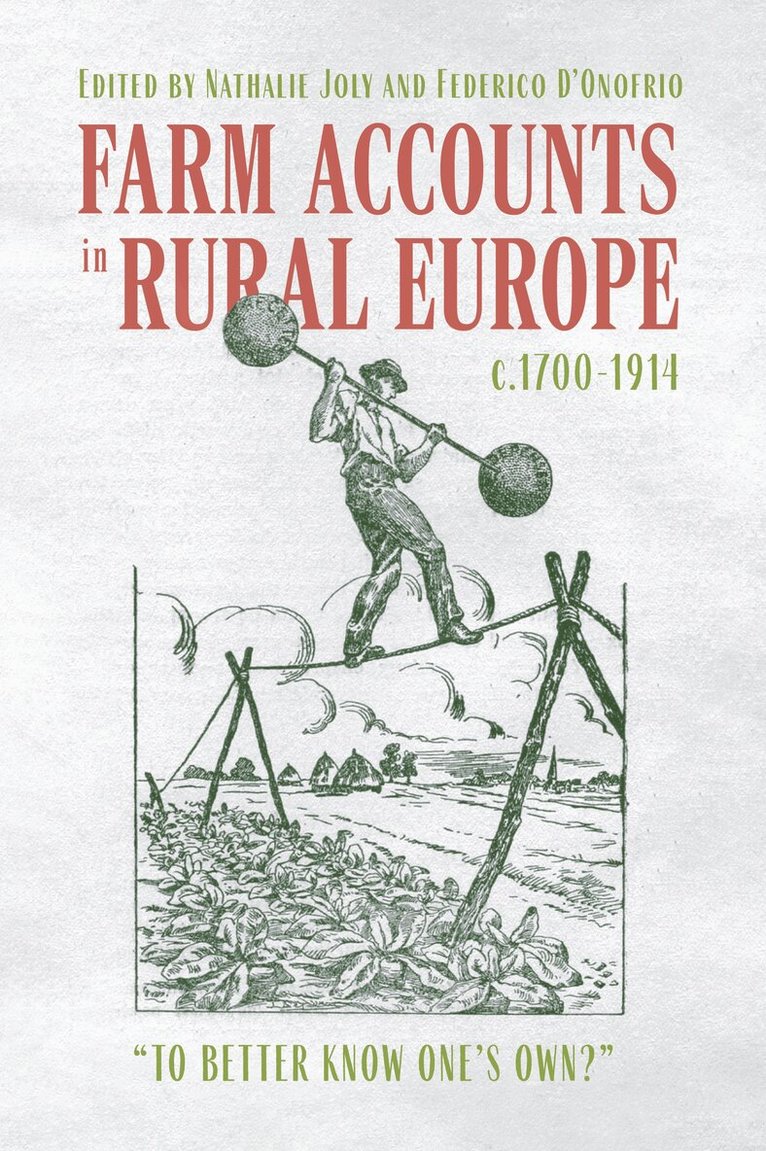
Farm Accounts in Rural Europe, c.1700-1914
"To Better Know One's Own?"
Inbunden, Engelska, 2025
1 068 kr
Skickas inom 7-10 vardagar
Analyses how book-keeping and estate accounting transformed attitudes and practices in farm management over three centuries of European history.From the eighteenth until well into the twentieth century, an ideal model developed of a farmer as accountant, who would record economic transactions meticulously; tidy book-keeping was regarded as the basis of sound management, and only those who accurately dealt with finances would survive and thrive. It is clear that this happened in both theory and practice, with growing numbers of farmers (men and women) keeping increasingly formalized records of their businesses during this period; a wide range of valuable documentation, originating from large estates, small sharecroppers, tenant and owner-farmers alike, has survived. Drawing on that rich body of sources, this book examines book-keeping and account practices in farm management across Europe, with case studies ranging from Westphalia and the Rhineland to France and Switzerland, over three centuries. It considers who kept these records and their motivations, how practices changed and developed across the period, and in what ways and to what extent accounts and accounting influenced the development of agriculture. It also examines the role of farmers' own organisations and government in encouraging higher standards of accounting.The Introduction and chapters 7 and 9 are available as Open Access under the Creative Commons licence CC BY-NC-ND.