Fernando Casal BA(c)rtoa – författare
1 136 kr
Läs direkt efter köp
1 136 kr
Läs direkt efter köp
2 367 kr
Läs direkt efter köp
2 031 kr
Läs direkt efter köp
1 457 kr
Skickas inom 5-8 vardagar
723 kr
Läs direkt efter köp
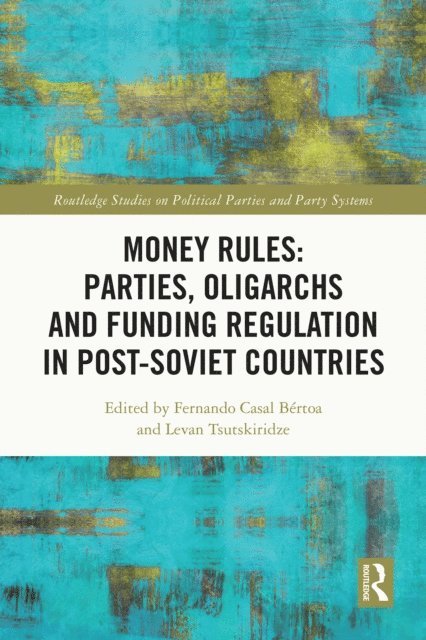
This book provides a comprehensive overview of the regulation of party finance in post-Soviet countries by leading academics and practitioners in the field.
Through a series of cutting-edge chapters, using both original quantitative and qualitative data, it systematically sheds theoretical and empirical light on the way party funding regulation has evolved since the fall of the Soviet Union in 1991, as well as on the manner in which the legal regulation of party finances has had an impact (or not) on the evolution of party politics and democratic consolidation in the region. The book examines regulation in post-Soviet countries like Armenia, Georgia, Kazakhstan, Kyrgyzstan, Moldova, Mongolia, Russia and Ukraine. In analysing the various dimensions of party funding regulation and their impact on political parties, party systems and democracy, it looks at the past and future, and makes recommendations on how legislation could be improved in order to further party development, party system stabilisation and democratic consolidation for all the countries in the region.
This book will be of key interest to scholars, students, practitioners and journalists interested in political party finance and anti-corruption, and more broadly to political parties, democracy and democratic governance, and post-Soviet/Russian and East European politics.
Chapter 1 of this book is freely available as a downloadable Open Access PDF at http://www.taylorfrancis.com under a Creative Commons Attribution (CC-BY) 4.0 license.
723 kr
Läs direkt efter köp
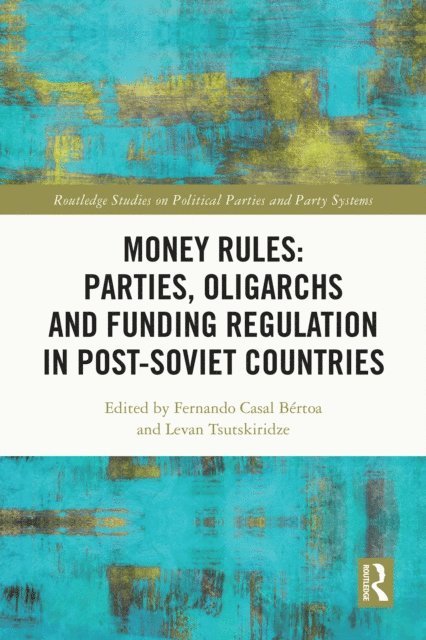
This book provides a comprehensive overview of the regulation of party finance in post-Soviet countries by leading academics and practitioners in the field.
Through a series of cutting-edge chapters, using both original quantitative and qualitative data, it systematically sheds theoretical and empirical light on the way party funding regulation has evolved since the fall of the Soviet Union in 1991, as well as on the manner in which the legal regulation of party finances has had an impact (or not) on the evolution of party politics and democratic consolidation in the region. The book examines regulation in post-Soviet countries like Armenia, Georgia, Kazakhstan, Kyrgyzstan, Moldova, Mongolia, Russia and Ukraine. In analysing the various dimensions of party funding regulation and their impact on political parties, party systems and democracy, it looks at the past and future, and makes recommendations on how legislation could be improved in order to further party development, party system stabilisation and democratic consolidation for all the countries in the region.
This book will be of key interest to scholars, students, practitioners and journalists interested in political party finance and anti-corruption, and more broadly to political parties, democracy and democratic governance, and post-Soviet/Russian and East European politics.
Chapter 1 of this book is freely available as a downloadable Open Access PDF at http://www.taylorfrancis.com under a Creative Commons Attribution (CC-BY) 4.0 license.
858 kr
Läs direkt efter köp
The question of how political parties are, and ought to be, regulated has assumed an increased importance in recent years, both within the scholarly community and among policy-makers and politicians as the state assumes an increasingly active role in the management of, and control over, their behaviour and organisation
This book concentrates on the regulation of political parties in the EU post-communist democracies, and on Bulgaria, Croatia, the Czech Republic, Estonia, Hungary, Latvia, Lithuania, Poland, Slovakia, Slovenia and Romania, in particular. In analysing the various dimensions of party regulation, it builds on the main premises derived from the neo-institutionalist literature in political science, concerning the ways in which the (formal and informal) rules and procedures may influence, constrain or determine the behaviour of political actors. In doing so, it provides a comprehensive overview of the regulation of Eastern European political parties provided by leading experts in the field and casts theoretical and empirical light on the manner in which the constitutional and legal regulation of party organizations and finances have had an impact (or not) on the consolidation of party politics in post-communist Europe since 1989.
This text will be of key interest to scholars and students of Political Parties and Behaviour, East European and Post-Communist Politics and Comparative Politics.
860 kr
Läs direkt efter köp
This edited collection, in honour of the late political scientist Peter Mair, contains original chapters that are directly linked to his theoretical and/or methodological ideas and approaches.
Peter Mair demonstrated that political parties have traditionally been central actors in European politics and an essential focus of comparative European political science. Though the nature of political parties and the manner in which they operate has been subject to significant change in recent decades, parties remain a crucial factor in the working of European liberal democracies. This volume analyses recent developments and current challenges that European parties, party systems and democracy face.
The volume will be of key interest to students and scholars of comparative politics, democracy studies, political parties, and European politics and European Union studies.
860 kr
Läs direkt efter köp
This edited collection, in honour of the late political scientist Peter Mair, contains original chapters that are directly linked to his theoretical and/or methodological ideas and approaches.
Peter Mair demonstrated that political parties have traditionally been central actors in European politics and an essential focus of comparative European political science. Though the nature of political parties and the manner in which they operate has been subject to significant change in recent decades, parties remain a crucial factor in the working of European liberal democracies. This volume analyses recent developments and current challenges that European parties, party systems and democracy face.
The volume will be of key interest to students and scholars of comparative politics, democracy studies, political parties, and European politics and European Union studies.
682 kr
Läs direkt efter köp
This book represents the first comprehensive study of the evolution of parties and party systems in all nine democratic European states with less than one million inhabitants.
As small political units have for long been considered to be most conducive to stable democracy, this volume analyses the actual role of political parties and partisan competition in the operation of modern democracy in those European microstates. Drawing on the crucial contribution of leading country experts in the field, it provides rich, systematic contextualized knowledge on these lesser-known cases. It further contributes to the mainstreaming of small state research in social science studies by comparing the experience of party politics in European microstates with that of larger countries in the same region of the world.
This volume will be of key interest to scholars and students of party systems and political parties, elections and democracy, small states, European politics and more broadly of comparative politics.
706 kr
Läs direkt efter köp
This book represents the first comprehensive study of the evolution of parties and party systems in all nine democratic European states with less than one million inhabitants.
As small political units have for long been considered to be most conducive to stable democracy, this volume analyses the actual role of political parties and partisan competition in the operation of modern democracy in those European microstates. Drawing on the crucial contribution of leading country experts in the field, it provides rich, systematic contextualized knowledge on these lesser-known cases. It further contributes to the mainstreaming of small state research in social science studies by comparing the experience of party politics in European microstates with that of larger countries in the same region of the world.
This volume will be of key interest to scholars and students of party systems and political parties, elections and democracy, small states, European politics and more broadly of comparative politics.