Feslin Anish Mon – författare
Visar alla böcker från författaren Feslin Anish Mon. Handla med fri frakt och snabb leverans.
3 produkter
3 produkter
Inbunden, Engelska, 2027
1 583 kr
Kommande
A contemporary discussion of real-world TinyML development In TinyML: Revolutionizing Embedded AI for Intelligent Devices, a team of distinguished researchers delivers an expert, up-to-date discussion of the practical applications of TinyML. The authors explain how to develop smart systems that learn and make decisions at the place of action on tiny, low-power devices. Readers will learn how to create systems that act without access to high-speed internet connectivity. Beginning with explanations of the fundamentals of TinyML, the hardware it runs on, and how to collect and prepare the data required to run applications, the book goes on to discuss neural networks, model training, and the wide array of real-world applications and examples of the technologies. Readers will also discover: A thorough introduction to the data privacy and security problems inherent in TinyML developmentComprehensive explorations of the hands-on techniques required to develop TinyML applicationsPractical discussions of the hardware and software ecosystems in which TinyML development occursComplete treatments of clustering, neural network architectures, and likely future developments in those areasPerfect for data scientists and machine learning engineers, TinyML will also benefit embedded systems engineers, IoT developers, and students of computer science, electrical engineering, and robotics.
Inbunden, Engelska, 2026
2 146 kr
Skickas inom 5-8 vardagar
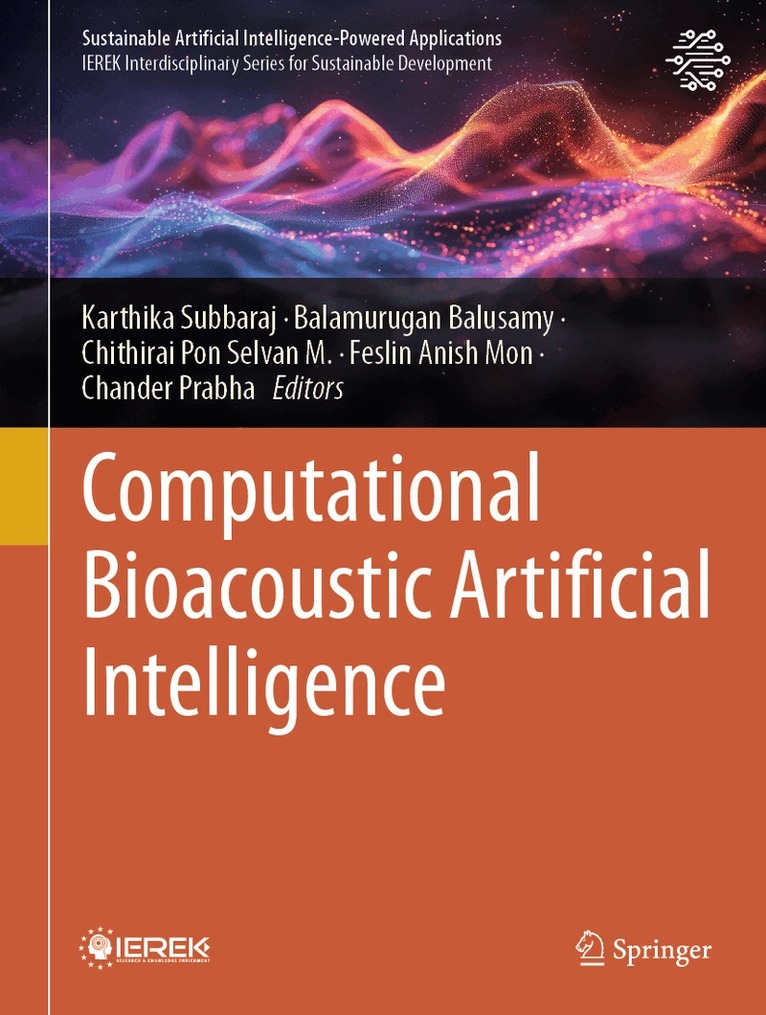
This book deep dives into the theoretical background of bioacoustics, signal processing techniques, feature extraction and pattern recognition algorithms, and technically advanced case studies in bioacoustics AI. By exploring the intricate characteristics of bioacoustic signals, this book offers a comprehensive understanding of the underlying principles and practical implementations. The fundamental chapters provide readers the basics by discussing the statistical and deterministic models of bioacoustic signals, including parametric and non-parametric approaches, time-frequency representations, and stochastic processes. Furthermore, this book delves into the complexities of bioacoustic signal generation and propagation, considering physiological factors, acoustic media, and signal degradation. The feature engineering methodology upon the complex and noisy sound data is understood and explored using advanced signal processing techniques, such as wavelet transforms, matching pursuit, higher-order statistics, and fractal analysis. The subsequent chapters focus on feature engineering and pattern recognition. The feature extraction methods under subject of discussion include time-domain, frequency-domain, and time-frequency features, as well as statistical and structural features. The advanced techniques related to deep learning such as convolutional neural networks and recurrent neural networks are also explored. Traditional classification techniques, including statistical pattern recognition and syntactic pattern recognition, are covered, followed by a deep dive into the application of deep learning for bioacoustic classification. The later chapters detail on the futuristic topics such as bioacoustic localization, source separation, change detection, and monitoring. The bioacoustic data collected with other sensor modalities are significant in the development of bioacoustic indices. This book leads the assessment techniques to determine the quality of ecosystem and its performance. Furthermore, the application of bioacoustic AI in man-machine interaction is examined.
E-bok
Engelska, 20262 741 kr
Läs direkt efter köp
This book deep dives into the theoretical background of bioacoustics, signal processing techniques, feature extraction and pattern recognition algorithms, and technically advanced case studies in bioacoustics AI. By exploring the intricate characteristics of bioacoustic signals, this book offers a comprehensive understanding of the underlying principles and practical implementations. The fundamental chapters provide readers the basics by discussing the statistical and deterministic models of bioacoustic signals, including parametric and non-parametric approaches, time-frequency representations, and stochastic processes. Furthermore, this book delves into the complexities of bioacoustic signal generation and propagation, considering physiological factors, acoustic media, and signal degradation. The feature engineering methodology upon the complex and noisy sound data is understood and explored using advanced signal processing techniques, such as wavelet transforms, matching pursuit, higher-order statistics, and fractal analysis. The subsequent chapters focus on feature engineering and pattern recognition. The feature extraction methods under subject of discussion include time-domain, frequency-domain, and time-frequency features, as well as statistical and structural features. The advanced techniques related to deep learning such as convolutional neural networks and recurrent neural networks are also explored. Traditional classification techniques, including statistical pattern recognition and syntactic pattern recognition, are covered, followed by a deep dive into the application of deep learning for bioacoustic classification. The later chapters detail on the futuristic topics such as bioacoustic localization, source separation, change detection, and monitoring. The bioacoustic data collected with other sensor modalities are significant in the development of bioacoustic indices. This book leads the assessment techniques to determine the quality of ecosystem and its performance. Furthermore, the application of bioacoustic AI in man-machine interaction is examined.