Feza Gunergun – författare
Visar alla böcker från författaren Feza Gunergun. Handla med fri frakt och snabb leverans.
5 produkter
5 produkter
Inbunden, Engelska, 2006
974 kr
Skickas inom 10-15 vardagar
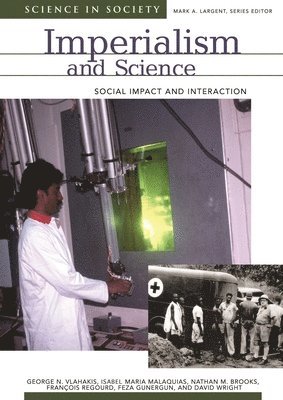
A unique resource that synthesizes existing primary and secondary sources to provide a fascinating introduction to the development and dissemination of science within history's great empires, as well as the complex interaction between imperialism and scientific progress over two centuries.Imperialism and Science is a scholarly yet accessible chronicle of the impact of imperialism on science over the past 200 years, from the effect of Catholicism on scientific progress in Latin America to the importance of U.S. government funding of scientific research to America's preeminent place in the world.Spanning two centuries of scientific advance throughout the age of empire, Imperialism and Science sheds new light on the spread of scientific thought throughout the former colonial world. Science made enormous advances during this period, often being associated with anti-Imperialist struggle or, as in the case of the science brought to 19th-century China and India by the British, with Western cultural hegemony.Packed with portraits of key scientists, their discoveries, and their achievements, bringing to life the contribution of scientists from even the most far-flung corners of empireIncludes a detailed chronology, bibliography, and a glossary of key scientific terms of the era, helping to make the history of science accessible to the general reader
E-bok
PDF, Engelska, 20061 022 kr
Läs direkt efter köp
A unique resource that synthesizes existing primary and secondary sources to provide a fascinating introduction to the development and dissemination of science within history's great empires, as well as the complex interaction between imperialism and scientific progress over two centuries.Imperialism and Science is a scholarly yet accessible chronicle of the impact of imperialism on science over the past 200 years, from the effect of Catholicism on scientific progress in Latin America to the importance of U.S. government funding of scientific research to America's preeminent place in the world.Spanning two centuries of scientific advance throughout the age of empire, Imperialism and Science sheds new light on the spread of scientific thought throughout the former colonial world. Science made enormous advances during this period, often being associated with anti-Imperialist struggle or, as in the case of the science brought to 19th-century China and India by the British, with Western cultural hegemony.
Inbunden, Engelska, 2010
1 682 kr
Skickas inom 10-15 vardagar
This book explores the various historical and cultural aspects of scientific, medical and technical exchanges that occurred between central Europe and Asia. A number of papers investigate the printing, gunpowder, guncasting, shipbuilding, metallurgical and drilling technologies while others deal with mapping techniques, the adoption of written calculation and mechanical clocks as well as the use of medical techniques such as pulse taking and electrotherapy. While human mobility played a significant role in the exchange of knowledge, translating European books into local languages helped the introduction of new knowledge in mathematical, physical and natural sciences from central Europe to its periphery and to the Middle East and Asian cultures. The book argues that the process of transmission of knowledge whether theoretical or practical was not a simple and one-way process from the donor to the receiver as it is often admitted, but a multi-dimensional and complex cultural process of selection and transformation where ancient scientific and local traditions and elements. The book explores the issue from a different geopolitical perspective, namely not focusing on a singular recipient and several points of distribution, namely the metropolitan centres of science, medicine, and technology, but on regions that are both recipients and distributors and provides new perspectives based on newly investigated material for historical studies on the cross scientific exchanges between different parts of the world.
E-bok
PDF, Engelska, 20102 036 kr
Läs direkt efter köp
This book explores the various historical and cultural aspects of scientific, medical and technical exchanges that occurred between central Europe and Asia. A number of papers investigate the printing, gunpowder, guncasting, shipbuilding, metallurgical and drilling technologies while others deal with mapping techniques, the adoption of written calculation and mechanical clocks as well as the use of medical techniques such as pulse taking and electrotherapy. While human mobility played a significant role in the exchange of knowledge, translating European books into local languages helped the introduction of new knowledge in mathematical, physical and natural sciences from central Europe to its periphery and to the Middle East and Asian cultures. The book argues that the process of transmission of knowledge whether theoretical or practical was not a simple and one-way process from the donor to the receiver as it is often admitted, but a multi-dimensional and complex cultural process of selection and transformation where ancient scientific and local traditions and elements. The book explores the issue from a different geopolitical perspective, namely not focusing on a singular recipient and several points of distribution, namely the metropolitan centres of science, medicine, and technology, but on regions that are both recipients and distributors and provides new perspectives based on newly investigated material for historical studies on the cross scientific exchanges between different parts of the world.
Del 275 - Boston Studies in the Philosophy and History of Science
Science between Europe and Asia
Historical Studies on the Transmission, Adoption and Adaptation of Knowledge
Häftad, Engelska, 2013
1 682 kr
Skickas inom 10-15 vardagar
This book explores the various historical and cultural aspects of scientific, medical and technical exchanges that occurred between central Europe and Asia. A number of papers investigate the printing, gunpowder, guncasting, shipbuilding, metallurgical and drilling technologies while others deal with mapping techniques, the adoption of written calculation and mechanical clocks as well as the use of medical techniques such as pulse taking and electrotherapy. While human mobility played a significant role in the exchange of knowledge, translating European books into local languages helped the introduction of new knowledge in mathematical, physical and natural sciences from central Europe to its periphery and to the Middle East and Asian cultures. The book argues that the process of transmission of knowledge whether theoretical or practical was not a simple and one-way process from the donor to the receiver as it is often admitted, but a multi-dimensional and complex cultural process of selection and transformation where ancient scientific and local traditions and elements. The book explores the issue from a different geopolitical perspective, namely not focusing on a singular recipient and several points of distribution, namely the metropolitan centres of science, medicine, and technology, but on regions that are both recipients and distributors and provides new perspectives based on newly investigated material for historical studies on the cross scientific exchanges between different parts of the world.