Fiona McKay - Böcker
Visar alla böcker från författaren Fiona McKay. Handla med fri frakt och snabb leverans.
4 produkter
4 produkter
2 150 kr
Skickas inom 10-15 vardagar
Important links between health and human rights are increasingly recognised, and human rights can be viewed as one of the social determinants of health. A human rights framework provides an excellent foundation for advocacy on health inequalities, a value-based alternative to views of health as a commodity, and an opportunity to move away from public health action being based on charity. This text demystifies systems set up for the protection and promotion of human rights globally, regionally, and nationally. It explores the use and usefulness of rights-based approaches as an important part of the toolbox available to health and welfare professionals and community members working in a variety of settings to improve health and reduce health inequities.Global in its scope, Health Equity, Social Justice, and Human Rights presents examples from all over the world to illustrate the successful use of human rights approaches in fields such as HIV/AIDS, improving access to essential drugs, reproductive health, women’s health, and improving the health of marginalised and disadvantaged groups.Understanding human rights and their interrelationships with health and health equity is essential for public health and health promotion practitioners, as well as being important for a wide range of other health and social welfare professionals. This text is valuable reading for students, practitioners, and researchers concerned with combating health inequalities and promoting social justice.
579 kr
Skickas inom 10-15 vardagar
Important links between health and human rights are increasingly recognised, and human rights can be viewed as one of the social determinants of health. A human rights framework provides an excellent foundation for advocacy on health inequalities, a value-based alternative to views of health as a commodity, and an opportunity to move away from public health action being based on charity. This text demystifies systems set up for the protection and promotion of human rights globally, regionally, and nationally. It explores the use and usefulness of rights-based approaches as an important part of the toolbox available to health and welfare professionals and community members working in a variety of settings to improve health and reduce health inequities.Global in its scope, Health Equity, Social Justice, and Human Rights presents examples from all over the world to illustrate the successful use of human rights approaches in fields such as HIV/AIDS, improving access to essential drugs, reproductive health, women’s health, and improving the health of marginalised and disadvantaged groups.Understanding human rights and their interrelationships with health and health equity is essential for public health and health promotion practitioners, as well as being important for a wide range of other health and social welfare professionals. This text is valuable reading for students, practitioners, and researchers concerned with combating health inequalities and promoting social justice.
431 kr
Skickas inom 3-6 vardagar
449 kr
Skickas inom 10-15 vardagar
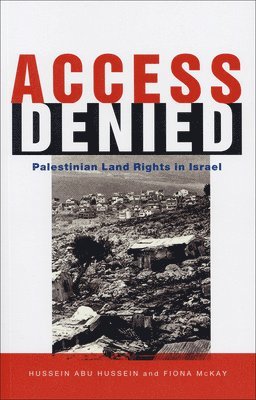
The struggle for land has been a key element of the conflict between Jews and Arabs in Palestine thoughout the past hundred years, and remains intense to this day. While international attention focuses on Israeli settlements that have encroached on to hitherto Arab land in the West Bank and the Gaza Strip, which lie legally outside Israel‘s boundaries, there is another dimension to the land question, as this book makes clear. Nearly one-fifth of Israel‘s population is Palestinian. This book examines the extent and means by which Israeli land policy today restricts access to land for these citizens within the 1948 boundaries of the State of Israel.Its authors - one a Palestinian lawyer and Israeli citizen practising in Israel, the other a British international human rights lawyer who worked in Israel for many years - examine the system of land ownership, the acquisition and administration of public land, and the control of land use through planning and housing regulations. What emerges is the extent to which the law is being used to restrict access to land by Israeli Palestinians and the discrimination that this entails for those citizens who are not of Jewish origin.The book argues that domestic and international law, which should operate to protect Palestinian land rights, have failed to do so, and that Israeli land policies breach international legal standards, including human rights norms.