Flavia Martinelli – författare
2 253 kr
Skickas inom 10-15 vardagar
1 009 kr
Läs direkt efter köp
This book re-evaluates a rich scientific heritage of space- and history-sensitive development theories and produces an integrated methodology for the comparative analysis of urban and regional trajectories within a globalized world. The main argument put forward is that current mainstream analyses of urban and regional development have forgotten this rich heritage and fail to address the connections between different dimensions of development, the role of history and the importance of place and scale relations.
The proposed methodology integrates elements from different theories – radical economic geography, regulation approach, cultural political economy, old and new institutionalism – that all share a strong concern with time and space dynamics. They are recombined into an interdisciplinary (meta)theoretical framework, capable of articulating the overall problem of socio-economic development and providing methodological anchors for comparative case-study analysis, while recognizing context specificities. The analytical methodology focuses on key dynamics and relations, such as strategic agency and collective action, institutions and structures, culture and discourse, as well as the tension between path-dependency and path-shaping.
The methodology is then applied to eight urban and regional cases, mostly from Western Europe, but also from the United States and China. The case studies confirm the relevance of time- and space-sensitive analysis, not only for understanding development trajectories, but also for policy making. They ultimately highlight that, while post-war institutions were able to address systemic contradictions and foster a relatively inclusive development model, the neoliberal turn has led to reductionist policies that not only have resulted in an increase in social and spatial inequalities, but have also undermined growth and democracy.
1 009 kr
Läs direkt efter köp
This book re-evaluates a rich scientific heritage of space- and history-sensitive development theories and produces an integrated methodology for the comparative analysis of urban and regional trajectories within a globalized world. The main argument put forward is that current mainstream analyses of urban and regional development have forgotten this rich heritage and fail to address the connections between different dimensions of development, the role of history and the importance of place and scale relations.
The proposed methodology integrates elements from different theories – radical economic geography, regulation approach, cultural political economy, old and new institutionalism – that all share a strong concern with time and space dynamics. They are recombined into an interdisciplinary (meta)theoretical framework, capable of articulating the overall problem of socio-economic development and providing methodological anchors for comparative case-study analysis, while recognizing context specificities. The analytical methodology focuses on key dynamics and relations, such as strategic agency and collective action, institutions and structures, culture and discourse, as well as the tension between path-dependency and path-shaping.
The methodology is then applied to eight urban and regional cases, mostly from Western Europe, but also from the United States and China. The case studies confirm the relevance of time- and space-sensitive analysis, not only for understanding development trajectories, but also for policy making. They ultimately highlight that, while post-war institutions were able to address systemic contradictions and foster a relatively inclusive development model, the neoliberal turn has led to reductionist policies that not only have resulted in an increase in social and spatial inequalities, but have also undermined growth and democracy.
992 kr
Läs direkt efter köp
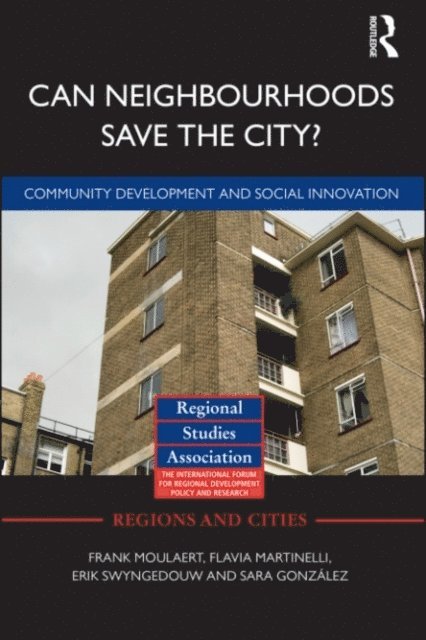
For decades, neighbourhoods been pivotal sites of social, economic and political exclusion processes, and civil society initiatives, attempting bottom-up strategies of re-development and regeneration. In many cases these efforts resulted in the creation of socially innovative organizations, seeking to satisfy the basic human needs of deprived population groups, to increase their political capabilities and to improve social interaction both internally and between the local communities, the wider urban society and political world.
SINGOCOM - Social INnovation GOvernance and COMmunity building – is the acronym of the EU-funded project on which this book is based. Sixteen case studies of socially-innovative initiatives at the neighbourhood level were carried out in nine European cities, of which ten are analysed in depth and presented here. The book compares these efforts and their results, and shows how grass-roots initiatives, alternative local movements and self-organizing urban collectives are reshaping the urban scene in dynamic, creative, innovative and empowering ways. It argues that such grass-roots initiatives are vital for generating a socially cohesive urban condition that exists alongside the official state-organized forms of urban governance.
The book is thus a major contribution to socio-political literature, as it seeks to overcome the duality between community-development studies and strategies, and the solidarity-based making of a diverse society based upon the recognising and maintaining of citizenship rights. It will be of particular interest to both students and researchers in the fields of urban studies, social geography and political science.
992 kr
Läs direkt efter köp
For decades, neighbourhoods been pivotal sites of social, economic and political exclusion processes, and civil society initiatives, attempting bottom-up strategies of re-development and regeneration. In many cases these efforts resulted in the creation of socially innovative organizations, seeking to satisfy the basic human needs of deprived population groups, to increase their political capabilities and to improve social interaction both internally and between the local communities, the wider urban society and political world.
SINGOCOM - Social INnovation GOvernance and COMmunity building – is the acronym of the EU-funded project on which this book is based. Sixteen case studies of socially-innovative initiatives at the neighbourhood level were carried out in nine European cities, of which ten are analysed in depth and presented here. The book compares these efforts and their results, and shows how grass-roots initiatives, alternative local movements and self-organizing urban collectives are reshaping the urban scene in dynamic, creative, innovative and empowering ways. It argues that such grass-roots initiatives are vital for generating a socially cohesive urban condition that exists alongside the official state-organized forms of urban governance.
The book is thus a major contribution to socio-political literature, as it seeks to overcome the duality between community-development studies and strategies, and the solidarity-based making of a diverse society based upon the recognising and maintaining of citizenship rights. It will be of particular interest to both students and researchers in the fields of urban studies, social geography and political science.
849 kr
Skickas inom 10-15 vardagar
2 505 kr
Skickas inom 5-8 vardagar