Flavio Oquendo – författare
Visar alla böcker från författaren Flavio Oquendo. Handla med fri frakt och snabb leverans.
6 produkter
6 produkter
Häftad, Engelska, 2016
503 kr
Skickas inom 10-15 vardagar
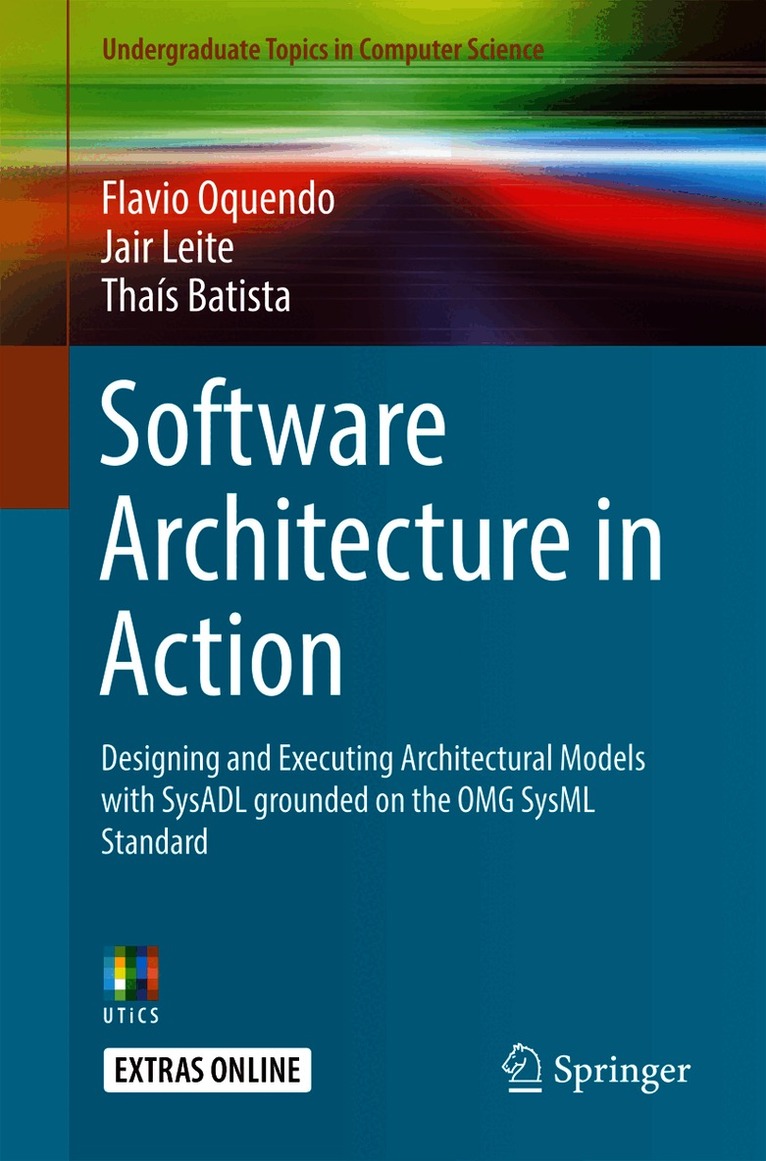
This book presents a systematic model-based approach for software architecture according to three complementary viewpoints: structure, behavior, and execution. It covers a unified modeling approach and consolidates theory and practice with well-established learning outcomes. The authors cover the fundamentals of software architecture description and presents SysADL, a specialization of the OMG Standard Systems Modeling Language (SysML) with the aim of bringing together the expressive power of an Architecture Description Language (ADL) with a standard notation, widely accepted by industry and compliant with the ISO/IEC/IEEE 42010 Standard on Architecture Description in Systems and Software Engineering.The book is clearly structured in four parts:The first part focuses on the fundamentals of software architecture, exploring the concepts and constructs for modeling software architecture from differing viewpoints. Each chapter covers a specific viewpoint illustrated with examples of a real system. The second part focuses on how to design software architecture for achieving quality attributes. Each chapter covers a specific quality attribute and presents well-defined approaches to achieve it. Each architectural case study is illustrated with different examples drawn from a real-life system.The third part shows readers how to apply software architecture style to design architectures that meet the quality attributes. Each chapter covers a specific architectural style and gives insights on how to describe substyles. Each style is illustrated by variants and examples of a real-life system.The fourth part presents how to textually represent software architecture models to complement visual notation, including different examples.Software Architecture in Action is designed for teaching the required modeling techniques to both undergraduate andgraduate students, giving them the practical techniques and tools needed to design the architecture of software-intensive systems. Similarly, this book will appeal to software development architects, designers, programmers and project managers too.
Häftad, Engelska, 2004
558 kr
Skickas inom 10-15 vardagar
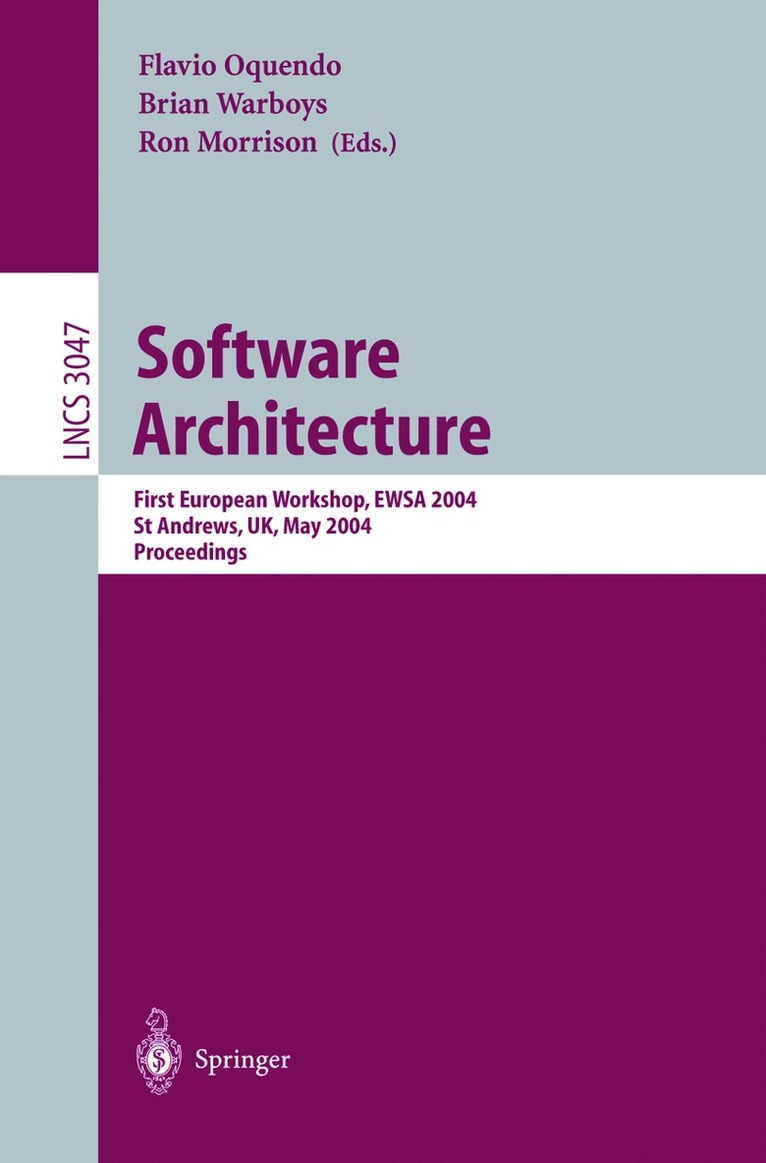
This book constitutes the refereed proceedings of the First European Workshop on Software Architecture, EWSA 2004, held in St Andrews, Scotland, UK in May 2004 in conjunction with ICSE 2004. The 9 revised full research papers, 4 revised full experience papers, and 6 revised position papers presented together with 5 invited presentations on ongoing European projects on software architectures were carefully reviewed and selected from 48 submissions. All current aspects of software architectures are addressed ranging from foundational and methodological issues to application issues of practical relevance.
Häftad, Engelska, 2005
558 kr
Skickas inom 10-15 vardagar
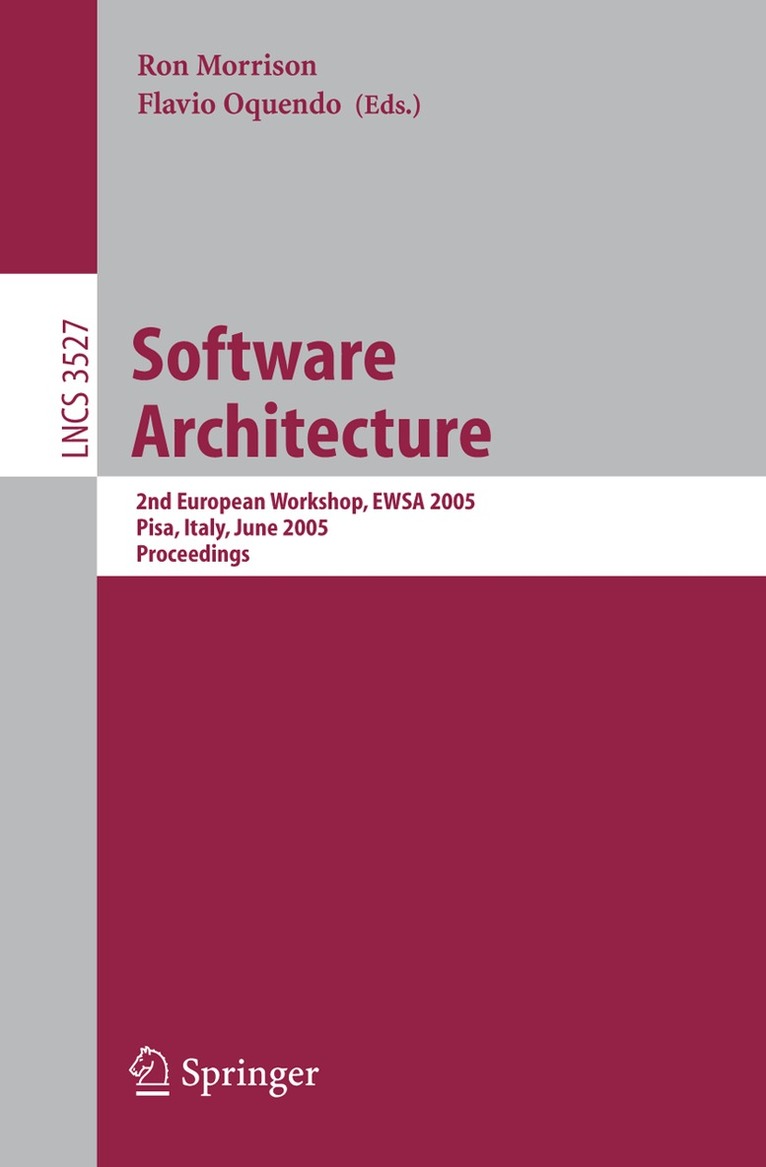
The1stEuropeanWorkshoponSoftwareArchitecture(EWSA2004)washeldin St Andrews, Scotland on 21–22 May 2004. The workshop provided an inter- tional forum for researchers and practitioners from academia and industry to discuss a wide range of topics in the area of software architecture and to jointly formulate an agenda for future research. We were pleased to continue this forum in EWSA 2005. The importance of software architecture as a fundamental area of software engineeringcontinues togrow.Inaddition todescribingtheunderlyingstructure of software systems, architectures are now being used to model and understand dynamicbehavior.Newareasofstudy,whichhavetheirrootsincontrolsystems, arebeginningtoemerge.The?eldofautonomicsrequiresanunderlyingsoftware architecture to describe the executing computation as does any control system that involves system evolution. The range of papers in EWSA 2005 re?ected both the traditional and new applications of software architecture techniques. EWSA 2005 distinguished between three types of papers: research papers (which describe authors’ novel research work), a case study (which describes experiencesrelatedtosoftwarearchitectures)andpositionpapers(whichpresent concise arguments about a topic of software architecture research or practice). TheProgrammeCommitteeselected18papers(12researchpapers,4position papers, 1 case study, and 1 unrefereed invited paper) out of 41 submissions from 20 countries (Australia, Belgium, Brazil, Chile, China, Czech Republic, Finland, France, Germany, India, Italy, Ireland, Korea, Netherlands, Pakistan, Portugal, Spain, Switzerland, UK, USA). All submissions were reviewed by at least three members of the Programme Committee. Papers were selected based on originality, quality, soundness and relevance to theworkshop. Credit for the quality of the proceedings goes to all authors of papers.
Häftad, Engelska, 2003
542 kr
Skickas inom 10-15 vardagar
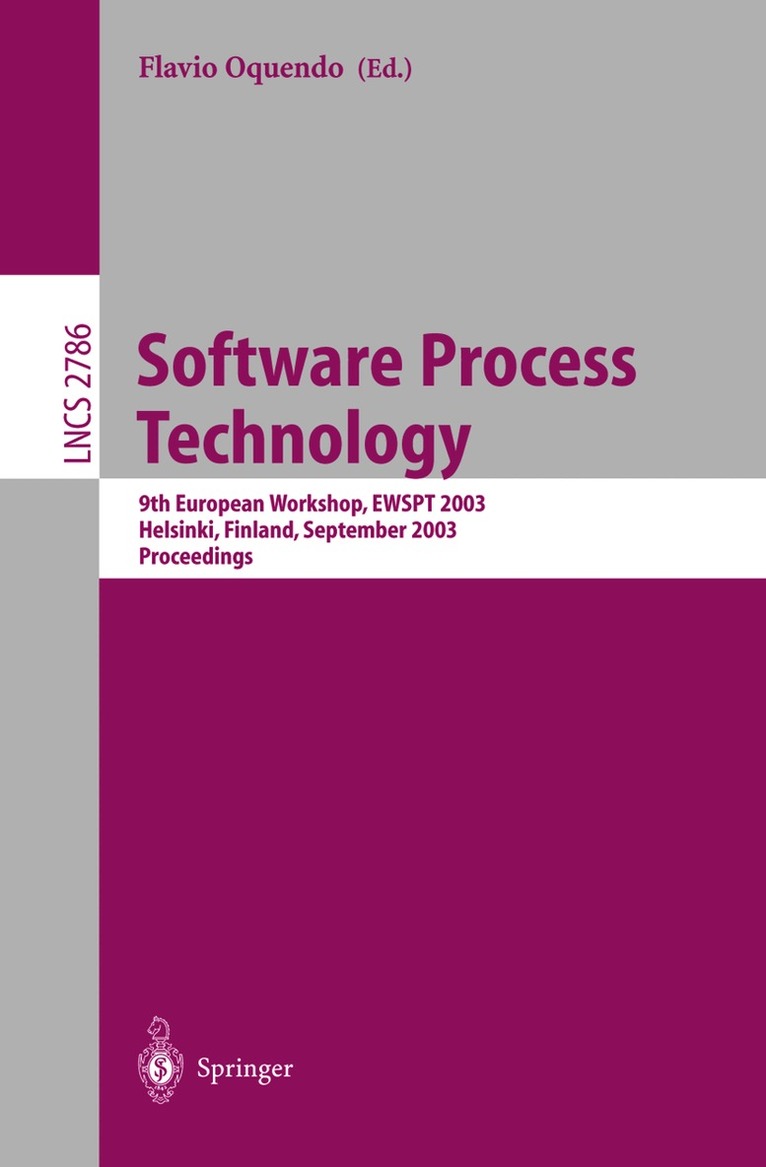
During the last two decades we have seen tremendous developments within software engineeringresearchandpractice.Theeverincreasingcomplexityofsoftwaresystems andtherevolutionarydevelopmentintheInternethaveledtomanyinterestingchallenges andopportunitiesfornewdevelopmentsinSoftwareProcessTechnology. Started in 1990, the primary goal of the European Workshops on Software P- cessTechnology is to achieve better understanding of the state-of-the-art on all issues related to software process technology, including (but not limited to): process mo- linglanguages,computer-supportedprocessdescription,analysis,reuse,re?nementand enactment,processmonitoring,measurement,management,improvementandevolution, process enactment engines, tools, and environments. Besides the technical viewpoint, the workshops have also taken into account human and social dimensions in software processenactment. The9thEuropeanWorkshoponSoftwareProcessTechnology(EWSPT-9)provided aninternationalforumforresearchersandpractitionersfromacademiaandindustryto discussawiderangeoftopicsintheareaofsoftwareprocesstechnology,andtojointly formulateanagendaforfutureresearchinthis?eld.TheProgramCommitteemetinPortland,Oregon,USAduringICSE2003,toselect thepapersforinclusionintheproceedings.Twelvepapers(elevenresearchpapersand onepositionpaper)wereselectedoutof25submissionsfrom12countries(Australia, Austria,Brazil,China,Finland,France,Germany,Mexico,Norway,Spain,UK,USA). All submissions were reviewed by three members of the Program Committee. Papers wereselectedbasedonoriginality,quality,soundnessandrelevancetotheworkshop.In addition,theprogramincludedaninvitedtalkbyVolkerGruhn(UniversityofLeipzig, Germany).Creditforthequalityoftheproceedingsgoestoallauthorsofthepapers. I would like to thank the members of the Program Committee (Jean-Claude D- niame, Jacky Estublier, Carlo Ghezzi, Carlo Montangero, Leon Osterweil, Dewayne Perry, and Brian Warboys) for providing timely and signi?cant reviews, and for their substantialeffortinmakingEWSPT-9asuccessfulworkshop. This year the workshop was held in conjunction with the joint European Software EngineeringConferenceandACMSIGSOFTSymposiumontheFoundationsofSo- ware Engineering.I would like to acknowledge the General Chair, Jukka Paakki, and themembersoftheOrganizingCommitteefortheirassistanceduringtheorganization ofEWSPT-9asaco-locatedworkshop. IwouldalsoliketoacknowledgethepromptandprofessionalsupportfromSpringer- Verlag, who published these proceedings in printed and electronic volumes as part of theLectureNotesinComputerScienceseries.
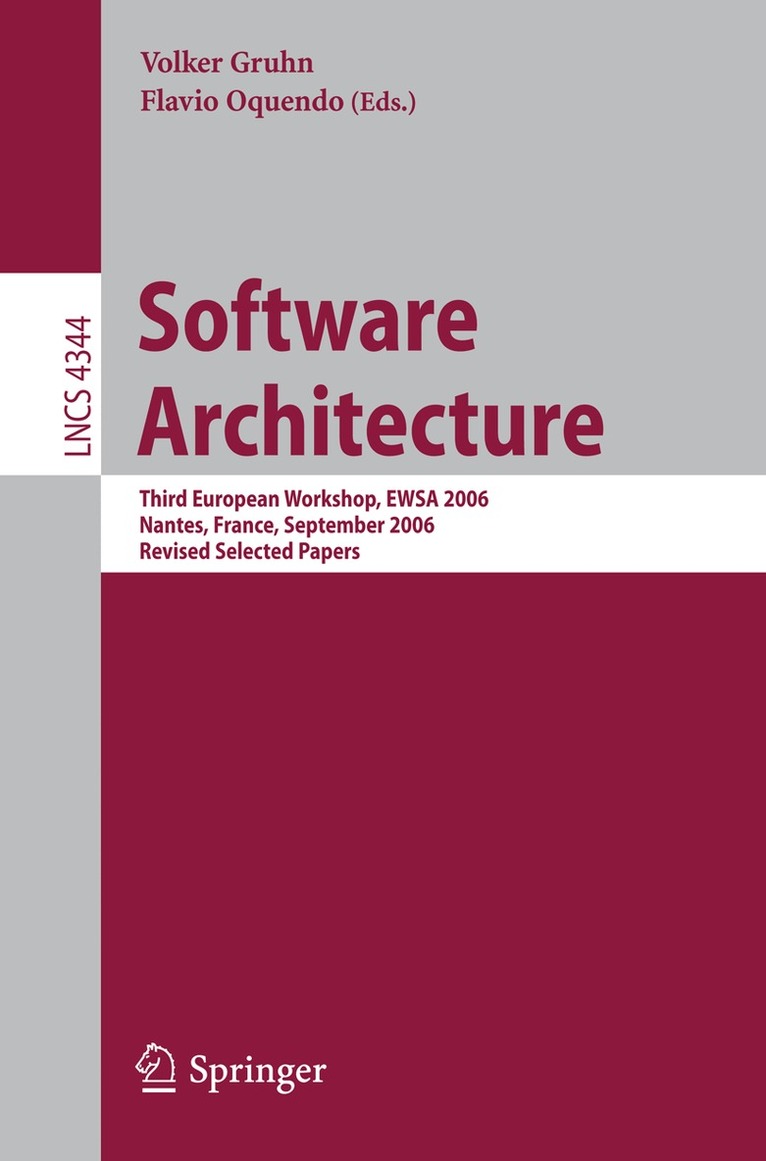
Häftad, Engelska, 2006
558 kr
Skickas inom 10-15 vardagar
Following the successful workshops held in St. Andrews, Scotland, UK in 2004 (EWSA 2004, Springer LNCS 3527) and in Pisa, Italy in 2005 (EWSA 2005, Springer LNCS 3047), the 3rd European Workshop on Software Architecture (EWSA 2006) held in Nantes, France during September 4–5, 2006 provided an internationalforumforresearchersandpractitionersfromacademiaandindustry to present innovative research and discuss a wide range of topics in the area of software architecture. Software architecture has emerged as an important subdiscipline of software engineering encompassing a broad set of languages, styles, models, tools, and processes. The role of software architecture in the engineering of softwa- intensive systems has become more and more important and widespread. Ch- lenging applications include support for dynamic, adaptive, autonomic and mobile systems. The workshopfocused onformalisms,technologies,and processesfor descr- ing, verifying, validating, re?ning, building, and evolving software systems, in particular based on component and service-oriented architectures. Topics c- eredincluded architecturemodeling,architecturalaspects,architectureanalysis, transformation and synthesis, quality attributes, model-driven engineering, and architecture-based support for assembling components and developing com- nent and service-oriented systems. EWSA 2006, distinguished between two types of papers: research papers, which describe authors novel research work, and position papers, which present concise arguments about a topic of software architecture research or practice.
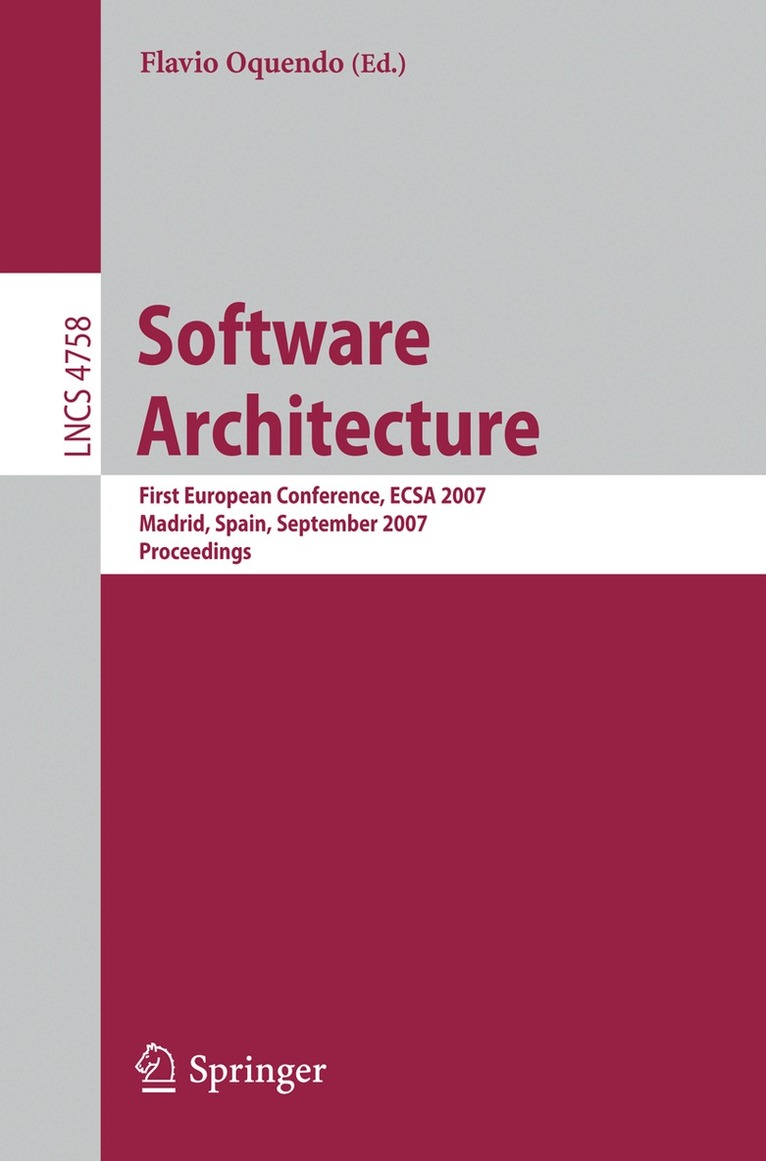
Häftad, Engelska, 2007
558 kr
Skickas inom 10-15 vardagar
Software architecture has emerged as an important subdiscipline of software engineering encompassing a broad set of languages, styles, models, tools, and processes. The role of software architecture in the engineering of software-intensive applications has become more and more important and widespread. Indeed, component-based and service-oriented architectures have become key to the design, development, and evolution of most software systems. The European Conference on Software Architecture (ECSA) is the premier European conference dedicated to the field of software architecture, covering all architectural features of software and service engineering. It is the follow-up of a successful series of European workshops on software architecture held in the United Kingdom in 2004 (Springer LNCS 3047), Italy in 2005 (Springer LNCS 3527), and France in 2006 (Springer LNCS 4344). Due to its success, it has evolved into a fu- fledged series of European conferences whose first edition was ECSA 2007, held in Madrid, Spain September 24–26, 2007. ECSA 2007 provided an international forum for researchers and practitioners from academia and industry to present innovative research and to discuss a wide range of topics in the area of software architecture. It focused on formalisms, technologies, and processes for describing, verifying, validating, transforming, building, and evolving software systems, in particular founded on component-based and service-oriented architectures. Covered topics included architecture modeling, architectural aspects, architecture analysis, transformation and synthesis, quality attributes, model-driven engineering, and architecture-based support for developing, adapting, reconfiguring, and evolving component-based and service-oriented systems.