Floris Schuiling - Böcker
Visar alla böcker från författaren Floris Schuiling. Handla med fri frakt och snabb leverans.
4 produkter
4 produkter
2 150 kr
Skickas inom 10-15 vardagar
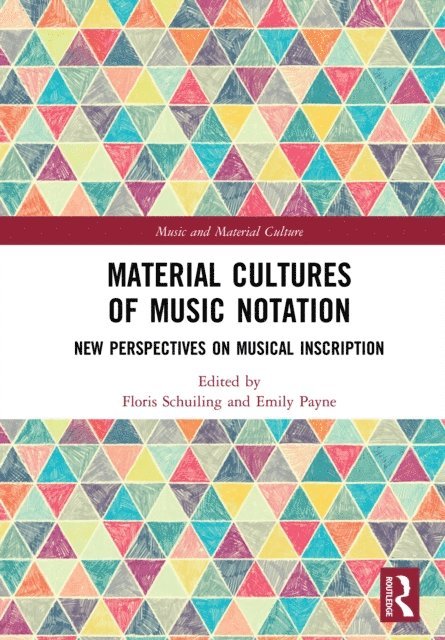
Material Cultures of Music Notation brings together a collection of essays that explore a fundamental question in the current landscape of musicology: how can writing and reading music be understood as concrete, material practices in a wider cultural context? Drawing on interdisciplinary approaches from musicology, media studies, performance studies, and more, the chapters in this volume offer a wide array of new perspectives that foreground the materiality of music notation. From digital scores to the transmission of manuscripts in the Middle Ages, the volume deliberately disrupts boundaries of discipline, historical period, genre, and tradition, by approaching notation's materiality through four key interrelated themes: knowledge, the body, social relations, and technology. Together, the chapters capture vital new work in an essential emerging area of scholarship.
2 150 kr
Skickas inom 10-15 vardagar
The Instant Composers Pool and Improvisation Beyond Jazz contributes to the expansion and diversification of our understanding of the jazz tradition by describing the history and practice of one of the most important non-American jazz groups: The Instant Composers Pool, founded in Amsterdam in 1967. The Instant Composers Pool describes the meaning of "instant composition" from both a historical and ethnographic perspective. Historically, it details instant composition’s emergence from the encounter between various overlapping transnational avant-gardes, including free jazz, serialism, experimental music, electronic music, and Fluxus. The author shows how the improvising musicians not only engaged with the cultural politics of ethnicity and race involved in the negotiation of the boundaries of jazz as a cultural practice, but transformed the meaning of music in society—particularly the nature of improvisation and performance. Ethnographically, The Instant Composers Pool encourages readers to reconsider the conceptual tools we use to describe music performance, improvisation, and creativity. It takes the practice of "instant composition" as an opportunity to reflect on music performance as a social practice, which is crucial not only for jazz studies, but for general music scholarship.
705 kr
Skickas inom 10-15 vardagar
The Instant Composers Pool and Improvisation Beyond Jazz contributes to the expansion and diversification of our understanding of the jazz tradition by describing the history and practice of one of the most important non-American jazz groups: The Instant Composers Pool, founded in Amsterdam in 1967. The Instant Composers Pool describes the meaning of "instant composition" from both a historical and ethnographic perspective. Historically, it details instant composition’s emergence from the encounter between various overlapping transnational avant-gardes, including free jazz, serialism, experimental music, electronic music, and Fluxus. The author shows how the improvising musicians not only engaged with the cultural politics of ethnicity and race involved in the negotiation of the boundaries of jazz as a cultural practice, but transformed the meaning of music in society—particularly the nature of improvisation and performance. Ethnographically, The Instant Composers Pool encourages readers to reconsider the conceptual tools we use to describe music performance, improvisation, and creativity. It takes the practice of "instant composition" as an opportunity to reflect on music performance as a social practice, which is crucial not only for jazz studies, but for general music scholarship.
593 kr
Skickas inom 10-15 vardagar
Material Cultures of Music Notation brings together a collection of essays that explore a fundamental question in the current landscape of musicology: how can writing and reading music be understood as concrete, material practices in a wider cultural context? Drawing on interdisciplinary approaches from musicology, media studies, performance studies, and more, the chapters in this volume offer a wide array of new perspectives that foreground the materiality of music notation. From digital scores to the transmission of manuscripts in the Middle Ages, the volume deliberately disrupts boundaries of discipline, historical period, genre, and tradition, by approaching notation's materiality through four key interrelated themes: knowledge, the body, social relations, and technology. Together, the chapters capture vital new work in an essential emerging area of scholarship.