Formigari Lia Formigari – författare
Visar alla böcker från författaren Formigari Lia Formigari. Handla med fri frakt och snabb leverans.
5 produkter
5 produkter
E-bok
PDF, Engelska, 19951 646 kr
Läs direkt efter köp
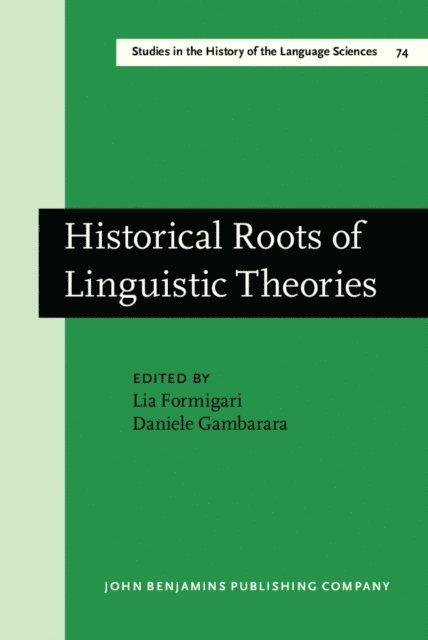
Most of the papers collected in this volume concentrate on the history of linguistic ideas in France and Italy in the modern period (from the Renaissance to the present day). Some of them are specifically focused on the links between the two traditions of reflection on language.The contributions have a common methodological outlook: the authors do not believe that the history of linguistic ideas is a separate activity from research on language or that it is marginal with respect to the latter. On the contrary, they are convinced that in contemporary research into language we can still discern the influence — positive or negative as this may be — of factors deriving from the (sometimes distant) past. A historical analysis of these factors — whether it rejects them as superseded, or redefines them in order to elicit the fruitful suggestions they may still contain — has a contribution to make to the progress of theory.

E-bok
PDF, Engelska, 19931 434 kr
Läs direkt efter köp
This book tells the story of how 18th-century European philosophy used Locke''s theory of signs to build a natural history of speech and to investigate the semiotic tools with which nature and civil society can be controlled. The story ends at the point where this approach to language sciences was called into question. Its epilogue is the description of the birth of an alternative between empiricism and idealism in late 18th- and early 19th-century theories of language.This alternative has given rise to such irreducible dichotomies as empirical linguistics vs. speculative linguistics, philosophies of linguistics vs. philosophy of language. Since then philosophers have largely given up reflecting on linguistic practice and have left the burden of unifying and interpreting empirical research data to professional linguists, limiting themselves to the study of foundations and to purely self-contemplative undertakings.The theoretical and institutional relevance to the present of the problems arising from this situation is in itself a sufficient reason for casting our minds back over a period in which, as in no other, linguistic research was an integral part of the encyclopaedia of knowledge, and in which philosophers reflected, and encouraged reflection, upon the semiotic instruments of science and politics.
E-bok
PDF, Engelska, 19901 646 kr
Läs direkt efter köp
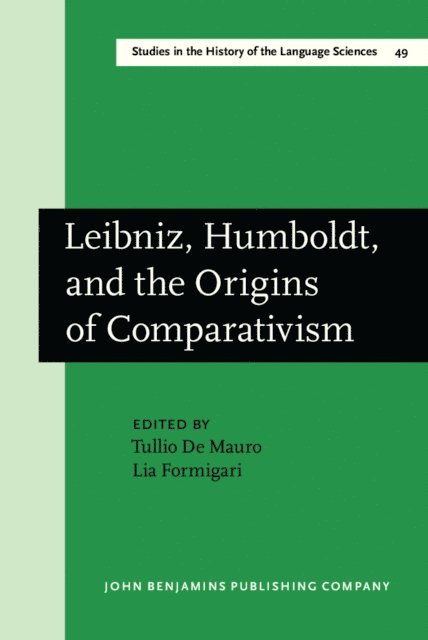
Both Leibniz and Humboldt are scholars in whose work we find a passionate interest in the history and development of languages combined with a strong theoretical commitment. Linking their names to linguistic comparativism draws attention to the contribution these scholars have made to the history of comparativism and also promotes discussion of the relationship of theory and practice in linguistic research in more general terms. In September 1986, a conference on Leibniz, Humboldt and the Origins of Comparativism'' was held in Rome. The papers included in this volume are revised versions of the papers presented at the conference.
E-bok
PDF, Engelska, 19881 344 kr
Läs direkt efter köp
The focus of this volume is the crisis of the traditional view of the relationship between words and things and the emergence of linguistic arbitrarism in 17th-century British philosophy. Different groups of sources are explored: philological and antiquarian writings, pedagogical treatises, debates on the respective merits of the liberal and mechanical arts, essays on cryptography and the art of gestures, polemical pamphlets on university reform, universal language scheme, and philosophical analyses of the conduct of the understanding. In the late 17th-century the philosophy of mind discards both the correspondence of predicamental series to reality and the archetypal metaphysics underpinning it. This is a turning point in semantic theory: language is conceived as the social construction of historical-conventional objects through signs and the study of strategies we use to bridge the gap between the privacy of experience and the publicness of speech emerges as one of the main topics in the philosophy of language.
E-bok
PDF, Engelska, 20041 535 kr
Läs direkt efter köp
Theory and history combine in this book to form a coherent narrative of the debates on language and languages in the Western world, from ancient classic philosophy to the present, with a final glance at on-going discussions on language as a cognitive tool, on its bodily roots and philogenetic role.An introductory chapter reviews the epistemological areas that converge into, or contribute to, language philosophy, and discusses their methods, relations, and goals. In this context, the status of language philosophy is discussed in its relation to the sciences and the arts of language. Each chapter is followed by a list of suggested readings that refer the reader to the final bibliography.About the author: Lia Formigari, Professor Emeritus at University of Rome, La Sapienza. Her publications include: Language and Experience in XVIIth-century British Philosophy. Amsterdam & Philadelphia: J. Benjamins, 1988; Signs, Science and Politics. Philosophies of Language in Europe 1700–1830. Amsterdam & Philadelphia: J. Benjamins, 1993; La sémiotique empiriste face au kantisme. Liège: Mardaga, 1994.