Fr d ric Magoules – författare
2 264 kr
Läs direkt efter köp
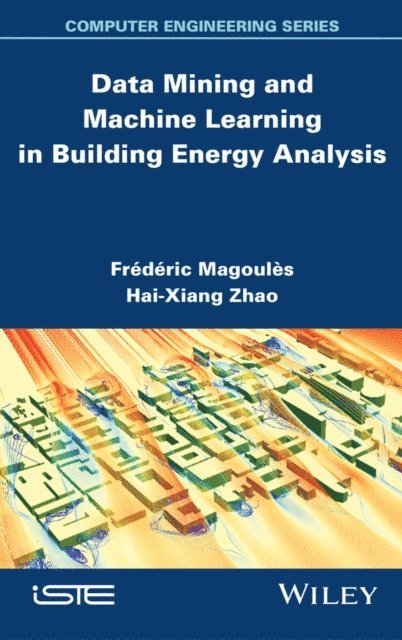
The energy consumption of a building has, in recent years, become a determining factor during its design and construction. With carbon footprints being a growing issue, it is important that buildings be optimized for energy conservation and CO2 reduction. This book therefore presents AI models and optimization techniques related to this application.
The authors start with a review of recent models for the prediction of building energy consumption: engineering methods, statistical methods, artificial intelligence methods, ANNs and SVMs in particular. The book then focuses on SVMs, by first applying them to building energy consumption, then presenting the principles and various extensions, and SVR. The authors then move on to RDP, which they use to determine building energy faults through simulation experiments before presenting SVR model reduction methods and the benefits of parallel computing. The book then closes by presenting some of the current research and advancements in the field.
2 264 kr
Läs direkt efter köp
The energy consumption of a building has, in recent years, become a determining factor during its design and construction. With carbon footprints being a growing issue, it is important that buildings be optimized for energy conservation and CO2 reduction. This book therefore presents AI models and optimization techniques related to this application.
The authors start with a review of recent models for the prediction of building energy consumption: engineering methods, statistical methods, artificial intelligence methods, ANNs and SVMs in particular. The book then focuses on SVMs, by first applying them to building energy consumption, then presenting the principles and various extensions, and SVR. The authors then move on to RDP, which they use to determine building energy faults through simulation experiments before presenting SVR model reduction methods and the benefits of parallel computing. The book then closes by presenting some of the current research and advancements in the field.
2 199 kr
Läs direkt efter köp
Scientific computing has become an indispensable tool in numerous fields, such as physics, mechanics, biology,finance and industry. For example, it enables us, thanks to efficient algorithms adapted to current computers, tosimulate, without the help of models or experimentations, the deflection of beams in bending, the sound level in a theater room or a fluid flowing around an aircraft wing.This book presents the scientific computing techniques applied to parallel computing for the numerical simulation of large-scale problems; these problems result from systems modeled by partial differential equations. Computing concepts will be tackled via examples.Implementation and programming techniques resulting from the finite element method will be presented for direct solvers, iterative solvers and domain decomposition methods, along with an introduction to MPI and OpenMP.
2 199 kr
Läs direkt efter köp
Scientific computing has become an indispensable tool in numerous fields, such as physics, mechanics, biology,finance and industry. For example, it enables us, thanks to efficient algorithms adapted to current computers, tosimulate, without the help of models or experimentations, the deflection of beams in bending, the sound level in a theater room or a fluid flowing around an aircraft wing.This book presents the scientific computing techniques applied to parallel computing for the numerical simulation of large-scale problems; these problems result from systems modeled by partial differential equations. Computing concepts will be tackled via examples.Implementation and programming techniques resulting from the finite element method will be presented for direct solvers, iterative solvers and domain decomposition methods, along with an introduction to MPI and OpenMP.