Francisco Sandoval - Böcker
Visar alla böcker från författaren Francisco Sandoval. Handla med fri frakt och snabb leverans.
7 produkter
7 produkter
137 kr
Skickas inom 5-8 vardagar
180 kr
Skickas inom 5-8 vardagar
171 kr
Skickas inom 5-8 vardagar
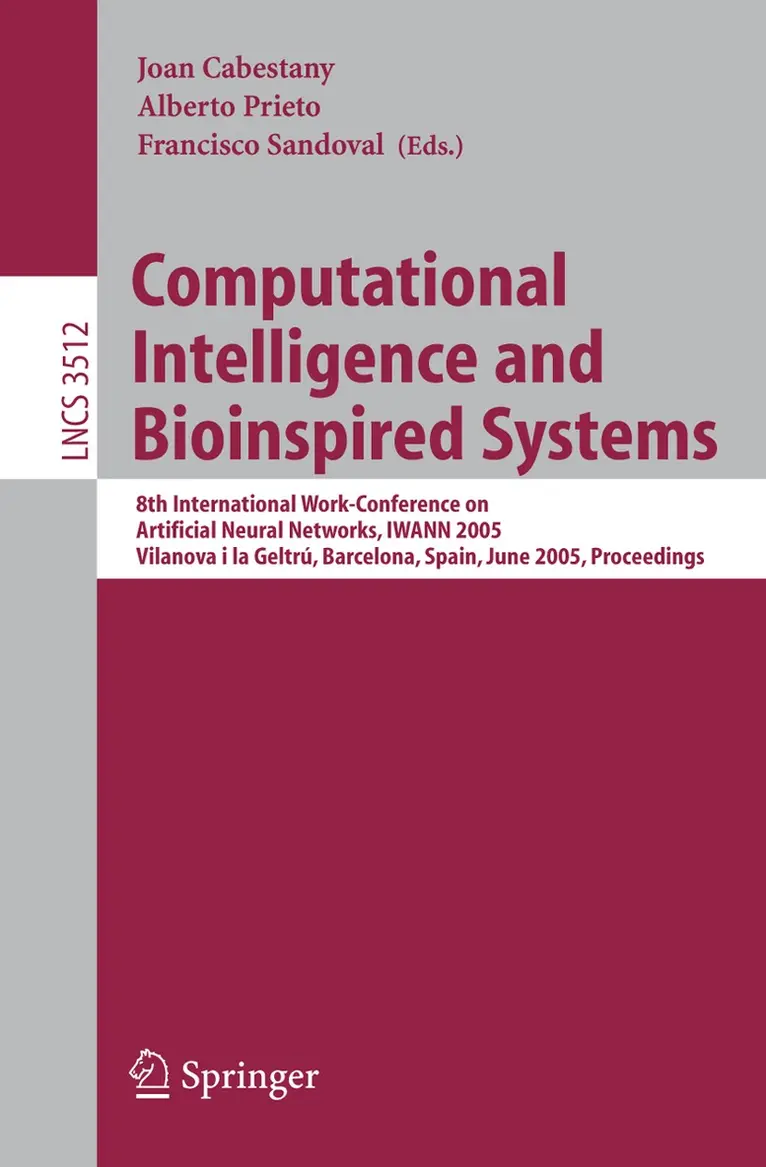
Computational Intelligence and Bioinspired Systems
8th International Work-Conference on Artificial Neural Networks, IWANN 2005, Vilanova i la Geltrú, Barcelona, Spain, June 8-10, 2005, Proceedings
Häftad, Engelska, 2005
1 577 kr
Skickas inom 10-15 vardagar
This biennial meeting focuses on the foundations, theory, models and applications of systems inspired by nature (neural networks, fuzzy logic and evolutionary systems).
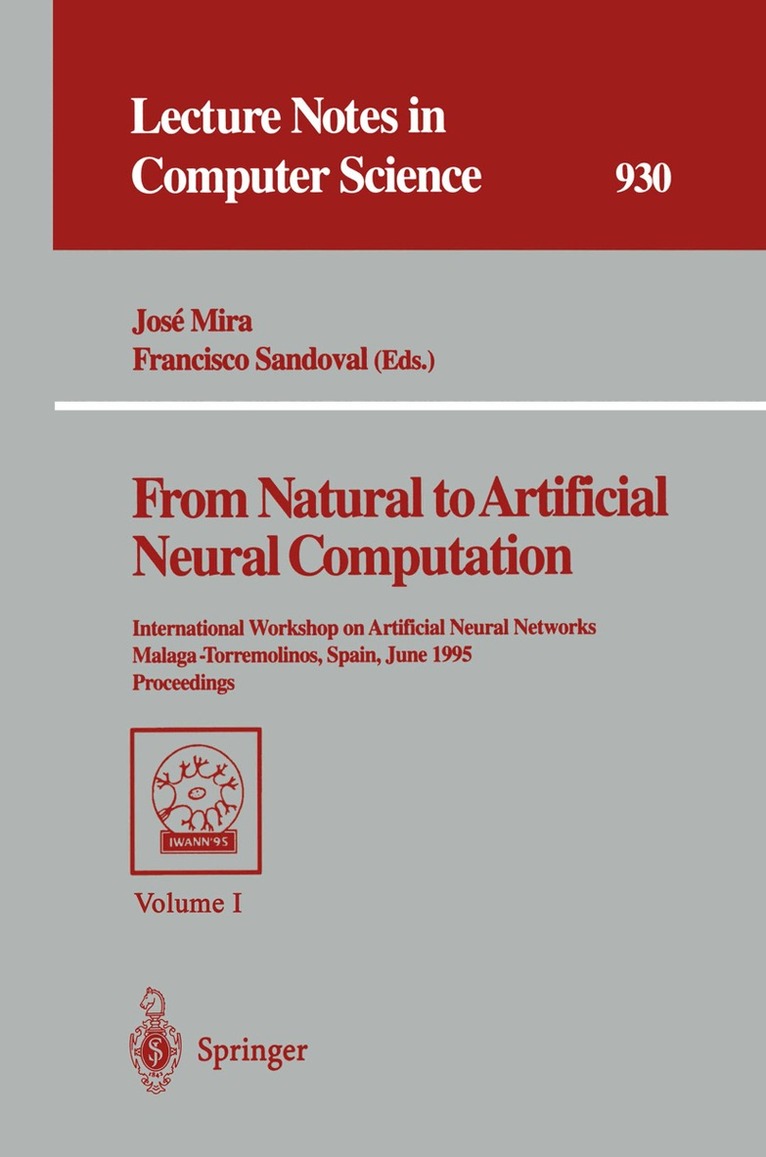
From Natural to Artificial Neural Computation
International Workshop on Artificial Neural Networks, Malaga-Torremolinos, Spain, June 7 – 9, 1995 Proceedings
Häftad, Engelska, 1995
554 kr
Skickas inom 10-15 vardagar
This volume presents the proceedings of the International Workshop on Artificial Neural Networks, IWANN '95, held in Torremolinos near Malaga, Spain in June 1995.The book contains 143 revised papers selected from a wealth of submissions and five invited contributions; it covers all current aspects of neural computation and presents the state of the art of ANN research and applications. The papers are organized in sections on neuroscience, computational models of neurons and neural nets, organization principles, learning, cognitive science and AI, neurosimulators, implementation, neural networks for perception, and neural networks for communication and control.
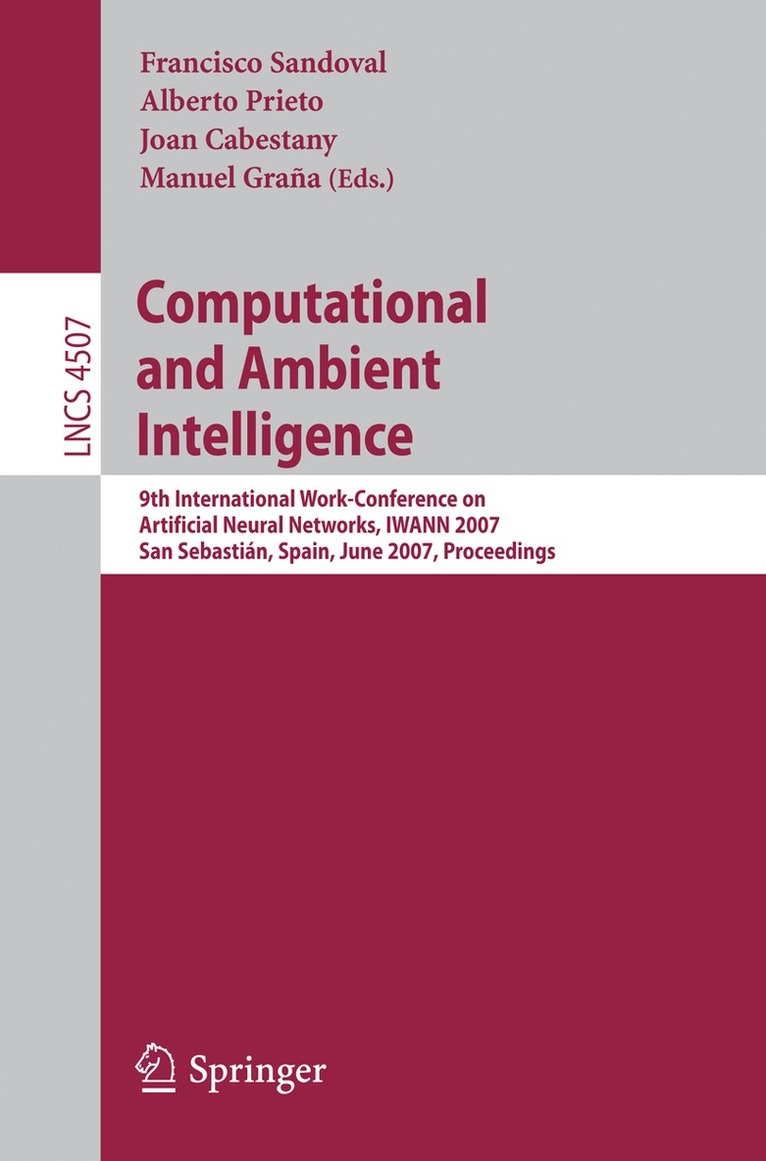
Computational and Ambient Intelligence
9th International Work-Conference on Artificial Neural Networks, IWANN 2007, San Sebastián, Spain, June 20-22, 2007, Proceedings
Häftad, Engelska, 2007
1 101 kr
Skickas inom 10-15 vardagar
We present in this volume the collection of finally accepted papers for the ninth e- tion of the IWANN conference (“International Work-Conference on Artificial Neural Networks”). This biennial meeting focuses on the foundations, theory, models and applications of systems inspired by nature (neural networks, fuzzy logic and evo- tionary systems). Since the first edition of IWANN in Granada (LNCS 540, 1991), the computational intelligence community and the domain itself have matured and evolved. Under the computational intelligent banner we find a very heterogeneous scenario with a main interest and objective: to better understand nature and natural entities for the correct elaboration of theories, models and new algorithms. For scientifics, engineers and professionals working in the area, this is a very good way to get real, solid and c- petitive applications. More and more, these new computational techniques are used in applications that try to bring a new situation of well-being to the user. The conjunction of a more and more miniaturized hardware together with the growing computational intelligence embodied in this hardware leads us towards fully integrated embedded systems-on- chip and opens the door for truly ubiquitous electronics.
1 868 kr
Skickas inom 10-15 vardagar
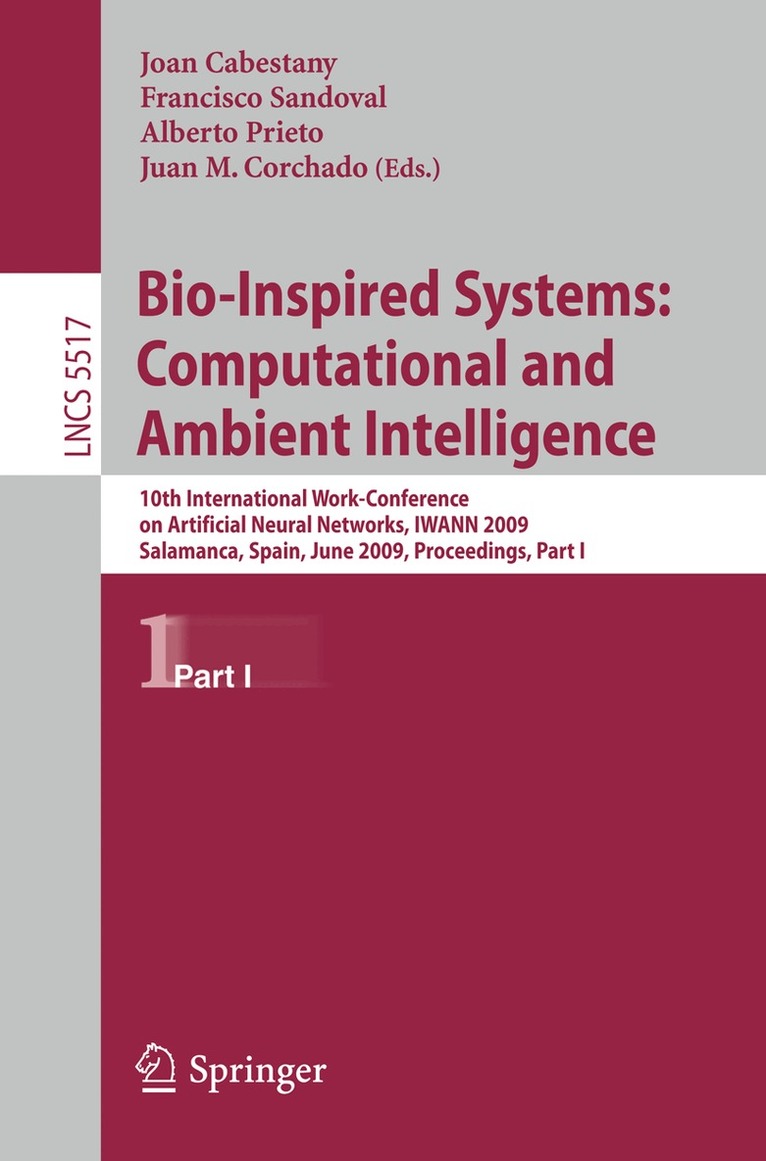
This volume presents the set of final accepted papers for the tenth edition of the IWANN conference “International Work-Conference on Artificial neural Networks” held in Salamanca (Spain) during June 10–12, 2009. IWANN is a biennial conference focusing on the foundations, theory, models and applications of systems inspired by nature (mainly, neural networks, evolutionary and soft-computing systems). Since the first edition in Granada (LNCS 540, 1991), the conference has evolved and matured. The list of topics in the successive Call for - pers has also evolved, resulting in the following list for the present edition: 1. Mathematical and theoretical methods in computational intelligence. C- plex and social systems. Evolutionary and genetic algorithms. Fuzzy logic. Mathematics for neural networks. RBF structures. Self-organizing networks and methods. Support vector machines. 2. Neurocomputational formulations. Single-neuron modelling. Perceptual m- elling. System-level neural modelling. Spiking neurons. Models of biological learning. 3. Learning and adaptation. Adaptive systems. Imitation learning. Reconfig- able systems. Supervised, non-supervised, reinforcement and statistical al- rithms. 4. Emulation of cognitive functions. Decision making. Multi-agent systems. S- sor mesh. Natural language. Pattern recognition. Perceptual and motor functions (visual, auditory, tactile, virtual reality, etc.). Robotics. Planning motor control. 5. Bio-inspired systems and neuro-engineering. Embedded intelligent systems. Evolvable computing. Evolving hardware. Microelectronics for neural, fuzzy and bio-inspired systems. Neural prostheses. Retinomorphic systems. Bra- computer interfaces (BCI). Nanosystems. Nanocognitive systems.