Franco Archibugi – författare
2 171 kr
Läs direkt efter köp
1 613 kr
Skickas inom 10-15 vardagar
2 482 kr
Skickas inom 10-15 vardagar
720 kr
Skickas inom 10-15 vardagar
654 kr
Läs direkt efter köp
First published in 1997, this volume responds to the increasingly urgent issue of degradation of the urban environment. It moves beyond the indirect environmentalism up until the 1990s, examining urban degradation and how urban planning can be directly applied to the concept of an ecological city. Particular focus is given to the Italian government’s ‘Urban Environment Programme’, a 10 year plan for the environment.
Archibugi’s study forms part of an international monograph publishing series covering new research into the ‘green’ issues such as government, corporate and public responses to environmental hazards, the economics of green policies and the effectiveness of environmental protection programmes.
654 kr
Läs direkt efter köp
First published in 1997, this volume responds to the increasingly urgent issue of degradation of the urban environment. It moves beyond the indirect environmentalism up until the 1990s, examining urban degradation and how urban planning can be directly applied to the concept of an ecological city. Particular focus is given to the Italian government’s ‘Urban Environment Programme’, a 10 year plan for the environment.
Archibugi’s study forms part of an international monograph publishing series covering new research into the ‘green’ issues such as government, corporate and public responses to environmental hazards, the economics of green policies and the effectiveness of environmental protection programmes.
855 kr
Läs direkt efter köp
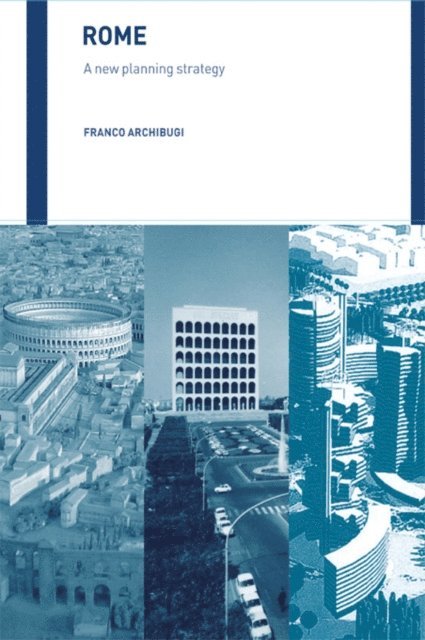
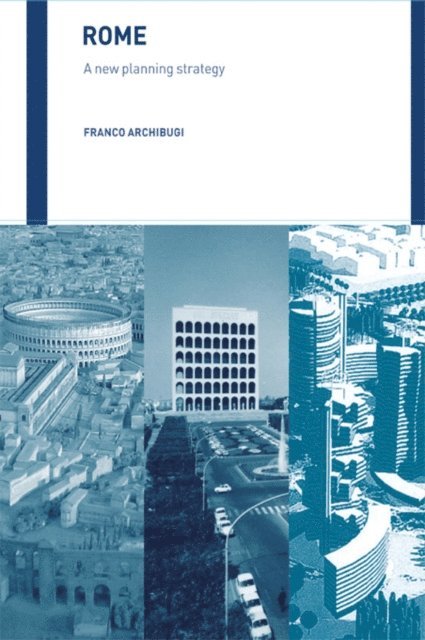
Rome: A New Planning Strategy looks at the problems of a city over the last century and suggests a totally new planning strategy. The book examines the stages that have marked the increase of population and change in land use and analyses the masterplans used to try and control these evolving conditions. Using Rome as an extended case study, the book deals with the socio-economic effect of an absence of planning strategy during the recent growth of the city. The author presents the characters and features of a new masterplan based on his many years of experience in theoretical and practical planning.
855 kr
Läs direkt efter köp
Rome: A New Planning Strategy looks at the problems of a city over the last century and suggests a totally new planning strategy. The book examines the stages that have marked the increase of population and change in land use and analyses the masterplans used to try and control these evolving conditions. Using Rome as an extended case study, the book deals with the socio-economic effect of an absence of planning strategy during the recent growth of the city. The author presents the characters and features of a new masterplan based on his many years of experience in theoretical and practical planning.
1 754 kr
Skickas inom 10-15 vardagar
552 kr
Skickas inom 10-15 vardagar
1 078 kr
Skickas inom 10-15 vardagar
1 413 kr
Läs direkt efter köp
In this book – the first of three volumes – Franco Archibugi sets out to create an epistemology of economics, arguing for a radical overturning of the conventional analysis from a “positive” approach to a “programming” approach. This overturning leads to a reappraisal of the foundations of Economics itself, and to an improved integration of Economics as an autonomous discipline alongside Sociology, Political Science, Operational Research, Social Engineering and Physical or Spatial Planning.
The author interrogates how scientific the social sciences really are before proposing a new scientific paradigm for the social sciences, a political preference function and a general programming approach. The chapters revisit hitherto neglected economists like Gunnar Myrdal, Ragnar Frisch, Vassili Leontief, and Leif Johansen, using their theory to overturn the epistemological approach of the entire science of economics.
Volume II explores oppositions to the traditional and conventional teaching of economics, whilst Volume III presents a concrete and practical example of how to build a Planning Accounting Framework (PAF), as associated with Frisch’s ‘plan-frame’ (explored in Volume II), to demonstrate the extent to which decisions and negotiations can be routed in the social sciences.

1 078 kr
Skickas inom 10-15 vardagar
1 413 kr
Läs direkt efter köp
This trilogy deals with an epistemology of economics, arguing for a radical overturning of conventional analysis and providing an alternative to political economy and social sciences, based not on positivism, but on a normative and programming paradigm.
Volume II builds on the work presented in Volume I to explore oppositions to the traditional and conventional teaching of economics, and presents testimonies that are favourable to a trend towards a programming approach, thereby giving substance to the epistemological ''overturning'' of conventional analysis. Such oppositions studied include the work of Ludvig von Mises and his theory of praxeology; Ian Tinbergen and Wassily Leontif''s preference for ''planning'' over ''forecasting science''; Bruno de Finetti and Daniel Bell''s support for the base of ''utopia'' in economics; the trend from the ''theory of planning'' towards the ''methodology of planning, by Andreas Faludi; neoclassic curiosity about the ''multi-purposes approach'' and ''non-economic commodities'' as investigated by Walter Isard, as well as theories expressed by Herbert Simon, Robert Lucas, George Soros and Mark Blaug.
Volume III takes studies further and presents a concrete and practical example of how to build a Planning Accounting Framework (PAF), as associated with Frisch''s ''plan-frame'' (explored in Volume II), to demonstrate the extent to which decisions and negotiations can be routed in the social sciences.
1 078 kr
Skickas inom 10-15 vardagar
1 413 kr
Läs direkt efter köp
This trilogy deals with an epistemology of economics, arguing for a radical overturning of conventional analysis and providing an alternative to political economy and social sciences, based not on positivism, but on a normative and programming paradigm.
Volume III furthers and concludes work presented in Volume I and Volume II, and introduces a concrete and practical example of how to build a Planning Accounting Framework (PAF), as associated with Frisch''s ''plan-frame'' (explored in Volume II), to demonstrate the extent to which decisions and negotiations can be routed in the social sciences. The PAF is an instrument of the programming approach that can be used to verify the compatibility of decisions and their effects. The author builds on Frisch''s classical PAF to maximise the phenomenology of economic systems, and assure a consistent and effective implementation of decision making.
542 kr
Skickas inom 10-15 vardagar
710 kr
Läs direkt efter köp
Planning Theory expresses a sound unease about the direction taken by the current analysis and criticism of planning experiences, both in the field of economics and in urban and regional planning.
Instead of seriously revising the technical and scientific shortcomings marking the various problems encountered in the planning experience in both fields, academic debates and reflection have instead led to a kind of political interpretation. On the basis of the hopelessness of improving the governance of managerial and political planning initiatives, planning theory has been reduced to a generic sociological debate on planning itself; a debate that freezes planning as a permanently declining engagement.
To oppose this, the present book aims to identify the essential guidelines of a re-launch of planning processes and techniques, configuring a kind of neo-discipline, called ‘planology’ by the author, which builds upon a multi-disciplinary integration (never seen and experimented with until now) of economic, environmental, and sociological approaches, a crucial element missing in previous unsuccessful planning attempts.
542 kr
Skickas inom 10-15 vardagar
545 kr
Tillfälligt slut