Franco Bifo Berardi – författare
Visar alla böcker från författaren Franco Bifo Berardi. Handla med fri frakt och snabb leverans.
10 produkter
Thinking after Gaza
An Essay on Ferocity
Häftad, 2026
172 kr
Lägg i varukorg
A call to imagine a less deadly future, written in the shadow of genocide and “ferocious optimism.” After Gaza, it is time to recognize that the attempt to humanize history has failed, and that there will not be a second try. It is time to recognize that the experiment called “civilization” has …
Breathing
Chaos and Poetry
Häftad, 2018
158 kr
Lägg i varukorg
The increasingly chaotic rhythm of our respiration, and the sense of suffocation that grows everywhere: an essay on poetical therapy. Since the hopeful days of the Occupy movement, many things have changed in the respiration of the world, and we have entered a cycle of spasm, despair, and chaos. …
Chaos and the Automaton
Häftad, 2025
331 kr
Lägg i varukorg
Facing real threats of extinction and futurelessness, a search for new ground on which to build projects toward emancipationChaos and the Automaton is the first volume to collect Franco “Bifo” Berardi’s extensive collaboration with e-flux, which has become one of his primary English-language …
Uprising
On Poetry and Finance
Häftad, 2012
3,0 utav 5 stjärnor. Totalt antal röster: (1)
155 kr
Lägg i varukorg
A manifesto against the concepts of growth and debt, and a call for a reinvestment in the social body. The Uprising is an Autonomist manifesto for today's precarious times, and a rallying cry in the face of the catastrophic and irreversible crisis that neoliberalism and the financial sphere have …
After the Future
Av Franco Bifo Berardi, Nicholas Thoburn m. fl.
E-bok, 2011
172 kr
Lägg i varukorg
After the Future explores a century-long obsession with the concept of the "future," starting with Marinetti''s "Futurist Manifesto," tracing it through the punk movement of the early 70s, and into the media revolution of the 90s. The future, Bifo argues, has come and gone, the concept has lost its …
Soul at Work
From Alienation to Autonomy
Häftad, 2009
175 kr
Lägg i varukorg
An examination of new forms of alienation in our never-off, plugged-in culture—and a clarion call for a “conspiracy of estranged people.” We can reach every point in the world but, more importantly, we can be reached from any point in the world. Privacy and its possibilities are abolished. …
Chaos and the Automaton
Inbunden, 2025
1371 kr
Lägg i varukorg
Facing real threats of extinction and futurelessness, a search for new ground on which to build projects toward emancipationChaos and the Automaton is the first volume to collect Franco “Bifo” Berardi’s extensive collaboration with e-flux, which has become one of his primary English-language …
Precarious Rhapsody
Häftad, 2009
176 kr
Lägg i varukorg
In this groundbreaking new text, Berardi argues that the story of human society is that of bifurcations. The fundamental one is always between machines for liberating desire and methods of control over the imaginary. In our time of digital mutation, technical automatisms are taking control of the …
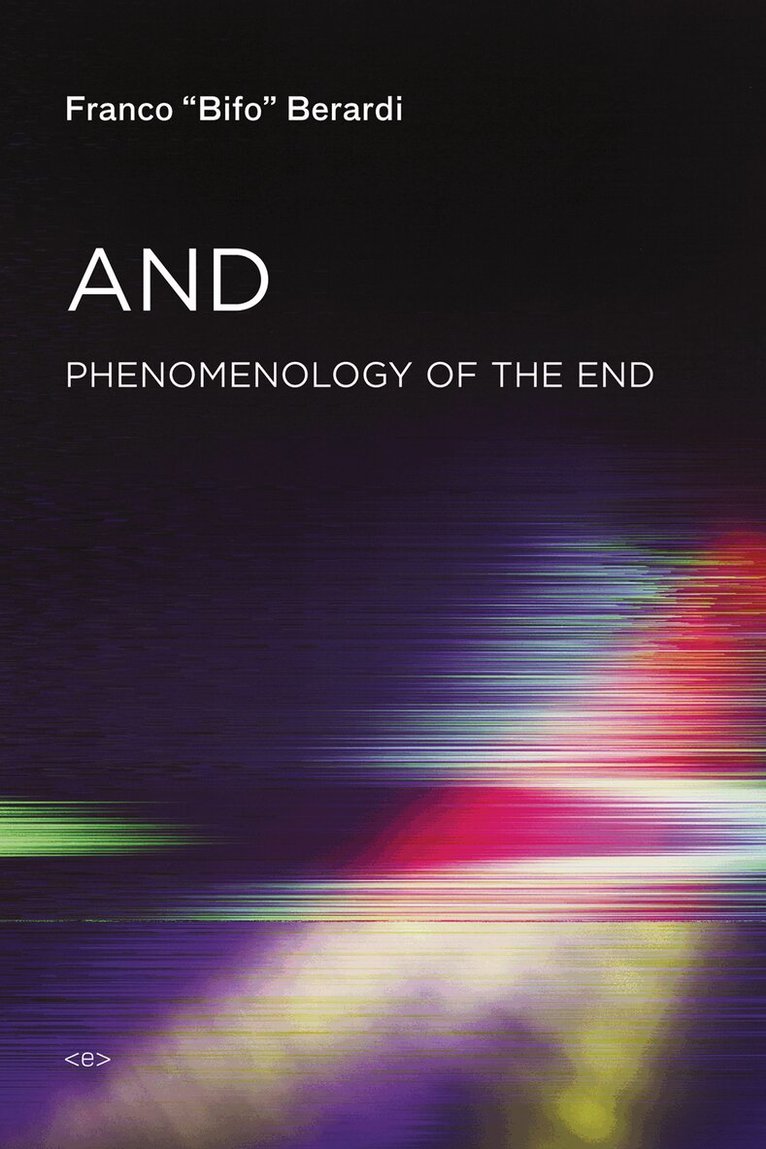
And
Phenomenology of the End
Häftad, 2015
187 kr
Lägg i varukorg
The changes taking place in our aesthetic and emotional sensibility: a deep mutation in the psychosphere, caused by semio-capitalism. Franco “Bifo” Berardi's newest book analyzes the contemporary changes taking place in our aesthetic and emotional sensibility—changes the author claims are the …
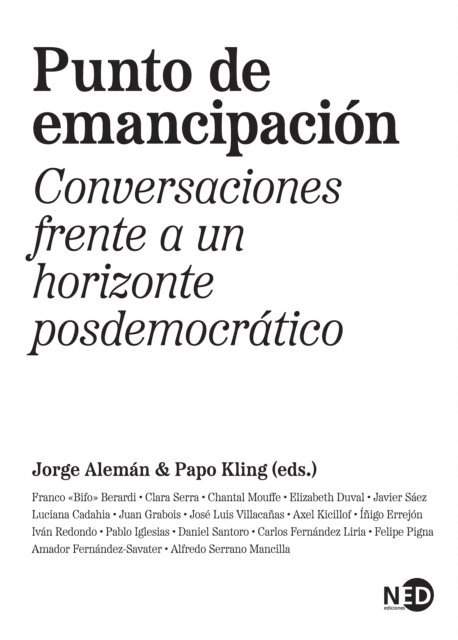
Punto de emancipación
Conversaciones frente a un horizonte posdemocrático
Av Alfredo Serrano Mancilla, Amador Fernandez-Savater m. fl.
E-bok, 2025
166 kr
Lägg i varukorg
Amor, consentimiento, militancia, populismo… Encontramos estos conceptos en los medios, los discutimos compartiendo un café y los pronunciamos en nuestra intimidad, pero ¿los entendemos realmente? Su mención constante, parece, los vacía de sentido y los vuelve opacos, invisibles de habituales. En …