Franco Strocchi - Böcker
Visar alla böcker från författaren Franco Strocchi. Handla med fri frakt och snabb leverans.
14 produkter
14 produkter
Del 158 - International Series of Monographs on Physics
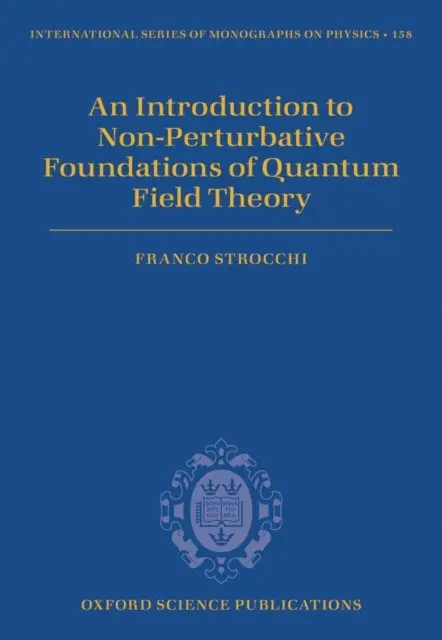
An Introduction to Non-Perturbative Foundations of Quantum Field Theory
Häftad, Engelska, 2016
674 kr
Skickas inom 7-10 vardagar
Quantum Field Theory (QFT) has proved to be the most useful strategy for the description of elementary particle interactions and as such is regarded as a fundamental part of modern theoretical physics. In most presentations, the emphasis is on the effectiveness of the theory in producing experimentally testable predictions, which at present essentially means Perturbative QFT. However, after more than fifty years of QFT, we still are in the embarrassing situation of not knowing a single non-trivial (even non-realistic) model of QFT in 3+1 dimensions, allowing a non-perturbative control. As a reaction to these consistency problems one may take the position that they are related to our ignorance of the physics of small distances and that QFT is only an effective theory, so that radically new ideas are needed for a consistent quantum theory of relativistic interactions (in 3+1 dimensions).The book starts by discussing the conflict between locality or hyperbolicity and positivity of the energy for relativistic wave equations, which marks the origin of quantum field theory, and the mathematical problems of the perturbative expansion (canonical quantization, interaction picture, non-Fock representation, asymptotic convergence of the series etc.). The general physical principles of positivity of the energy, Poincare' covariance and locality provide a substitute for canonical quantization, qualify the non-perturbative foundation and lead to very relevant results, like the Spin-statistics theorem, TCP symmetry, a substitute for canonical quantization, non-canonical behaviour, the euclidean formulation at the basis of the functional integral approach, the non-perturbative definition of the S-matrix (LSZ, Haag-Ruelle-Buchholz theory).A characteristic feature of gauge field theories is Gauss' law constraint. It is responsible for the conflict between locality of the charged fields and positivity, it yields the superselection of the (unbroken) gauge charges, provides a non-perturbative explanation of the Higgs mechanism in the local gauges, implies the infraparticle structure of the charged particles in QED and the breaking of the Lorentz group in the charged sectors.A non-perturbative proof of the Higgs mechanism is discussed in the Coulomb gauge: the vector bosons corresponding to the broken generators are massive and their two point function dominates the Goldstone spectrum, thus excluding the occurrence of massless Goldstone bosons.The solution of the U(1) problem in QCD, the theta vacuum structure and the inevitable breaking of the chiral symmetry in each theta sector are derived solely from the topology of the gauge group, without relying on the semiclassical instanton approximation.
Del 158 - International Series of Monographs on Physics
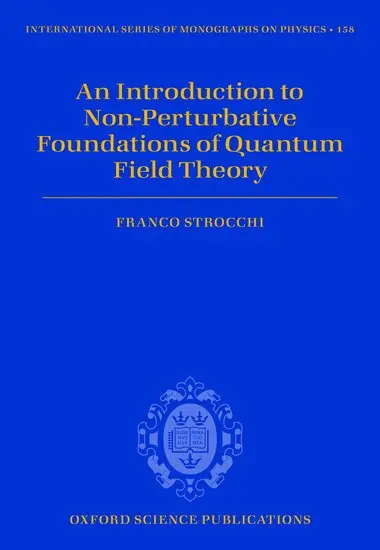
An Introduction to Non-Perturbative Foundations of Quantum Field Theory
Inbunden, Engelska, 2013
1 803 kr
Skickas inom 7-10 vardagar
Quantum Field Theory (QFT) has proved to be the most useful strategy for the description of elementary particle interactions and as such is regarded as a fundamental part of modern theoretical physics. In most presentations, the emphasis is on the effectiveness of the theory in producing experimentally testable predictions, which at present essentially means Perturbative QFT. However, after more than fifty years of QFT, we still are in the embarrassing situation of not knowing a single non-trivial (even non-realistic) model of QFT in 3+1 dimensions, allowing a non-perturbative control. As a reaction to these consistency problems one may take the position that they are related to our ignorance of the physics of small distances and that QFT is only an effective theory, so that radically new ideas are needed for a consistent quantum theory of relativistic interactions (in 3+1 dimensions).The book starts by discussing the conflict between locality or hyperbolicity and positivity of the energy for relativistic wave equations, which marks the origin of quantum field theory, and the mathematical problems of the perturbative expansion (canonical quantization, interaction picture, non-Fock representation, asymptotic convergence of the series etc.). The general physical principles of positivity of the energy, Poincare' covariance and locality provide a substitute for canonical quantization, qualify the non-perturbative foundation and lead to very relevant results, like the Spin-statistics theorem, TCP symmetry, a substitute for canonical quantization, non-canonical behaviour, the euclidean formulation at the basis of the functional integral approach, the non-perturbative definition of the S-matrix (LSZ, Haag-Ruelle-Buchholz theory). A characteristic feature of gauge field theories is Gauss' law constraint. It is responsible for the conflict between locality of the charged fields and positivity, it yields the superselection of the (unbroken) gauge charges, provides a non-perturbative explanation of the Higgs mechanism in the local gauges, implies the infraparticle structure of the charged particles in QED and the breaking of the Lorentz group in the charged sectors.A non-perturbative proof of the Higgs mechanism is discussed in the Coulomb gauge: the vector bosons corresponding to the broken generators are massive and their two point function dominates the Goldstone spectrum, thus excluding the occurrence of massless Goldstone bosons.The solution of the U(1) problem in QCD, the theta vacuum structure and the inevitable breaking of the chiral symmetry in each theta sector are derived solely from the topology of the gauge group, without relying on the semiclassical instanton approximation.
538 kr
Skickas inom 10-15 vardagar
This book presents the basic elements of Analytical Mechanics, starting from the physical motivations that favor it with respect to the Newtonian Mechanics in Cartesian coordinates. Rather than presenting Analytical Mechanics mainly as a formal development of Newtonian Mechanics, it highlights its effectiveness due to the following five important achievements: 1) the most economical description of time evolution in terms of the minimal set of coordinates, so that there are no constraint forces in their evolution equations; 2) the form invariance of the evolution equations, which automatically solves the problem of fictitious forces; 3) only one scalar function encodes the formulation of the dynamics, rather than the full set of vectors which describe the forces in Cartesian Newtonian Mechanics; 4) in the Hamiltonian formulation, the corresponding evolution equations are of first order in time and are fully governed by the Hamiltonian function (usually corresponding to the energy); 5) the emergence of the Hamiltonian canonical algebra and its effectiveness in simplifying the control of the dynamical problem (e.g. the constant of motions identified by the Poisson brackets with the Hamiltonian, the relation between symmetries and conservations laws, the use of canonical transformations to reduce the Hamiltonian to a simpler form etc.). The book also addresses a number of points usually not included in textbook presentations of Analytical Mechanics, such as 1) the characterization of the cases in which the Hamiltonian differs from the energy, 2) the characterization of the non-uniqueness of the Lagrangian and of the Hamiltonian and its relation to a “gauge” transformation, 3) the Hamiltonian formulation of the Noether theorem, with the possibility that the constant of motion corresponding to a continuous symmetry of the dynamics is not the canonical generator of the symmetry transformation but also involves the generator of a gauge transformation. In turn, the book’s closing chapter is devoted to explaining the extraordinary analogy between the canonical structure of Classical and Quantum Mechanics. By correcting the Dirac proposal for such an explanation, it demonstrates that there is a common Poisson algebra shared by Classical and Quantum Mechanics, the differences between the two theories being reducible to the value of the central variable of that algebra.
Del 904 - Lecture Notes in Physics
Gauge Invariance and Weyl-polymer Quantization
Häftad, Engelska, 2015
379 kr
Skickas inom 10-15 vardagar
The book gives an introduction to Weyl non-regular quantization suitable for the description of physically interesting quantum systems, where the traditional Dirac-Heisenberg quantization is not applicable. The latter implicitly assumes that the canonical variables describe observables, entailing necessarily the regularity of their exponentials (Weyl operators). However, in physically interesting cases -- typically in the presence of a gauge symmetry -- non-observable canonical variables are introduced for the description of the states, namely of the relevant representations of the observable algebra.In general, a gauge invariant ground state defines a non-regular representation of the gauge dependent Weyl operators, providing a mathematically consistent treatment of familiar quantum systems -- such as the electron in a periodic potential (Bloch electron), the Quantum Hall electron, or the quantum particle on a circle -- where the gauge transformations are, respectively, the lattice translations, the magnetic translations and the rotations of 2π. Relevant examples are also provided by quantum gauge field theory models, in particular by the temporal gauge of Quantum Electrodynamics, avoiding the conflict between the Gauss law constraint and the Dirac-Heisenberg canonical quantization. The same applies to Quantum Chromodynamics, where the non-regular quantization of the temporal gauge provides a simple solution of the U(1) problem and a simple link between the vacuum structure and the topology of the gauge group.Last but not least, Weyl non-regular quantization is briefly discussed from the perspective of the so-called polymer representations proposed for Loop Quantum Gravity in connection with diffeomorphism invariant vacuum states.
750 kr
Skickas inom 10-15 vardagar
This book presents the basic elements of Analytical Mechanics, starting from the physical motivations that favor it with respect to the Newtonian Mechanics in Cartesian coordinates. Rather than presenting Analytical Mechanics mainly as a formal development of Newtonian Mechanics, it highlights its effectiveness due to the following five important achievements: 1) the most economical description of time evolution in terms of the minimal set of coordinates, so that there are no constraint forces in their evolution equations; 2) the form invariance of the evolution equations, which automatically solves the problem of fictitious forces; 3) only one scalar function encodes the formulation of the dynamics, rather than the full set of vectors which describe the forces in Cartesian Newtonian Mechanics; 4) in the Hamiltonian formulation, the corresponding evolution equations are of first order in time and are fully governed by the Hamiltonian function (usually corresponding to the energy); 5) the emergence of the Hamiltonian canonical algebra and its effectiveness in simplifying the control of the dynamical problem (e.g. the constant of motions identified by the Poisson brackets with the Hamiltonian, the relation between symmetries and conservations laws, the use of canonical transformations to reduce the Hamiltonian to a simpler form etc.). The book also addresses a number of points usually not included in textbook presentations of Analytical Mechanics, such as 1) the characterization of the cases in which the Hamiltonian differs from the energy, 2) the characterization of the non-uniqueness of the Lagrangian and of the Hamiltonian and its relation to a “gauge” transformation, 3) the Hamiltonian formulation of the Noether theorem, with the possibility that the constant of motion corresponding to a continuous symmetry of the dynamics is not the canonical generator of the symmetry transformation but also involves the generator of a gauge transformation. In turn, the book’s closing chapter is devoted to explaining the extraordinary analogy between the canonical structure of Classical and Quantum Mechanics. By correcting the Dirac proposal for such an explanation, it demonstrates that there is a common Poisson algebra shared by Classical and Quantum Mechanics, the differences between the two theories being reducible to the value of the central variable of that algebra.
644 kr
Skickas inom 10-15 vardagar
The main motivation for such lecture notes is the importance of the concept and mechanism of spontaneous symmetry breaking in modern theoretical physics and the relevance of a textbook exposition at the graduate student level beyond the oversimpli?ed (non-rigorous) treatments, often con?ned to speci?c models. One of the main points is to emphasize that the radical loss of symmetric behaviour requiresboth the existence of non-symmetric ground states and the in?nite extension of the system. The ?rst Part on SYMMETRY BREAKING IN CLASSICAL SYSTEMS is devoted to the mathematical understanding of spontaneous symmetry breaking on the basis of classical ?eld theory. The main points, which do not seem to appear in textbooks, are the following. i) ExistenceofdisjointHilbertspacesectors, stable under time e- lution in the set of solutions of the classical (non-linear) ?eld equations. Theyarethestrictanalogsofthedi?erentphasesofstatisticalmechanical systems and/or of the inequivalent representations of local ?eld algebras in quantum ?eld theory (QFT). As in QFT, such structures rely on the concepts of locality (or localization) and stability, (see Chap. 5), with emphasis on the physicalmotivations of the mathematicalconcepts; such structures have the physical meaning of disjoint physical worlds, disjoint phases etc. which can be associated to a given non-linear ?eld equation. The result of Theorem 5.2 may be regarded as a generalization of the criterium of stability to in?nite dimensional systems and it links such n stability to elliptic problems inR with non-trivial boundary conditions at in?nity (Appendix E).
1 387 kr
Skickas inom 10-15 vardagar
The third edition of the by now classic reference on rigorous analysis of symmetry breaking in both classical and quantum field theories adds new topics of relevance, in particular the effect of dynamical Coulomb delocalization, by which boundary conditions give rise to volume effects and to energy/mass gap in the Goldstone spectrum (plasmon spectrum, Anderson superconductivity, Higgs phenomenon). The book closes with a discussion of the physical meaning of global and local gauge symmetries and their breaking, with attention to the effect of gauge group topology in QCD.From the reviews of the first edition: It is remarkable to see how much material can actually be presented in a rigorous way (incidentally, many of the results presented are due to Strocchi himself), yet this is largely ignored, the original heuristic derivations being, as a rule, more popular. - At each step he strongly emphasizes the physical meaning and motivation of the variousnotions introduced [...] a book that fills a conspicuous gap in the literature, and does it rather well. It could also be a good basis for a graduate course in mathematical physics. J.-P. Antoine, Physicalia 28/2, 2006 Despite many accounts in popular textbooks and a widespread belief, the phenomenon is rather subtle, requires an infinite set of degrees of freedom and an advanced mathematical setting of the system under investigation. [...] The mathematically oriented graduate student will certainly benefit from this thorough, rigorous and detailed investigation. G. Roepstorff, Zentralblatt MATH, Vol. 1075, 2006 From the reviews of the second edition: This second edition of Strocchi’s Symmetry Breaking presents a complete, generalized and highly rigorous discussion of the subject, based on a formal analysis of conditions necessary for the mechanism of spontaneous symmetry breaking to occur in classical systems, as well as in quantum systems. […] This book is specifically recommended for mathematical physicists interested in a deeper and rigorous understanding of the subject, and it should be mandatory for researchers studying the mechanism of spontaneous symmetry breaking. S. Hajjawi, Mathematical Reviews, 2008
219 kr
Skickas inom 10-15 vardagar
The book provides a non-perturbative approach to the symmetry breaking in the standard model, in this way avoiding the critical issues which affect the standard presentations.
Del 51 - World Scientific Lecture Notes In Physics
Selected Topics On The General Properties Of Quantum Field Theory: Lecture Notes
Inbunden, Engelska, 1993
1 428 kr
Tillfälligt slut
This book provides a readable account of the foundations of QFT, in particular of the Euclidean formulation with emphasis on the interplay between physical requirements and mathematical structures. The general structures underlying the conventional local (renormalizable) formulation of gauge QFT are discussed also on the basis of simple models. The mechanism of confinement, non-trivial topology and θ-vacua, chiral symmetry breaking and solution of the U(1) problem are clarified through a careful analysis of the Schwinger model, which settles unclear or debated points.
Del 51 - World Scientific Lecture Notes In Physics
Selected Topics On The General Properties Of Quantum Field Theory: Lecture Notes
Häftad, Engelska, 1993
721 kr
Tillfälligt slut
This book provides a readable account of the foundations of QFT, in particular of the Euclidean formulation with emphasis on the interplay between physical requirements and mathematical structures. The general structures underlying the conventional local (renormalizable) formulation of gauge QFT are discussed also on the basis of simple models. The mechanism of confinement, non-trivial topology and θ-vacua, chiral symmetry breaking and solution of the U(1) problem are clarified through a careful analysis of the Schwinger model, which settles unclear or debated points.
Del 27 - Advanced Series In Mathematical Physics
Introduction To The Mathematical Structure Of Quantum Mechanics, An: A Short Course For Mathematicians
Inbunden, Engelska, 2005
758 kr
Skickas inom 5-8 vardagar
This book arises out of the need for Quantum Mechanics (QM) to be part of the common education of mathematics students. Rather than starting from the Dirac-Von Neumann axioms, the book offers a short presentation of the mathematical structure of QM using the C--algebraic structure of the observable based on the operational definition of measurements and the duality between states and observables. The description of states and observables as Hilbert space vectors and operators is then derived from the GNS and Gelfand-Naimark Theorems.For finite degrees of freedom, the Weyl algebra codifies the experimental limitations on the measurements of position and momentum (Heisenberg uncertainty relations) and Schroedinger QM follows from the von Neumann uniqueness theorem.The existence problem of the dynamics is related to the self-adjointness of the differential operator describing the Hamiltonian and solved by the Rellich-Kato theorems. Examples are discussed which include the explanation of the discreteness of the atomic spectra.Because of the increasing interest in the relation between QM and stochastic processes, a final chapter is devoted to the functional integral approach (Feynman-Kac formula), the formulation in terms of ground state correlations (Wightman functions) and their analytic continuation to imaginary time (Euclidean QM). The quantum particle on a circle as an example of the interplay between topology and functional integral is also discussed in detail.
Del 28 - Advanced Series In Mathematical Physics
Introduction To The Mathematical Structure Of Quantum Mechanics, An: A Short Course For Mathematicians (2nd Edition)
Inbunden, Engelska, 2008
960 kr
Skickas inom 5-8 vardagar
The second printing contains a critical discussion of Dirac derivation of canonical quantization, which is instead deduced from general geometric structures. This book arises out of the need for Quantum Mechanics (QM) to be part of the common education of mathematics students. The mathematical structure of QM is formulated in terms of the C*-algebra of observables, which is argued on the basis of the operational definition of measurements and the duality between states and observables, for a general physical system.The Dirac-von Neumann axioms are then derived. The description of states and observables as Hilbert space vectors and operators follows from the GNS and Gelfand-Naimark Theorems. The experimental existence of complementary observables for atomic systems is shown to imply the noncommutativity of the observable algebra, the distinctive feature of QM; for finite degrees of freedom, the Weyl algebra codifies the experimental complementarity of position and momentum (Heisenberg commutation relations) and Schrödinger QM follows from the von Neumann uniqueness theorem.The existence problem of the dynamics is related to the self-adjointness of the Hamiltonian and solved by the Kato-Rellich conditions on the potential, which also guarantee quantum stability for classically unbounded-below Hamiltonians. Examples are discussed which include the explanation of the discreteness of the atomic spectra.Because of the increasing interest in the relation between QM and stochastic processes, a final chapter is devoted to the functional integral approach (Feynman-Kac formula), to the formulation in terms of ground state correlations (the quantum mechanical analog of the Wightman functions) and their analytic continuation to imaginary time (Euclidean QM). The quantum particle on a circle is discussed in detail, as an example of the interplay between topology and functional integral, leading to the emergence of superselection rules and θ sectors.
Del 3 - International School For Advanced Studies Lecture Series
Elements Of Quantum Mechanics Of Infinite Systems
Inbunden, Engelska, 1985
851 kr
Skickas inom 5-8 vardagar
This book is a collection of lecture notes discussing the basic features of the Quantum Mechanics of Infinite Systems such as collective phenomena, spontaneous symmetry breaking, etc. The mathematical precision has been reduced to a minimum in order to communicate the main ideas to a larger audience including those who are not mathematically meinded. It is aimed at helping students who have difficulty in finding accessible and compact expositions of the material in standard textbooks.
Del 3 - International School For Advanced Studies Lecture Series
Elements Of Quantum Mechanics Of Infinite Systems
Häftad, Engelska, 1985
572 kr
Skickas inom 5-8 vardagar
This book is a collection of lecture notes discussing the basic features of the Quantum Mechanics of Infinite Systems such as collective phenomena, spontaneous symmetry breaking, etc. The mathematical precision has been reduced to a minimum in order to communicate the main ideas to a larger audience including those who are not mathematically meinded. It is aimed at helping students who have difficulty in finding accessible and compact expositions of the material in standard textbooks.