Françoise Baylis - Böcker
Visar alla böcker från författaren Françoise Baylis. Handla med fri frakt och snabb leverans.
6 produkter
6 produkter
616 kr
Skickas
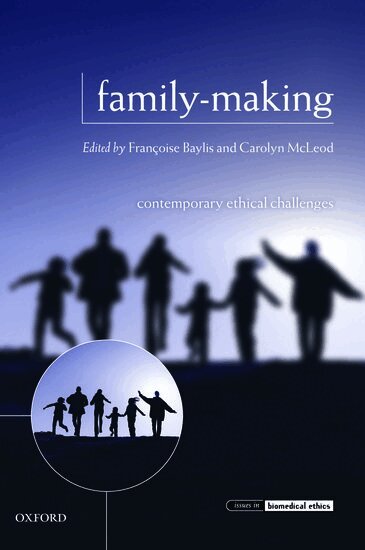
This volume explores the ethics of making or expanding families through adoption or technologically assisted reproduction. For many people, these methods are separate and distinct: they can choose either adoption or assisted reproduction. But for others, these options blend together. For example, in some jurisdictions, the path of assisted reproduction for same-sex couples is complicated by the need for the partner who is not genetically related to the resulting child to adopt this child if she wants to become the child's legal parent. The essays in this volume critically examine moral choices to pursue adoption, assisted reproduction, or both, and highlight the social norms that can distort decision-making. Among these norms are those that favour people having biologically related children ('bionormativity') or that privilege a traditional understanding of family as a heterosexual unit with one or more children where both parents are the genetic, biological, legal, and social parents of these children. As a whole, the book looks at how adoption and assisted reproduction are morally distinct from one another, but also emphasizes how the two are morally similar. Choosing one, the other, or both of these approaches to family-making can be complex in some respects, but ought to be simple in others, provided that one's main goal is to become a parent.
1 430 kr
Skickas inom 7-10 vardagar
This volume explores the ethics of making or expanding families through adoption or technologically assisted reproduction. For many people, these methods are separate and distinct: they can choose either adoption or assisted reproduction. But for others, these options blend together. For example, in some jurisdictions, the path of assisted reproduction for same-sex couples is complicated by the need for the partner who is not genetically related to the resulting child to adopt this child if she wants to become the child's legal parent. The essays in this volume critically examine moral choices to pursue adoption, assisted reproduction, or both, and highlight the social norms that can distort decision-making. Among these norms are those that favour people having biologically related children ('bionormativity') or that privilege a traditional understanding of family as a heterosexual unit with one or more children where both parents are the genetic, biological, legal, and social parents of these children. As a whole, the book looks at how adoption and assisted reproduction are morally distinct from one another, but also emphasizes how the two are morally similar. Choosing one, the other, or both of these approaches to family-making can be complex in some respects, but ought to be simple in others, provided that one's main goal is to become a parent.
232 kr
Skickas inom 10-15 vardagar
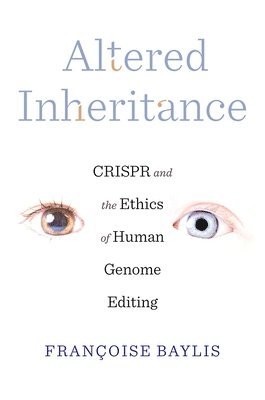
A leading bioethicist offers critical insights into the scientific, ethical, and political implications of human genome editing.Designer babies, once found only in science fiction, have become a reality. We are entering a new era of human evolution with the advent of a technology called CRISPR, which allows scientists to modify our genes. Although CRISPR shows great promise for therapeutic use, it raises thorny ethical, legal, political, and societal concerns because it can be used to make permanent changes to future generations. What if changes intended for the good turn out to have unforeseen negative effects? What if the divide between the haves and have-nots widens as a result? Who decides whether we genetically modify human beings and, if so, how?Françoise Baylis insists that we must all have a role in determining our future as a species. The scientists who develop and use genome-editing tools should not be the only ones making decisions about future uses of the technology. Such decisions must be the fruit of a broad societal consensus. Baylis argues that it is in our collective interest to assess and steer the development and implementation of biomedical technologies. Members of the public with different interests and diverse perspectives must be among the decision makers; only in this way can we ensure that societal concerns are taken into account and that responsible decisions are made. We must be engaged and informed, think critically, and raise our voices as we create our future together.Sharp, rousing, timely, and thought-provoking, Altered Inheritance is essential reading. The future of humanity is in our hands.
1 092 kr
Skickas inom 10-15 vardagar
In The Health Care Ethics Consultant, a panel of 15 health care ethicists and scholars in medicine, philosophy, theology, and law hammer out a standard of care governing the now decisively emergent practice of ethics consultation in the health care community. They debate such issues as: Who should be considered health care ethics consultants? To whom should they give advice? What should be their responsibilities and training? And should there be some kind of accreditation or certification program? The authoritative contributors here develop, as an alternative to certification, a profile of the professional health care ethics consultant and describe what they believe that person's requisite knowledge, skills, and character traits ought to be. Also included is a thorough analysis of legal liability by a respected law firm, a critical overview of the education and training needed for the position, and a discussion of minimal working conditions.The Health Care Ethics Consultant offers important insights into, and ideas about, the role and training of the new generation of advisors - health care ethics consultants who are today everywhere engaged in helping the medical establishment grapple with the increasingly complex ethical issues raised by advancing medical technology.
1 744 kr
Skickas inom 10-15 vardagar
This book discusses ‘how’ to respectfully and responsibly include pregnant women in clinical research. In sharp contrast, the existing literature predominantly focuses on the reasons ‘why’ the inclusion of pregnant women in clinical research is necessary – viz., to develop effective treatments for women during pregnancy, to promote fetal safety, to reduce harm to women and fetuses from suboptimal care, and to allow access to the benefits of research participation. This book supports the shift to a new default position, whereby pregnant women are included in clinical research unless researchers argue convincingly for their exclusion. This shift raises many as yet unexplored ethical and policy questions about existing barriers to the equitable inclusion of pregnant women in research.This book is original in three key ways. First, it presents an unparalleled depth of analysis of the ethics of research with pregnant women, bringing together many of the key authors inthis field as well as experts in research ethics and in vulnerability who have not previously applied their work to pregnant women. Second, it includes innovative theoretical work in ethics and disease specific case studies that highlight the current complexity and future challenges of research involving pregnant women. Third, the book brings together authors who argue both for and against including more pregnant women in formal clinical trials.
1 693 kr
Skickas inom 10-15 vardagar
This book discusses ‘how’ to respectfully and responsibly include pregnant women in clinical research. In sharp contrast, the existing literature predominantly focuses on the reasons ‘why’ the inclusion of pregnant women in clinical research is necessary – viz., to develop effective treatments for women during pregnancy, to promote fetal safety, to reduce harm to women and fetuses from suboptimal care, and to allow access to the benefits of research participation. This book supports the shift to a new default position, whereby pregnant women are included in clinical research unless researchers argue convincingly for their exclusion. This shift raises many as yet unexplored ethical and policy questions about existing barriers to the equitable inclusion of pregnant women in research.This book is original in three key ways. First, it presents an unparalleled depth of analysis of the ethics of research with pregnant women, bringing together many of the key authors inthis field as well as experts in research ethics and in vulnerability who have not previously applied their work to pregnant women. Second, it includes innovative theoretical work in ethics and disease specific case studies that highlight the current complexity and future challenges of research involving pregnant women. Third, the book brings together authors who argue both for and against including more pregnant women in formal clinical trials.