Frank H. Clarke – författare
Visar alla böcker från författaren . Handla med fri frakt och snabb leverans.
3 produkter
3 produkter
Häftad, Engelska, 1989
665 kr
Skickas inom 5-8 vardagar
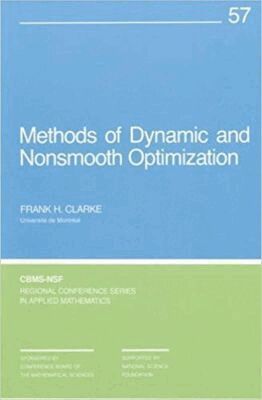
Presents the elements of a unified approach to optimization based on ""nonsmooth analysis,"" a term introduced in the 1970s by the author, who is a pioneer in the field. Based on a series of lectures given at a conference at Emory University in 1986, this volume presents its subjects in a self contained and accessible manner. The topics treated here have been in an active state of development, and this work therefore incorporates more recent results than those presented in 1986.Focuses mainly on deterministic optimal control, the calculus of variations, and mathematical programming. In addition, it features a tutorial in nonsmooth analysis and geometry and demonstrates that the method of value function analysis via proximal normals is a powerful tool in the study of necessary conditions, sufficient conditions, controllability, and sensitivity analysis. The distinction between inductive and deductive methods, the use of Hamiltonians, the verification technique, and penalization are also emphasized.
Häftad, Engelska, 1990
925 kr
Skickas inom 5-8 vardagar
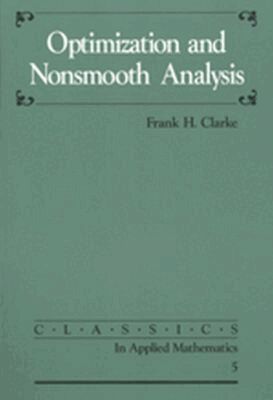
Mathematical Reviews said of this book that it was ""destined to become a classical reference"". It has appeared in Russian translation and has been praised both for its lively exposition and its fundamental contributions.The author first develops a general theory of nonsmooth analysis and geometry which, together with a set of associated techniques, has had a profound effect on several branches of analysis and optimization. Clarke then applies these methods to obtain a powerful, unified approach to the analysis of problems in optimal control and mathematical programming. Examples are drawn from economics, engineering, mathematical physics, and various branches of analysis in this reprint volume.
E-bok
PDF, Engelska, 2013783 kr
Läs direkt efter köp
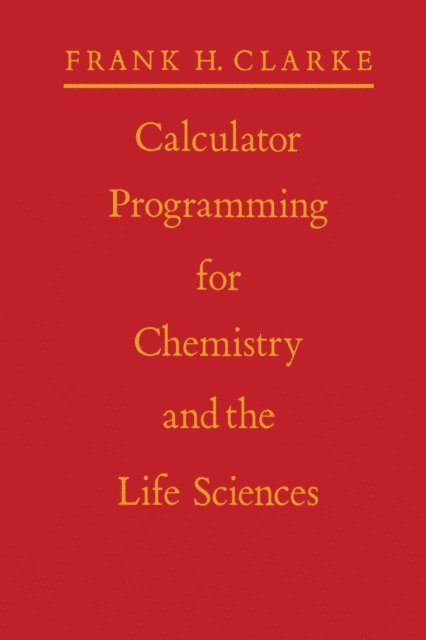
Calculator Programming for Chemistry and the Life Sciences illustrates the power of the programmable calculator as a tool that provides new dimensions to scientific research. This book is divided into four chapters. Each chapter provides calculation, examples, instructions, design, and programs. This text includes the application of calculator programming in the determination of molecular formulas, coordinate transformations, potentiometric titrations, and correlation analysis. This book is of great value to scientists and students with no experience in the use of computers.