Frank Krauss – författare
Visar alla böcker från författaren Frank Krauss. Handla med fri frakt och snabb leverans.
5 produkter
5 produkter
E-bok
PDF, Engelska, 2018840 kr
Läs direkt efter köp
This is an open access title. It is available to read and download as a free PDF version on Oxford Academic and is made available under a Creative Commons Attribution 4.0 licence.The Black Book of Quantum Chromodynamics is an in-depth introduction to the particle physics of current and future experiments at particle accelerators. The book offers the reader an overview of practically all aspects of the strong interaction necessary to understand and appreciate modern particle phenomenology at the energy frontier. It assumes a working knowledge of quantum field theory at the level of introductory textbooks used for advanced undergraduate or in standardpostgraduate lectures. The book expands this knowledge with an intuitive understanding of relevant physical concepts, an introduction to modern techniques, and their application to the phenomenology of the strong interaction at the highest energies. Aimed at graduate students and researchers, it also serves as acomprehensive reference for LHC experimenters and theorists.This book offers an exhaustive presentation of the technologies developed and used by practitioners in the field of fixed-order perturbation theory and an overview of results relevant for the ongoing research programme at the LHC. It includes an in-depth description of various analytic resummation techniques, which form the basis for our understanding of the QCD radiation pattern and how strong production processes manifest themselves in data, and a concise discussion of numerical resummationthrough parton showers, which form the basis of event generators for the simulation of LHC physics, and their matching and merging with fixed-order matrix elements. It also gives a detailed presentation of the physics behind the parton distribution functions, which are a necessary ingredient forevery calculation relevant for physics at hadron colliders such as the LHC, and an introduction to non-perturbative aspects of the strong interaction, including inclusive observables such as total and elastic cross sections, and non-trivial effects such as multiple parton interactions and hadronization. The book concludes with a useful overview contextualising data from previous experiments such as the Tevatron and the Run I of the LHC which have shaped our understanding of QCD at hadroncolliders.
Häftad, Engelska, 2022
680 kr
Skickas
The Black Book of Quantum Chromodynamics is an in-depth introduction to the particle physics of current and future experiments at particle accelerators. The book offers the reader an overview of practically all aspects of the strong interaction necessary to understand and appreciate modern particle phenomenology at the energy frontier. It assumes a working knowledge of quantum field theory at the level of introductory textbooks used for advanced undergraduate or in standard postgraduate lectures. The book expands this knowledge with an intuitive understanding of relevant physical concepts, an introduction to modern techniques, and their application to the phenomenology of the strong interaction at the highest energies. Aimed at graduate students and researchers, it also serves as a comprehensive reference for LHC experimenters and theorists.This book offers an exhaustive presentation of the technologies developed and used by practitioners in the field of fixed-order perturbation theory and an overview of results relevant for the ongoing research programme at the LHC. It includes an in-depth description of various analytic resummation techniques (which form the basis for our understanding of the QCD radiation pattern and how strong production processes manifest themselves in data) and a concise discussion of numerical resummation through parton showers. This forms the basis of event generators for the simulation of LHC physics, and their matching and merging with fixed-order matrix elements. It also gives a detailed presentation of the physics behind the parton distribution functions (which are a necessary ingredient for every calculation relevant for physics at hadron colliders such as the LHC) and an introduction to non-perturbative aspects of the strong interaction, including inclusive observables such as total and elastic cross sections, and non-trivial effects such as multiple parton interactions and hadronization. The book concludes with a useful overview contextualising data from previous experiments such as the Tevatron and the Run I of the LHC which have shaped our understanding of QCD at hadron colliders.
Inbunden, Engelska, 2017
1 089 kr
Skickas inom 7-10 vardagar
This is an open access title. It is available to read and download as a free PDF version on Oxford Academic and is made available under a Creative Commons Attribution 4.0 licence.The Black Book of Quantum Chromodynamics is an in-depth introduction to the particle physics of current and future experiments at particle accelerators. The book offers the reader an overview of practically all aspects of the strong interaction necessary to understand and appreciate modern particle phenomenology at the energy frontier. It assumes a working knowledge of quantum field theory at the level of introductory textbooks used for advanced undergraduate or in standard postgraduate lectures. The book expands this knowledge with an intuitive understanding of relevant physical concepts, an introduction to modern techniques, and their application to the phenomenology of the strong interaction at the highest energies. Aimed at graduate students and researchers, it also serves as a comprehensive reference for LHC experimenters and theorists.This book offers an exhaustive presentation of the technologies developed and used by practitioners in the field of fixed-order perturbation theory and an overview of results relevant for the ongoing research programme at the LHC. It includes an in-depth description of various analytic resummation techniques, which form the basis for our understanding of the QCD radiation pattern and how strong production processes manifest themselves in data, and a concise discussion of numerical resummation through parton showers, which form the basis of event generators for the simulation of LHC physics, and their matching and merging with fixed-order matrix elements. It also gives a detailed presentation of the physics behind the parton distribution functions, which are a necessary ingredient for every calculation relevant for physics at hadron colliders such as the LHC, and an introduction to non-perturbative aspects of the strong interaction, including inclusive observables such as total and elastic cross sections, and non-trivial effects such as multiple parton interactions and hadronization. The book concludes with a useful overview contextualising data from previous experiments such as the Tevatron and the Run I of the LHC which have shaped our understanding of QCD at hadron colliders.
Inbunden, Tyska, 2022
998 kr
Skickas inom 3-6 vardagar
E-bok
PDF, Tyska, 2022895 kr
Läs direkt efter köp
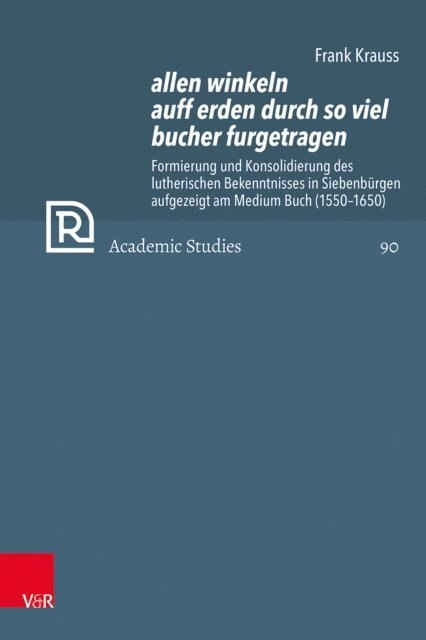
Stellt man sich die Frage danach, wie sich das Luthertum unter den Siebenbürger Sachsen gefestigt hat, kommt man um das Massenmedium der Frühen Neuzeit nicht herum. Druckerzeugnisse prägten die Reformation und in der Folgezeit die konfessionelle Vereinheitlichung der Kirche der Siebenbürger Sachsen maßgeblich. Konfessionelle "Uneindeutigkeiten" wurden jedoch im 16. Jahrhundert oftmals zum Prinzip der Kirchenleitung. Zugleich beriefen sie sich oftmals auf die Autoren, die sie lasen. Die Druckwerke der Siebenbürger Sachsen aus dem 16. und 17. Jahrhundert folgten zwei Linien: Das gebildete Latein diente der eigenen Elite und den anderen Theologen in Siebenbürgen als Vermittlungssprache. Deutsche Werke waren hingegen theologisch einheitlicher an einer lutherischen Theologie ausgerichtet und brachten diese unter die übrige Bevölkerung. Diese Linien verfolgt Frank Krauss in den untersuchten Erbschaftsprotokollen der siebenbürgisch-sächsischen Städte.