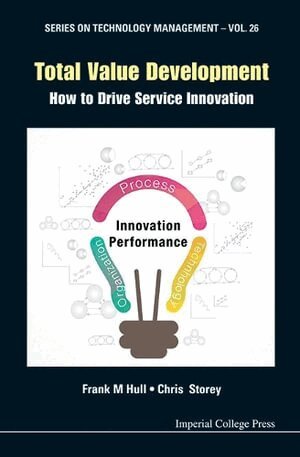
Total Value Development provides a framework to help businesses innovate and derive greater value from the services they offer. The secret is to devise an innovative model built on total value creation, identified as the total value development (TVD) model.The TVD model has broad applicability for any large organization. Here, case studies are presented showing the effectiveness of the TVD model in its practical application within companies. Statistical evidence is used to recommend improvements to performance outcomes, such as time compression, cost reduction, quality and innovation. Studies of over 100 service enterprises in the United States and the United Kingdom provide compelling evidence for benefits from business model innovation. Additional material in the form of guidance forms give readers the tools needed for the implementation and recording of successful in-project value development.Providing both a practical framework and real-life examples of adding value to current business practices, this book is essential reading for executives, managers and researchers in the field of business and innovation.
In the most advanced service economies, services create up to three-quarters of the wealth and 85% of employment, and yet we know relatively little about managing innovation in this sector. The critical role of services, in the broadest sense, has long been recognized, but is still not well understood. Most research and management prescriptions have been based on the experience of manufacturing and high technology sectors. There is a clear need to distinguish which, if any, of what we know about managing innovation in manufacturing is applicable to services, what must be adapted, and what is distinct and different. Such is the goal of this book.This unique collection brings together the latest academic research and management practice on innovation in services, and identifies a range of successful organizational responses to current technological opportunities and market imperatives. The contributors include leading researchers, consultants and practitioners in the field, who provide rigorous yet practical insights into managing and organizing innovation in services. Two themes help to integrate the contributions in this book:• That generic good practices exist in the management and organization of innovation in services, which the authors seek to identify, but that these must be adapted to different contexts, specifically the scale and complexity of the tasks, the degree of customization of the offerings, and the uncertainty of the environment.• That innovation in services is much more than the application of information technology (IT). In fact, the disappointing returns to IT investments in services have resulted in a widespread debate about the causes and potential solutions — the so-called “productivity paradox” in services. Instead here the authors adopt a broader notion of innovation, including technological, organizational and market change. The key is to match the configuration of organization and technology to the specific market environment.Sample Chapter(s)