Frank Merrett – författare
1 610 kr
Skickas inom 10-15 vardagar
474 kr
Skickas inom 10-15 vardagar
1 620 kr
Skickas inom 10-15 vardagar
544 kr
Skickas inom 10-15 vardagar
1 889 kr
Skickas inom 10-15 vardagar
571 kr
Skickas inom 10-15 vardagar
525 kr
Läs direkt efter köp
521 kr
Läs direkt efter köp
662 kr
Läs direkt efter köp
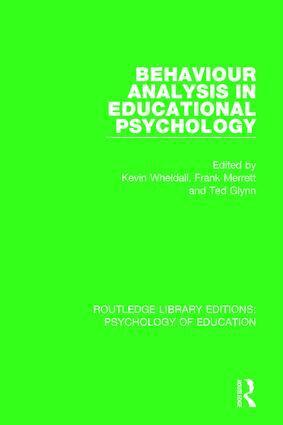
In the early 1980s there had been a marked increase in the application of behavioural methods in schools. However, much of this work was weak conceptually and limited in its remit. Behaviour analysis has more to offer education than ‘smarties’ and time-out.
Originally published in 1986, this collection of twenty papers, many of them experimental, serves to demonstrate the power of behaviour analysis in a wide variety of applications. The editors stress the importance of antecedent control, as well as consequence management strategies, and illustrate their relevance in solving problems in everyday situations at school and in the home. The Editors, whose own work is well represented in this collection, are acknowledged as leading researchers in this field.
662 kr
Läs direkt efter köp
In the early 1980s there had been a marked increase in the application of behavioural methods in schools. However, much of this work was weak conceptually and limited in its remit. Behaviour analysis has more to offer education than ‘smarties’ and time-out.
Originally published in 1986, this collection of twenty papers, many of them experimental, serves to demonstrate the power of behaviour analysis in a wide variety of applications. The editors stress the importance of antecedent control, as well as consequence management strategies, and illustrate their relevance in solving problems in everyday situations at school and in the home. The Editors, whose own work is well represented in this collection, are acknowledged as leading researchers in this field.
631 kr
Läs direkt efter köp
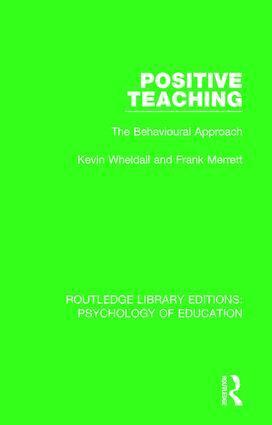
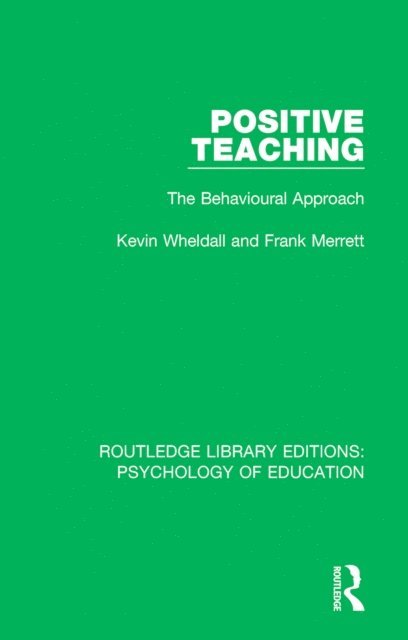
Problems of classroom management and control are a recurring concern for many teachers. Disruptive behaviour and inattention hinder effective learning and impose a constant drain upon the teachers’ emotional resources. Continual nagging at children only increases teacher stress: what is needed is an effective alternative set of strategies.
Originally published in 1984, Positive Teaching seeks to meets this need by presenting the behavioural approach to teaching in a clear, direct and lucid way. By adopting the behavioural approach, problem behaviour can be minimised, or rapidly nipped in the bud when it does arise. While punishment may be used in an attempt to stop almost any kind of behaviour, only the appropriate use of positive methods applied contingently, immediately and consistently can teach new, more adaptive behaviour. This is a crucial issue in real teaching and is rarely encountered or even discussed in most teacher education programmes. It is the central focus of Positive Teaching.
This book is for all teachers, from the beginning student to experienced head teachers; for those teaching in a first school, and for those teaching sixth-formers; for those experiencing difficulties and for those whose authority is already well established. The behavioural approach offers practical support to those who are struggling and a rationale for the effective, positive strategies of the successful. We can all improve our teaching.
631 kr
Läs direkt efter köp
Problems of classroom management and control are a recurring concern for many teachers. Disruptive behaviour and inattention hinder effective learning and impose a constant drain upon the teachers’ emotional resources. Continual nagging at children only increases teacher stress: what is needed is an effective alternative set of strategies.
Originally published in 1984, Positive Teaching seeks to meets this need by presenting the behavioural approach to teaching in a clear, direct and lucid way. By adopting the behavioural approach, problem behaviour can be minimised, or rapidly nipped in the bud when it does arise. While punishment may be used in an attempt to stop almost any kind of behaviour, only the appropriate use of positive methods applied contingently, immediately and consistently can teach new, more adaptive behaviour. This is a crucial issue in real teaching and is rarely encountered or even discussed in most teacher education programmes. It is the central focus of Positive Teaching.
This book is for all teachers, from the beginning student to experienced head teachers; for those teaching in a first school, and for those teaching sixth-formers; for those experiencing difficulties and for those whose authority is already well established. The behavioural approach offers practical support to those who are struggling and a rationale for the effective, positive strategies of the successful. We can all improve our teaching.