Frank Schulze-Engler – författare
Visar alla böcker från författaren Frank Schulze-Engler. Handla med fri frakt och snabb leverans.
4 produkter
4 produkter
Inbunden, Engelska, 2024
2 085 kr
Skickas inom 3-6 vardagar
This book explores core issues in the emerging field of World Anglophone Studies. It shows that traditional frameworks based on the colonial and imperial legacies of English need to be revised and extended to understand the complex adaptations, iterations, and incarnations of English in the contemporary world.The chapters in this volume make three significant interventions in the field:First, they showcase the emergence of Anglophone literatures and cultures in parts of the world not traditionally considered Anglophone – Cuba, the Arab world, the Balkan region, Vietnam, Algeria, and Belize, among othersSecond, they feature new zones of contact and creolization between Anglophone literatures, cultures, and languages such as Swahili, Santhali, Ojibway, and Hindi, as well as Anglophone representations of colonial encounters and contemporary experiences in non-Anglophone settings such as Cuba, Angola, and AlgeriaAnd finally, the volume turns to Anglophone literary and cultural productions on new platforms such as social media and Netflix and highlights the role of English in emergent sites of resistance involving women, Indigenous populations, queer and other non-heteronormative sexualities, as well as post-conflict societiesMapping linguistic transgressions and the transmigration of cultural tropes between Englishes, vernaculars, and a wide variety of other languages with a rich set of case studies, this volume will be essential reading for courses such as world literatures in English, postcolonial studies, anglophone studies, literature and culture, Indian Ocean worlds, Global Englishes, and Global South studies.
Häftad, Engelska, 2024
628 kr
Skickas inom 10-15 vardagar
This book explores core issues in the emerging field of World Anglophone Studies. It shows that traditional frameworks based on the colonial and imperial legacies of English need to be revised and extended to understand the complex adaptations, iterations, and incarnations of English in the contemporary world.The chapters in this volume make three significant interventions in the field:First, they showcase the emergence of Anglophone literatures and cultures in parts of the world not traditionally considered Anglophone – Cuba, the Arab world, the Balkan region, Vietnam, Algeria, and Belize, among othersSecond, they feature new zones of contact and creolization between Anglophone literatures, cultures, and languages such as Swahili, Santhali, Ojibway, and Hindi, as well as Anglophone representations of colonial encounters and contemporary experiences in non-Anglophone settings such as Cuba, Angola, and AlgeriaAnd finally, the volume turns to Anglophone literary and cultural productions on new platforms such as social media and Netflix and highlights the role of English in emergent sites of resistance involving women, Indigenous populations, queer and other non-heteronormative sexualities, as well as post-conflict societiesMapping linguistic transgressions and the transmigration of cultural tropes between Englishes, vernaculars, and a wide variety of other languages with a rich set of case studies, this volume will be essential reading for courses such as world literatures in English, postcolonial studies, anglophone studies, literature and culture, Indian Ocean worlds, Global Englishes, and Global South studies.
Del 10 - Studies in World Literature
Entanglements: Envisioning World Literature from the Global South
Häftad, Engelska, 2022
378 kr
Skickas inom 3-6 vardagar
E-bok
PDF, Engelska, 2014393 kr
Läs direkt efter köp
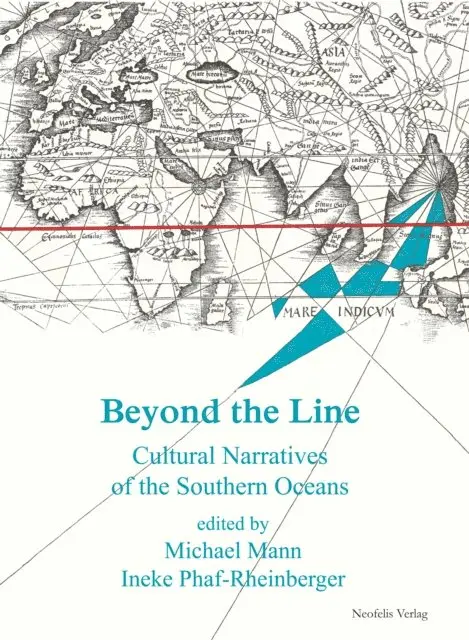
The title of Beyond the Line refers to the imaginary "Line" drawn between North and South, a division established by the Peace Treaty of Cateau-Cambrésis in 1559. This is an early modern time and Eurocentric construction, according to which the southern oceanic world has long been taken as symbol of expansionist philosophies and practices.An obvious motivation for changing this "Line" division is the growing influence of the "Global South" in the contemporary economic and political setting. However, another motivation for changing opinions in regard to the "Line" is equally important. We observe an emergent consciousness of the pivotal role of the oceanic world for human life. This requires the reformulation of former views and raises numerous questions. A diversity of connections comes to the mind, which demands the composition of a catalogue of case studies with an oceanic horizon.Through this operation, different problems are being linked together. Which problems encounter historians with their research on fishes in the archives? How to trace records about pirates of non-European descent in the Indian Ocean? Which role play the Oceans as mediators for labor migrations, not only of the Black Atlantic but also of people moving from Asia to Africa and vice versa? What do we know about workers on the oceans and their routes? When considering oceans as "contact zones," with which criteria can their influence in different literary texts be analyzed? Is it possible to study nationalisms taking into account these transoceanic relationships? And how do artists address these questions in their use of the media?Against the background of this catalogue of oceanic questions, "old" stories are told anew. Sometimes, their cultural stereotypes are recycled to criticize political and social situations. Or, in other cases, they are adopted for elaborating alternative options. In this sense, the contributions concentrate on countries like India, Kenya, Angola, or Brazil and cover different academic fields. A variety of objects and situations are explored, which have been and still are determinant for the construction of cultural narratives in view of the modified relationship with the geographically southern oceanic regions.