Frank Stähler – författare
Visar alla böcker från författaren Frank Stähler. Handla med fri frakt och snabb leverans.
3 produkter
3 produkter
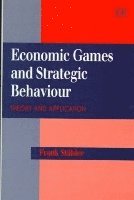
Inbunden, Engelska, 1998
1 948 kr
Skickas inom 5-8 vardagar
Economic Games and Strategic Behaviour is a seminal volume which introduces a model providing solutions to economic games subject to repeated play. It develops a link between strategic bargaining and the theory of self-enforcing contracts to give insights into the long-term relationships between two parties, such as firms or governments, who meet in a negotiating situation.The author provides an original approach to strategic bargaining to find a solution to economic games in which cooperation cannot be enforced by a third party. He then applies this approach to a wide range of real life situations including international environmental agreements, bilateral trade agreements, collusion between firms in industry and bargaining between buyers and sellers in the market place. The author also discusses important policy implications as well as setting an agenda for future research.Economic Games and Strategic Behaviour is an original contribution to the existing literature which will be welcomed for providing accurate outcomes for situations in which conventional theories produce ambiguous results. It will be of great interest to students and scholars of microeconomics, game theory and industrial economics.
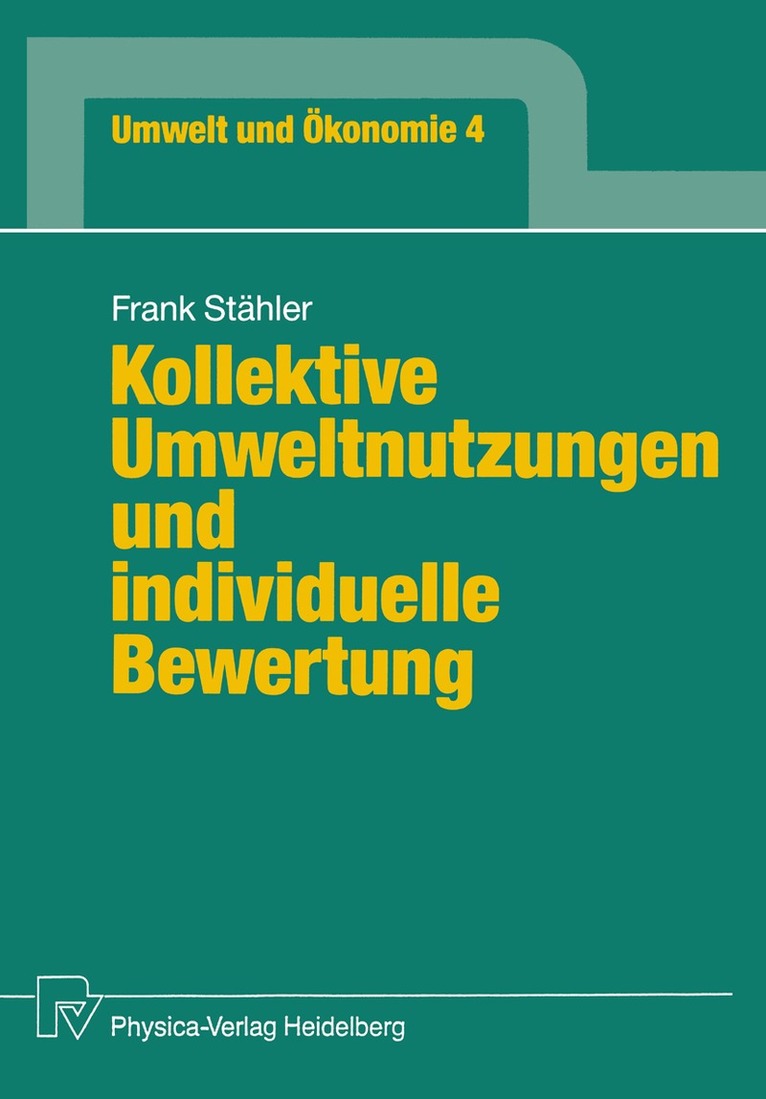
Häftad, Tyska, 1991
581 kr
Skickas inom 10-15 vardagar
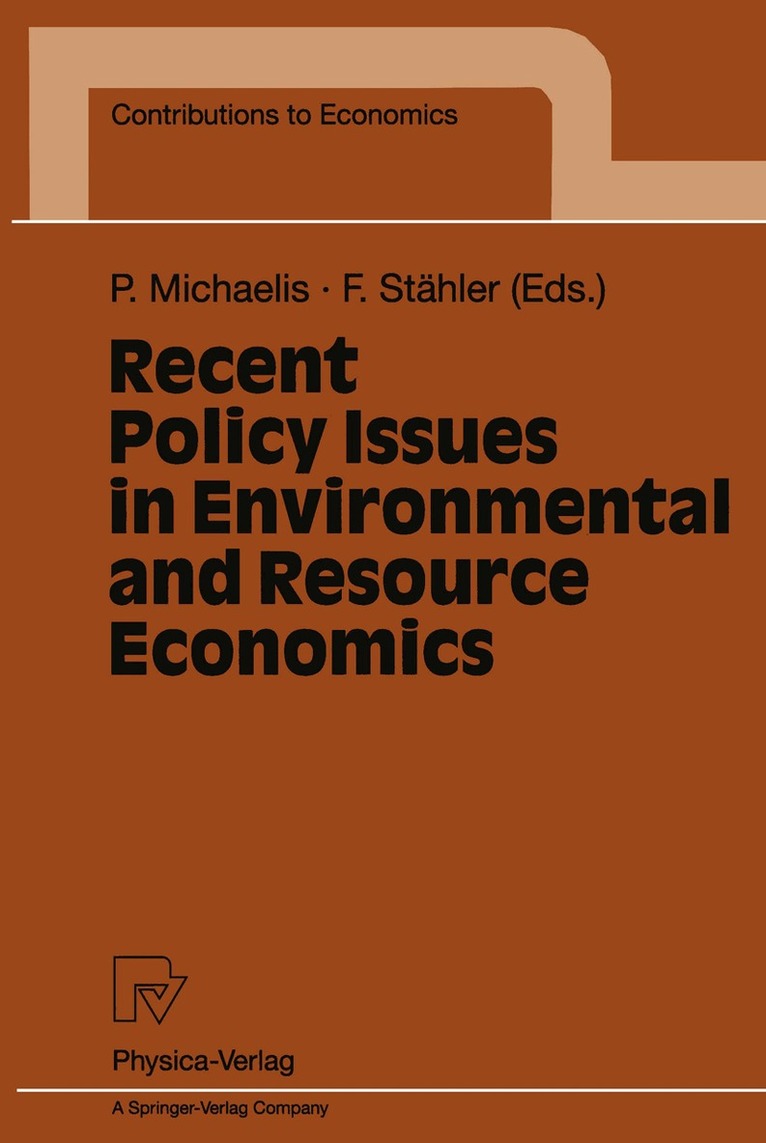
Häftad, Engelska, 1998
1 123 kr
Skickas inom 10-15 vardagar
Peter Michaelis and Frank Stahler This book deals with recent policy issues in environmental and resource economics. To collect articles on recent policy issues is of course always also a question of taste. This volume tries to represent a broad range of papers which covers the double dividend hypothesis, the role of non-profit organizations for environmental policies, trade implications and international environmental agreements. It consists of two parts, a part on domestic policy issues and a part on international policy issues. A separate part on international policy issues would not have been on the agenda when this volume would have been published two decades ago. But international and global environmental problems are different from purely national problems and deserve a special approach. However, also domestic policies face new challenges. One new focus of domestic policies is the discussion on the relationship between environmental benefits and other policy objectives. 'Some Remarks on the Double Dividend Hypothesis' by Christian Scholz deals with this discussion. In opposition to a number of recent papers it is found that the possibility for a double dividend depends largely on the substitutability characteristics of taxed commodities.