Franklin Lambert - Böcker
Visar alla böcker från författaren Franklin Lambert. Handla med fri frakt och snabb leverans.
5 produkter
5 produkter
1 059 kr
Skickas inom 10-15 vardagar
On April 29, 1814 Napoleon landed on the island of Elba, surrounded with a personal army of 1200 men. The allies, Russia, Prussia, England and Austria, hadforcedhimintoexileafteranumberofverycostlydefeats;hewasdeprived ofallhistitles,butcouldkeepthetitleof"EmperorofElba". Historytellsusthat each morning he took long walks in the sun, reviewed his army each midday anddiscussedworldmatterswithnewlyappointedadvisors,followingthesame pattern everyday, to the great surprise of Campbell, the British of?cer who was to keep an eye on him. All this made everyone believe he was settled there for good. Napoleononcesaid:Elbaisbeautiful,butabitsmall. Elbawasde?nitely a source of inspiration; indeed, the early morning, March 6, 1815, Metternich, the chancellor of Austria was woken up by one of his aides with the stunning news that Napoleon had left Elba with his 1200 men and was marching to Paris with little resistance; A few days later he took up his throne again in the Tuileries. In spite of his insatiable hunger for battles and expansion, he is remembered as an important statesman.He was a pioneer in setting up much of the legal, administrative and political machinery in large parts of continental Europe. We gathered here in a lovely and quaint ?shing port, Marciana Marina on theislandofElba,tocelebrateoneofthepioneersofintegrablesystems,Hirota Sensei,andthisattheoccasionofhisseventiethbirthday. Trainedasaphysicist in his home university Kyushu University, Professor Hirota earned his PhD in '61 at Northwestern University with Professor Siegert in the ?eld of "Quantum Statistical mechanics". He wrote a widely appreciated Doctoral dissertation on "FunctionalIntegralrepresentationofthegrandpartitionfunction".

1 059 kr
Skickas inom 10-15 vardagar
On April 29, 1814 Napoleon landed on the island of Elba, surrounded with a personal army of 1200 men. The allies, Russia, Prussia, England and Austria, hadforcedhimintoexileafteranumberofverycostlydefeats;hewasdeprived ofallhistitles,butcouldkeepthetitleof"EmperorofElba". Historytellsusthat each morning he took long walks in the sun, reviewed his army each midday anddiscussedworldmatterswithnewlyappointedadvisors,followingthesame pattern everyday, to the great surprise of Campbell, the British of?cer who was to keep an eye on him. All this made everyone believe he was settled there for good. Napoleononcesaid:Elbaisbeautiful,butabitsmall. Elbawasde?nitely a source of inspiration; indeed, the early morning, March 6, 1815, Metternich, the chancellor of Austria was woken up by one of his aides with the stunning news that Napoleon had left Elba with his 1200 men and was marching to Paris with little resistance; A few days later he took up his throne again in the Tuileries. In spite of his insatiable hunger for battles and expansion, he is remembered as an important statesman.He was a pioneer in setting up much of the legal, administrative and political machinery in large parts of continental Europe. We gathered here in a lovely and quaint ?shing port, Marciana Marina on theislandofElba,tocelebrateoneofthepioneersofintegrablesystems,Hirota Sensei,andthisattheoccasionofhisseventiethbirthday. Trainedasaphysicist in his home university Kyushu University, Professor Hirota earned his PhD in '61 at Northwestern University with Professor Siegert in the ?eld of "Quantum Statistical mechanics". He wrote a widely appreciated Doctoral dissertation on "FunctionalIntegralrepresentationofthegrandpartitionfunction".

706 kr
Skickas inom 5-8 vardagar
1 238 kr
Skickas inom 3-6 vardagar
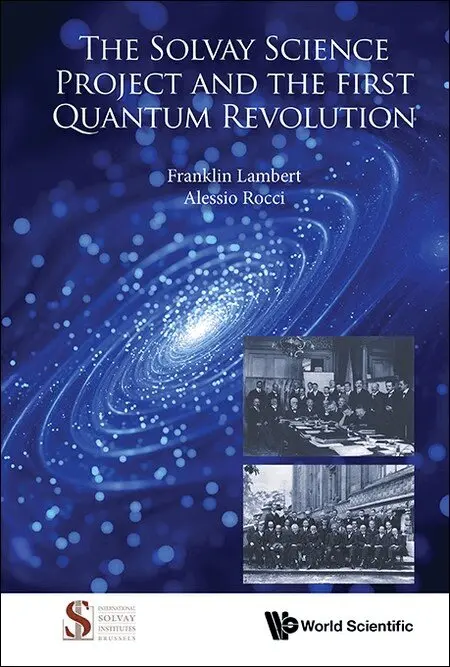
This book presents a historical reconstruction of the first quantum revolution, from the first Solvay meeting (1911) to the fifth Physics Council (1927). The reader is guided through a journey to discover how a project envisioned by Ernest Solvay — the Solvay Science Project — contributed to this process. The authors investigate two of its main aspects: the five Physics Councils chaired by H A Lorentz and the subsidy programme of the International Solvay Institute of Physics (ISIP). Special attention is given to a point that escaped the attention of most science historians: how Solvay subsidies, granted by an International Committee, contributed to the validation of Bohr's atomic theory, one of the most significant steps in the quantum revolution. More than ten beneficiaries of Solvay grants were named by Bohr in his Rutherford Memorial Lecture; six were awarded a Nobel Prize.The book contains a detailed analysis of the steps taken by ISIP's Scientific Committee to prepare the Councils that marked the transition from classical to quantum physics. Emphasis is placed on the information provided by X-ray research and by C T R Wilson's cloud chamber, two elements that paved the way to a recognition of the dual nature of light and matter, a fundamental characteristic of the quantum world.
680 kr
Skickas inom 3-6 vardagar
This book presents a historical reconstruction of the first quantum revolution, from the first Solvay meeting (1911) to the fifth Physics Council (1927). The reader is guided through a journey to discover how a project envisioned by Ernest Solvay — the Solvay Science Project — contributed to this process. The authors investigate two of its main aspects: the five Physics Councils chaired by H A Lorentz and the subsidy programme of the International Solvay Institute of Physics (ISIP). Special attention is given to a point that escaped the attention of most science historians: how Solvay subsidies, granted by an International Committee, contributed to the validation of Bohr's atomic theory, one of the most significant steps in the quantum revolution. More than ten beneficiaries of Solvay grants were named by Bohr in his Rutherford Memorial Lecture; six were awarded a Nobel Prize.The book contains a detailed analysis of the steps taken by ISIP's Scientific Committee to prepare the Councils that marked the transition from classical to quantum physics. Emphasis is placed on the information provided by X-ray research and by C T R Wilson's cloud chamber, two elements that paved the way to a recognition of the dual nature of light and matter, a fundamental characteristic of the quantum world.