Frantisek Plasil – författare
Visar alla böcker från författaren Frantisek Plasil. Handla med fri frakt och snabb leverans.
13 produkter
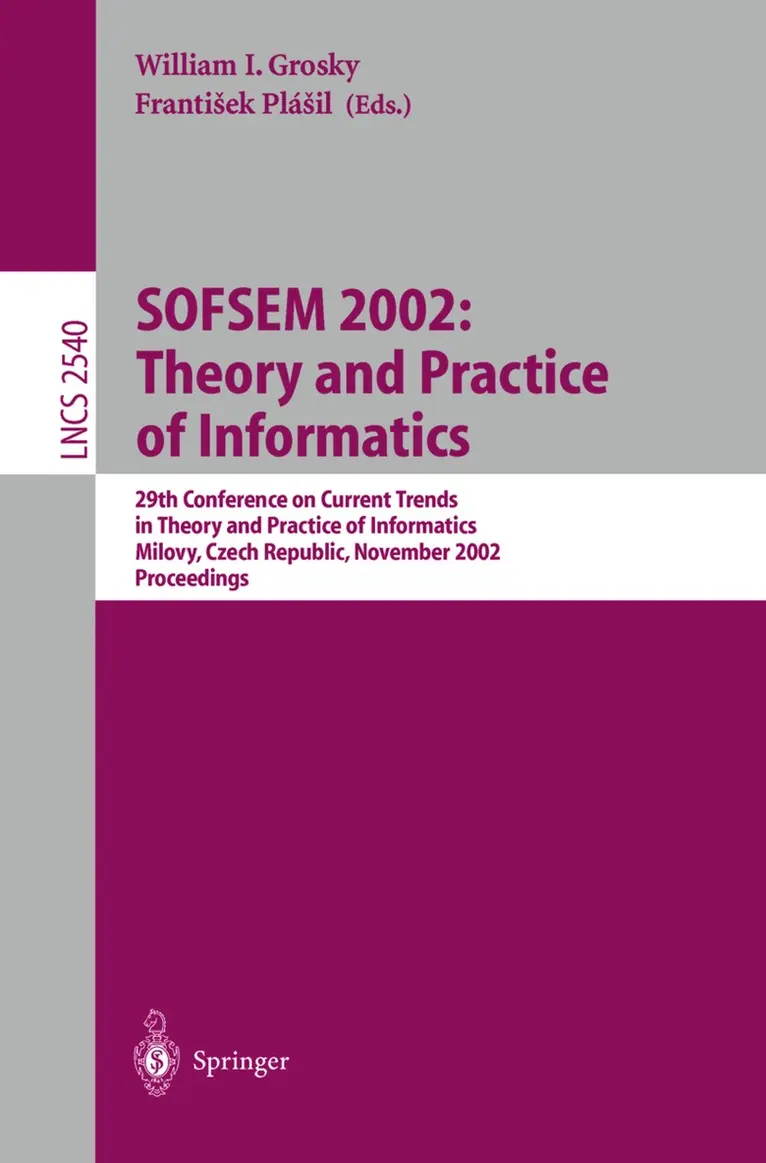
SOFSEM 2002: Theory and Practice of Informatics
29th Conference on Current Trends in Theory and Practice of Informatics, Milovy, Czech Republic, November 22-29, 2002, Proceedings
Av William I. Grosky, Frantisek Plasil
Häftad, 2002
567 kr
Lägg i varukorg
Forthe29thtime,SOFSEM(SOFtwareSEMinar)washeld.Havingtransformed over the years from a local event to a fully international conference, the c- temporary SOFSEM is a mix of a winter school and a conference striving for multidisciplinarity in computer science, accompaniedby workshops dedicated to a …
SOFSEM 2002: Theory and Practice of Informatics
29th Conference on Current Trends in Theory and Practice of Informatics, Milovy, Czech Republic, November 22-29, 2002, Proceedings
Av Frantisek Plasil, William I. Grosky
E-bok, 2003
755 kr
Lägg i varukorg
Forthe29thtime,SOFSEM(SOFtwareSEMinar)washeld.Havingtransformed over the years from a local event to a fully international conference, the c- temporary SOFSEM is a mix of a winter school and a conference striving for multidisciplinarity in computer science, accompaniedby workshops dedicated to a …
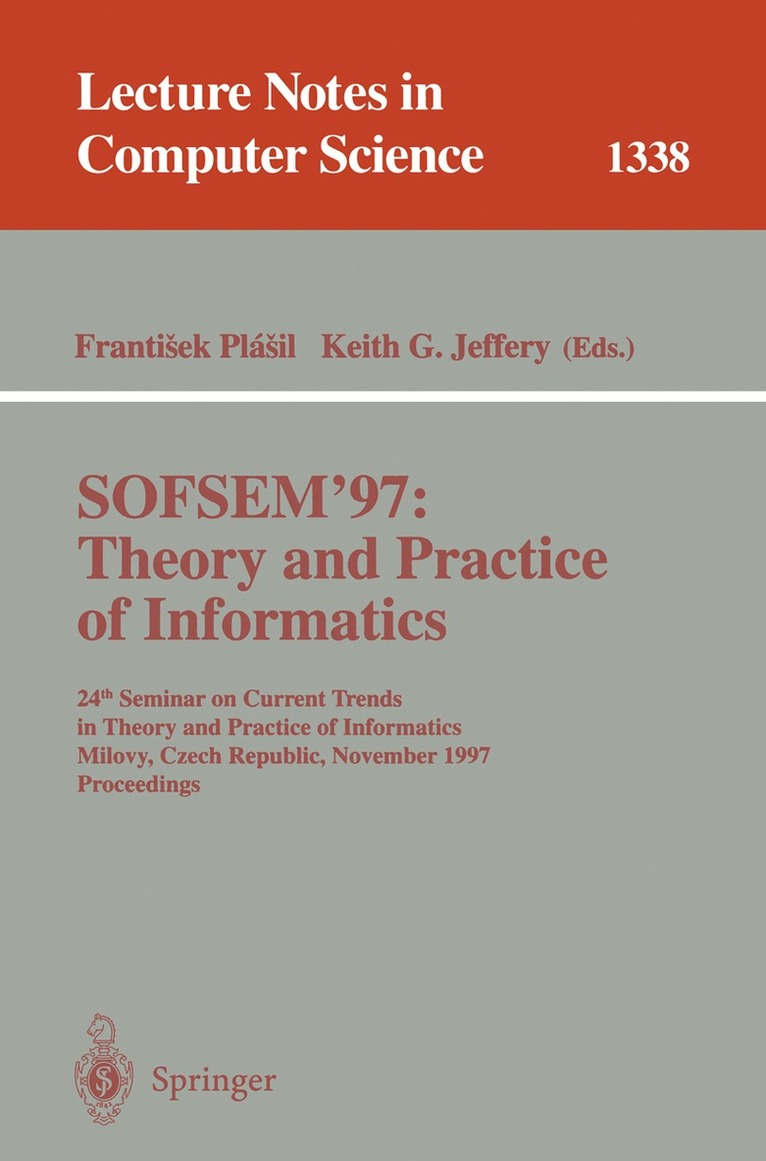
SOFSEM '97: Theory and Practice of Informatics
24th Seminar on Current Trends in Theory and Practice of Informatics, Milovy, Czech Republic, November 22-29, 1997. Proceedings
Av Frantisek Plasil, Keith G. Jeffery
Häftad, 1997
567 kr
Lägg i varukorg
This book constitutes the refereed proceedings of the 24th Seminar on Current Trends in Theory and Practice of Informatics, SOFSEM'97, held in Milovy, Czech Republic, in November 1997. SOFSEM is special in being a mix of a winter school, an international conference, and an advanced workshop meeting …
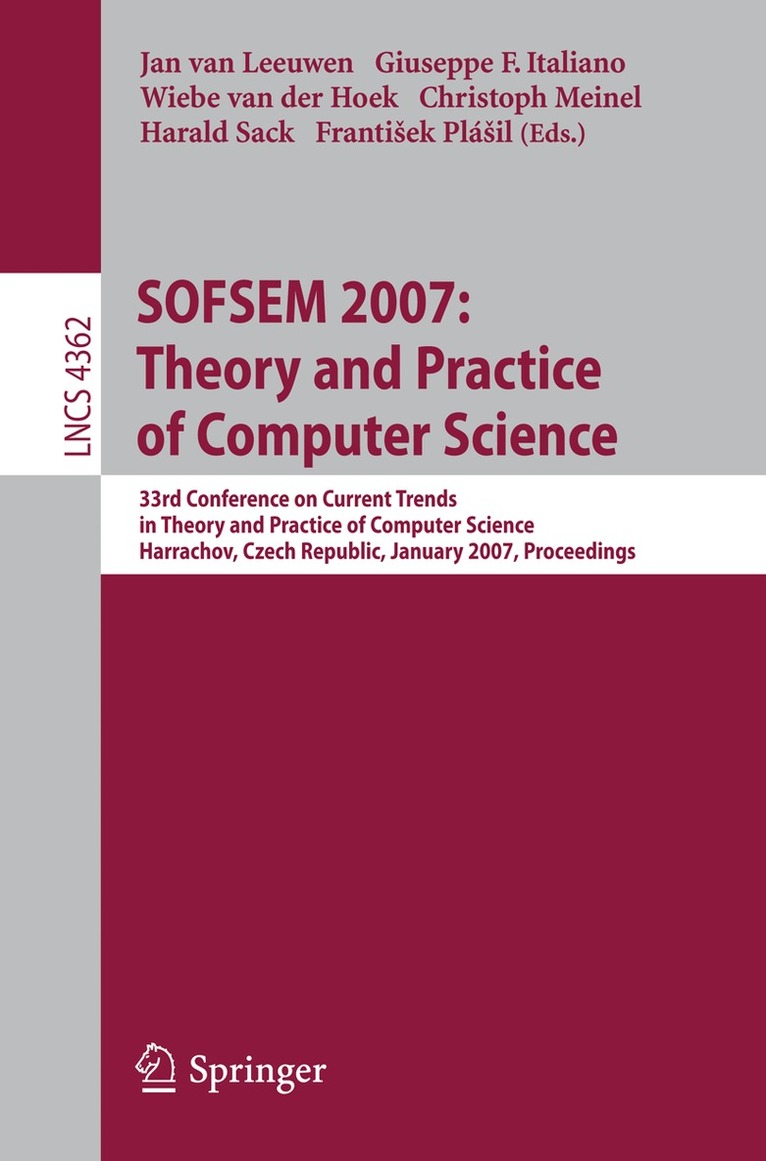
SOFSEM 2007: Theory and Practice of Computer Science
33nd Conference on Current Trends in Theory and Practice of Computer Science, Harrachov, Czech Republic, January 20-26, 2007, Proceedings
Av Jan van Leeuwen, Giuseppe F. Italiano m. fl.
Häftad, 2007
1127 kr
Lägg i varukorg
This book constitutes the refereed proceedings of the 33rd Conference on Current Trends in Theory and Practice of Computer Science, SOFSEM 2007, held in Harrachov, Czech Republic in January 2007. The 69 revised full papers, presented together with 11 invited contributions were carefully reviewed …
SOFSEM 2007: Theory and Practice of Computer Science
33nd Conference on Current Trends in Theory and Practice of Computer Science, Harrachov, Czech Republic, January 20-26, 2007, Proceedings
Av Frantisek Plasil, Harald Sack m. fl.
E-bok, 2007
1502 kr
Lägg i varukorg
Common Component Modeling Example
Comparing Software Component Models
Av Andreas Rausch, Ralf H. Reussner m. fl.
Häftad, 2008
567 kr
Lägg i varukorg
Severalconferenceand workshopseriesarededicated to formalcomponent m- els and their use in veri?cation and quality prediction, such as FMCO, CBSE, FESCA,FACS andQoSA. There are a plethoraof componentmodels published, all with speci?c merits and bene?ts. However, most often these models are not used …
Common Component Modeling Example
Comparing Software Component Models
Av Frantisek Plasil, Raffaela Mirandola m. fl.
E-bok, 2008
734 kr
Lägg i varukorg
Quality of Software Architectures Models and Architectures
4th International Conference on the Quality of Software Architectures, QoSA 2008, Karlsruhe, Germany, October 14-17, 2008, Proceedings
Av Steffen Becker, Frantisek Plasil m. fl.
Häftad, 2008
567 kr
Lägg i varukorg
Models are used in all kinds of engineering disciplines to abstract from the various details of the modelled entity in order to focus on a speci?c aspect. Like a blueprint in civil engineering, a software architecture providesan abstraction from the full software system’s complexity. It allows …
Quality of Software Architectures Models and Architectures
4th International Conference on the Quality of Software Architectures, QoSA 2008, Karlsruhe, Germany, October 14-17, 2008, Proceedings
Av Ralf H. Reussner, Frantisek Plasil m. fl.
E-bok, 2008
739 kr
Lägg i varukorg
Models are used in all kinds of engineering disciplines to abstract from the various details of the modelled entity in order to focus on a speci?c aspect. Like a blueprint in civil engineering, a software architecture providesan abstraction from the full software system’s complexity. It allows …
Component-Based Software Engineering
13th International Symposium, CBSE 2010, Prague, Czech Republic, June 23-25, 2010, Proceedings
Av Lars Grunske, Ralf H. Reussner m. fl.
Häftad, 2010
567 kr
Lägg i varukorg
The 2010 Symposium on Component-Based Software Engineering (CBSE 2010) was the 13th in a series of successful events that have grown into the main forum for industrial and academic experts to discuss component technology. CBSE is concerned with the development of software-intensive systems from - …
Component-Based Software Engineering
13th International Symposium, CBSE 2010, Prague, Czech Republic, June 23-25, 2010, Proceedings
Av Frantisek Plasil, Ralf H. Reussner m. fl.
E-bok, 2010
755 kr
Lägg i varukorg
The 2010 Symposium on Component-Based Software Engineering (CBSE 2010) was the 13th in a series of successful events that have grown into the main forum for industrial and academic experts to discuss component technology. CBSE is concerned with the development of software-intensive systems from - …
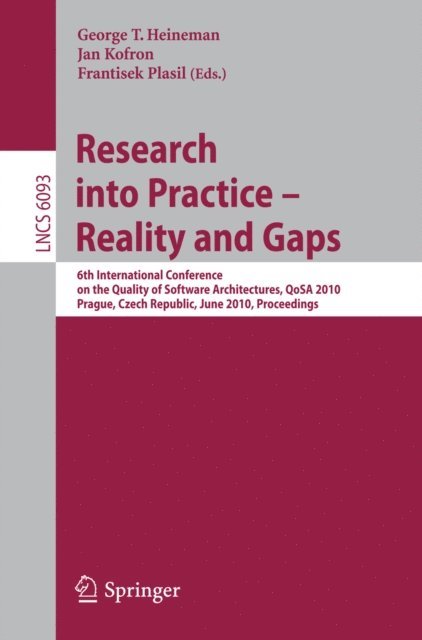
Research into Practice - Reality and Gaps
6th International Conference on the Quality of Software Architectures, QoSA 2010, Prague, Czech Republic, June 23-25, 2010, Proceedings
Av George Heineman, Jan Kofron m. fl.
Häftad, 2010
567 kr
Lägg i varukorg
The goal of QoSA is to addressaspects of softwarearchitecturefocusing broadly on quality characteristics and how these relate to the design of software arc- tectures. Speci?c issues of interest are de?ning quality measures, evaluating and managing architecture quality, linking architecture to …
Research into Practice - Reality and Gaps
6th International Conference on the Quality of Software Architectures, QoSA 2010, Prague, Czech Republic, June 23-25, 2010, Proceedings
Av Frantisek Plasil, Jan Kofron m. fl.
E-bok, 2010
732 kr
Lägg i varukorg