
Franz von Benda-Beckham – författare
Visar alla böcker från författaren Franz von Benda-Beckham. Handla med fri frakt och snabb leverans.
4 produkter
4 produkter
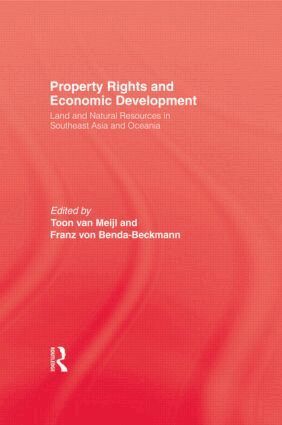
Inbunden, Engelska, 1999
2 203 kr
Skickas inom 10-15 vardagar
This book provides a critical analysis of the widespread assumption that the formalisation and standardisation of property rights through state legislation has a positive impact on economic development. It is based on anthropological case studies of land and natural resource rights in Southeast Asia and Oceania. These suggest that the economic impact of the formalisation of property rights is not necessarily positive, certainly not for all categories of peoples. They also suggest that state reform of property rights do not necessarily eliminate the conditions of legal pluralism, but rather add new legal structures to an already complex constellation of property rights and duties. The point of departure for the empirical analyses of the central hypothesis examined in this book is that the practical significance of complex forms of property rights and related socio-economic practices cannot be usefully examined within formalistic, one-dimensional and normatively oriented legalistic or economic approaches. Instead, an anthropoligical approach to law is advocated in order to analyse the complicated, multi-dimensional relationships between property rights and economic development, and their embeddedness in social practice. Based on this approach, the contributions to this book show how different people and institutions attribute different meanings to the various components of property relationships, and how they use them as resources in their everyday lives and social struggles.
E-bok
PDF, Engelska, 2012849 kr
Läs direkt efter köp
First Published in 1999. This book provides a critical analysis of the widespread assumption that the formalisation and standardisation of property rights through state legislation has a positive impact on economic development. It is based on anthropological case studies of land and natural resource rights in Southeast Asia and Oceania. These suggest that the economic impact of the formalisation of property rights is not necessarily positive, certainly not for all categories of peoples. They also suggest that state reform of property rights do not necessarily eliminate the conditions of legal pluralism, but rather add new legal structures to an already complex constellation of property rights and duties. The point of departure for the empirical analyses of the central hypothesis examined in this book is that the practical significance of complex forms of property rights and related socio-economic practices cannot be usefully examined within formalistic, one-dimensional and normatively oriented legalistic or economic approaches. Instead, an anthropoligical approach to law is advocated in order to analyse the complicated, multi-dimensional relationships between property rights and economic development, and their embeddedness in social practice. Based on this approach, the contributions to this book show how different people and institutions attribute different meanings to the various components of property relationships, and how they use them as resources in their everyday lives and social struggles.
E-bok
Engelska, 2012849 kr
Läs direkt efter köp
First Published in 1999. This book provides a critical analysis of the widespread assumption that the formalisation and standardisation of property rights through state legislation has a positive impact on economic development. It is based on anthropological case studies of land and natural resource rights in Southeast Asia and Oceania. These suggest that the economic impact of the formalisation of property rights is not necessarily positive, certainly not for all categories of peoples. They also suggest that state reform of property rights do not necessarily eliminate the conditions of legal pluralism, but rather add new legal structures to an already complex constellation of property rights and duties. The point of departure for the empirical analyses of the central hypothesis examined in this book is that the practical significance of complex forms of property rights and related socio-economic practices cannot be usefully examined within formalistic, one-dimensional and normatively oriented legalistic or economic approaches. Instead, an anthropoligical approach to law is advocated in order to analyse the complicated, multi-dimensional relationships between property rights and economic development, and their embeddedness in social practice. Based on this approach, the contributions to this book show how different people and institutions attribute different meanings to the various components of property relationships, and how they use them as resources in their everyday lives and social struggles.
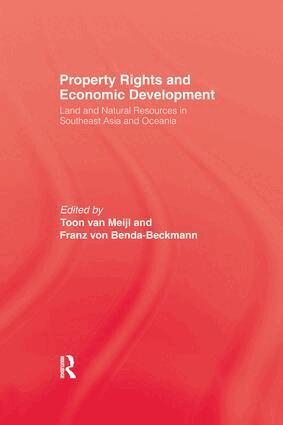
Häftad, Engelska, 2016
716 kr
Skickas inom 10-15 vardagar
First Published in 1999. This book provides a critical analysis of the widespread assumption that the formalisation and standardisation of property rights through state legislation has a positive impact on economic development. It is based on anthropological case studies of land and natural resource rights in Southeast Asia and Oceania. These suggest that the economic impact of the formalisation of property rights is not necessarily positive, certainly not for all categories of peoples. They also suggest that state reform of property rights do not necessarily eliminate the conditions of legal pluralism, but rather add new legal structures to an already complex constellation of property rights and duties. The point of departure for the empirical analyses of the central hypothesis examined in this book is that the practical significance of complex forms of property rights and related socio-economic practices cannot be usefully examined within formalistic, one-dimensional and normatively oriented legalistic or economic approaches. Instead, an anthropoligical approach to law is advocated in order to analyse the complicated, multi-dimensional relationships between property rights and economic development, and their embeddedness in social practice. Based on this approach, the contributions to this book show how different people and institutions attribute different meanings to the various components of property relationships, and how they use them as resources in their everyday lives and social struggles.