Inbunden, Engelska, 2019
1 271 kr
Skickas inom 10-15 vardagar
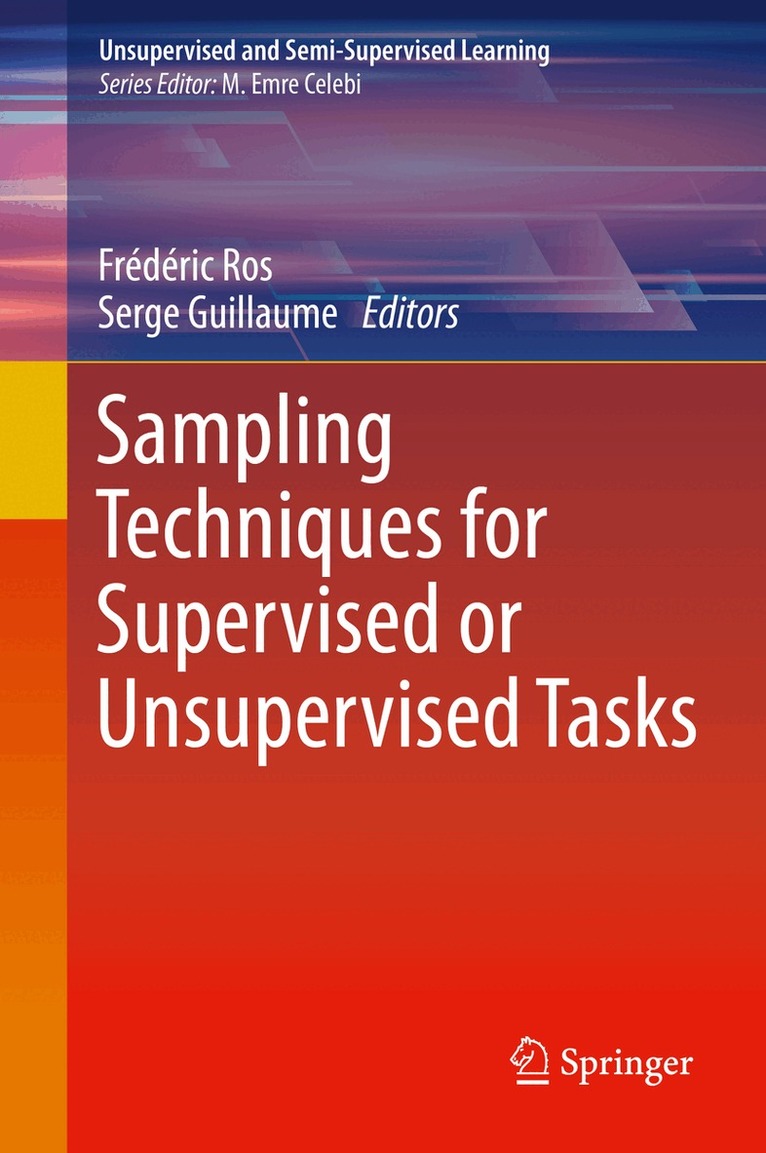
This book describes in detail sampling techniques that can be used for unsupervised and supervised cases, with a focus on sampling techniques for machine learning algorithms. It covers theory and models of sampling methods for managing scalability and the “curse of dimensionality”, their implementations, evaluations, and applications. A large part of the book is dedicated to database comprising standard feature vectors, and a special section is reserved to the handling of more complex objects and dynamic scenarios. The book is ideal for anyone teaching or learning pattern recognition and interesting teaching or learning pattern recognition and is interested in the big data challenge. It provides an accessible introduction to the field and discusses the state of the art concerning sampling techniques for supervised and unsupervised task.Provides a comprehensive description of sampling techniques for unsupervised and supervised tasks;Describe implementationand evaluation of algorithms that simultaneously manage scalable problems and curse of dimensionality;Addresses the role of sampling in dynamic scenarios, sampling when dealing with complex objects, and new challenges arising from big data. "This book represents a timely collection of state-of-the art research of sampling techniques, suitable for anyone who wants to become more familiar with these helpful techniques for tackling the big data challenge."M. Emre Celebi, Ph.D., Professor and Chair, Department of Computer Science, University of Central Arkansas"In science the difficulty is not to have ideas, but it is to make them work"From Carlo Rovelli