
Frederick Corney – författare
Visar alla böcker från författaren Frederick Corney. Handla med fri frakt och snabb leverans.
3 produkter
3 produkter
1 601 kr
Skickas inom 10-15 vardagar
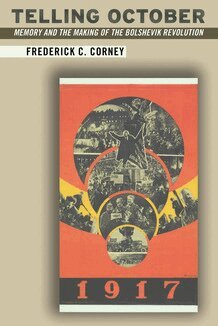
All revolutionary regimes seek to legitimize themselves through foundation narratives that, told and retold, become constituent parts of the social fabric, erasing or pushing aside alternative histories. Frederick C. Corney draws on a wide range of sources—archives, published works, films—to explore the potent foundation narrative of Russia's Great October Socialist Revolution. He shows that even as it fought a bloody civil war with the forces that sought to displace it, the Bolshevik regime set about creating a new historical genealogy of which the October Revolution was the only possible culmination. This new narrative was forged through a complex process that included the sacralization of October through ritualized celebrations, its institutionalization in museums and professional institutes devoted to its study, and ambitious campaigns to persuade the masses that their lives were an inextricable part of this historical process. By the late 1920s, the Bolshevik regime had transformed its representation of what had occurred in 1917 into a new orthodoxy, the October Revolution. Corney investigates efforts to convey the dramatic essence of 1917 as a Bolshevik story through the increasingly elaborate anniversary celebrations of 1918, 1919, and 1920. He also describes how official commissions during the 1920s sought to institutionalize this new foundation narrative as history and memory. In the book's final chapter, the author assesses the state of the October narrative at its tenth anniversary, paying particular attention to the versions presented in the celebratory films by Eisenstein and Pudovkin. A brief epilogue assesses October's fate in the years since the collapse of the Soviet Union.
447 kr
Skickas inom 10-15 vardagar
All revolutionary regimes seek to legitimize themselves through foundation narratives that, told and retold, become constituent parts of the social fabric, erasing or pushing aside alternative histories. Frederick C. Corney draws on a wide range of sources—archives, published works, films—to explore the potent foundation narrative of Russia's Great October Socialist Revolution. He shows that even as it fought a bloody civil war with the forces that sought to displace it, the Bolshevik regime set about creating a new historical genealogy of which the October Revolution was the only possible culmination. This new narrative was forged through a complex process that included the sacralization of October through ritualized celebrations, its institutionalization in museums and professional institutes devoted to its study, and ambitious campaigns to persuade the masses that their lives were an inextricable part of this historical process. By the late 1920s, the Bolshevik regime had transformed its representation of what had occurred in 1917 into a new orthodoxy, the October Revolution. Corney investigates efforts to convey the dramatic essence of 1917 as a Bolshevik story through the increasingly elaborate anniversary celebrations of 1918, 1919, and 1920. He also describes how official commissions during the 1920s sought to institutionalize this new foundation narrative as history and memory. In the book's final chapter, the author assesses the state of the October narrative at its tenth anniversary, paying particular attention to the versions presented in the celebratory films by Eisenstein and Pudovkin. A brief epilogue assesses October's fate in the years since the collapse of the Soviet Union.
Del 114 - Historical Materialism Book Series
Trotsky’s Challenge
The ‘Literary Discussion’ of 1924 and the Fight for the Bolshevik Revolution
Inbunden, Engelska, 2015
5 256 kr
Skickas inom 3-6 vardagar
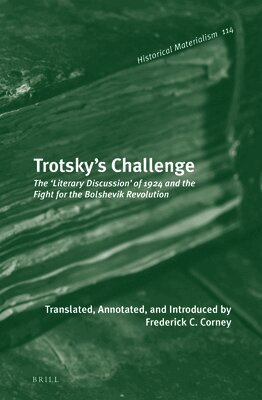
In Trotsky’s Challenge: The ‘Literary Discussion’ of 1924 and the Fight for the Bolshevik Revolution, Frederick C. Corney examines the political polemic surrounding the publication of Trotsky’s The Lessons of October. Trotsky’s analysis ran counter to the efforts of Bolshevik leaders to fashion the narrative of October as a foundation event in which the Bolshevik Party, under the clear-sighted leadership of Lenin, played a major role in bringing about a radical socialist revolution in Russia. Corney has translated into English the major contributions to this polemic, annotated them, and written an extensive contextualising introduction, examining the polemic for its impact not only on the figure of Trotsky, but also on the changing political culture of the 1920s and 1930s.