Frederick R. Eirich – författare
Visar alla böcker från författaren Frederick R. Eirich. Handla med fri frakt och snabb leverans.
4 produkter
4 produkter
E-bok
PDF, Engelska, 2014756 kr
Läs direkt efter köp
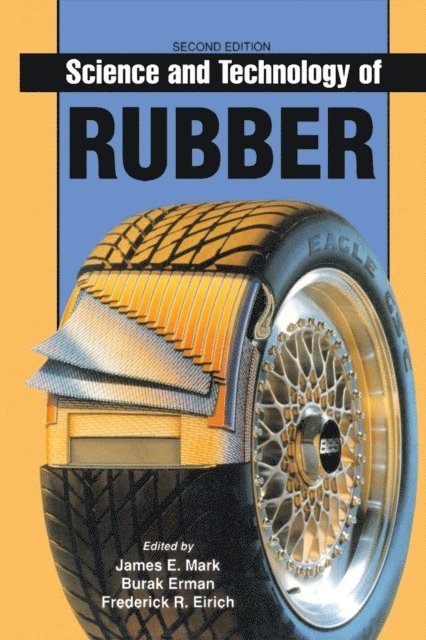
Science and Technology of Rubber, Second Edition provides a general survey of elastomers and an examination of rubberlike elasticity, with an emphasis on a unified treatment ranging from physical theory to final applications. Researchers in polymer science and engineering fields will find coverage of recent advances, unsolved problems and projections, and processing.- Expanded coverage- Updated chapters featuring substantially more information- A unified treatment of the subject, with comprehensive coverage ranging from chemical aspects such as elastomer synthesis and curing, through theoretical developments and characterization of equilibrium and dynamic properties, to final applications
E-bok
PDF, Engelska, 2012672 kr
Läs direkt efter köp
Science and Technology of Rubber covers the most important aspects of rubber science and technology, from synthesis and structure to elasticity and flow, blending, filling, and cross-linking. Polymerization and copolymerization, the rheological behavior of unvulcanized rubber, vulcanization, reinforcement of elastomers by particulate fillers, and the chemical modification of polymers are also discussed. This book is comprised of 14 chapters; the first ten of which take the reader from an introduction through synthesis characterization, mechanical behavior, and flow to the major processing steps of filling, compounding, and vulcanization and to the theories and measurement of elastomeric performance, leaning strongly on the ""materials"" approach. The next three chapters deal with blended, modified, and thermoplastic elastomers, touching on topics such as polymer esterification, etherification, hydrolysis, and hydrogenation as well as the influence of blending on the properties of elastomer/plastic blends, especially impact strength and crack resistance. The book concludes with a chapter on tire manufacture and engineering, with emphasis on the geometric, structural, and chemical aspects of tire. This book will be of vital interest to students, practitioners, and research and development managers, as well as to anyone interested in the unusual chemistry and physics and the outstanding properties and usefulness of elastomers.
E-bok
PDF, Engelska, 2014979 kr
Läs direkt efter köp
Rheology: Theory and Applications, Volume 4 focuses on the characteristics and reactions of materials of more fluid nature, including viscosity, dispersions, kinetics, and molecular structure. The selection first elaborates on viscosity and molecular structure and microrheology of dispersions. Discussions focus on applications to hemorheology and suspension viscosity, kinetics of flowing dispersions, inertial effects, stresses on particles in laminar shear, molecular motions in liquids, effect of molecular structure on viscosity of nonassociated liquids, and viscosity of mixtures and solutions. The manuscript then takes a look at high-shear viscometry and thixotropy and dilatancy, as well as polymer degradation under high-shear conditions, occurrence of thixotropy and dilatancy, structural turbulence, and analysis of flow behavior at high shear rates. The text examines the rheological aspects of the mixing of plastics compounds, rheology of liquid crystals, and nonlinear steady-flow behavior. Topics include normal stress functions, cholesteric mesophase, nematic mesophase and systems of rods, experimental evaluation of laminar-flow mixing theory, and mixers in the plastics industry. The selection is a dependable source material for researchers interested in the theories and applications of rheology.
E-bok
PDF, Engelska, 2014979 kr
Läs direkt efter köp
Rheology: Theory and Applications, Volume 5 focuses on overtly fluid behavior of polymers, including the theory of large deformations, thermoelastic effects, elastic phenomena observed during the extrusion of polymeric melts, and theories of the structure of liquids and glasses. The selection first elaborates on the application of large deformation theory to the thermomechanical behavior of rubberlike polymers and unstable flow of molten polymers. Discussions focus on the mechanism proposed for unstable flow, ripple and associated effects, direct observation of waviness phenomena, empirical behavior of porous, unfilled, and filled rubberlike polymers, and problems connected with the interpretation of mechanical response parameters. The text then examines elasticity effects in polymer extrusion and strength and extensibility of elastomers. The publication takes a look at free volume and polymer rheology and studies of the deformation of crystalline polymers. Topics include the contribution of the two orientation processes to the birefringence, deformation of superstructure, rate of orientation of crystalline regions, free volume and physical state, glass transition and free volume, and reappraisal of time-temperature superposition. The manuscript also elaborates on the deformation and dissipative processes in high polymeric solids and the thermodynamics of deformation. The selection is a vital source of data for researchers interested in the theories and applications of rheology.