Friedrich A. Uehlein – författare
Visar alla böcker från författaren Friedrich A. Uehlein. Handla med fri frakt och snabb leverans.
4 produkter
4 produkter
Häftad, Engelska, 1988
1 235 kr
Skickas inom 10-15 vardagar
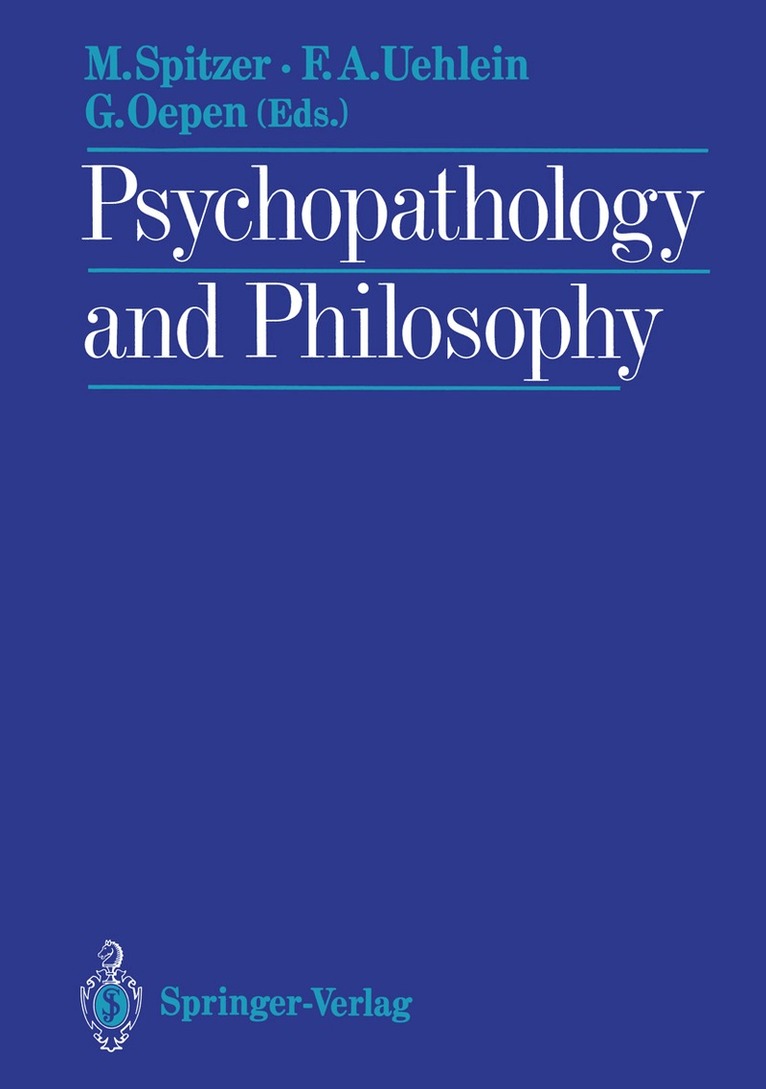
"Psychopathology should make clear what we know, how we know, and what we do not know. " "ffYoU thinkyou could eliminate philosophy, and regard it as something irrele vant it will overwhelm you in some obscure tDsguise. This is the point where that bulk of bad philosophy in psychopathological studies originates. " KARL JASPERS Since the publication of KARL JASPERS' General Psychopathology in 1913 at least, it has become obvious that a psychopathologist cannot do without philosophical reflection. If he wants to say anything about disorders of perception and thought, or of the experiencing I, to name the subjects of this book, he must know those disorders and the problems related to them. The phenomena and problems in question are not at all simply empirical (which is to say that they concern the structure and function of the organs of sense or the central nervous system), but conceptual. We have already formed some notions and prejudices concerning those subjects - perception, e. g. , is considered to be "a projection from the outside into the inward", thinking "a kind of inward talk", the I refers to "reflec ting upon me by myself', etc. Unless we think about these ideas critically, we shall fail in describing disorders of experience, thought, and action.
E-bok
PDF, Engelska, 20121 565 kr
Läs direkt efter köp
"Psychopathology should make clear what we know, how we know, and what we do not know. " "ffYoU thinkyou could eliminate philosophy, and regard it as something irrele vant it will overwhelm you in some obscure tDsguise. This is the point where that bulk of bad philosophy in psychopathological studies originates. " KARL JASPERS Since the publication of KARL JASPERS'' General Psychopathology in 1913 at least, it has become obvious that a psychopathologist cannot do without philosophical reflection. If he wants to say anything about disorders of perception and thought, or of the experiencing I, to name the subjects of this book, he must know those disorders and the problems related to them. The phenomena and problems in question are not at all simply empirical (which is to say that they concern the structure and function of the organs of sense or the central nervous system), but conceptual. We have already formed some notions and prejudices concerning those subjects - perception, e. g. , is considered to be "a projection from the outside into the inward", thinking "a kind of inward talk", the I refers to "reflec ting upon me by myself'', etc. Unless we think about these ideas critically, we shall fail in describing disorders of experience, thought, and action.
Häftad, Tyska, 1982
418 kr
Skickas inom 5-8 vardagar
E-bok
PDF, Tyska, 1985272 kr
Läs direkt efter köp
Schon unter rein historischem Aspekt muss es verwundern, dass die deutsche philosophische Forschung das Werk des englischen Dichters, Literaturkritikers und Philosophen Samuel Taylor Coleridge (1772-1834) nahezu aus den Augen verlor: Der Begründer der englischen Romantik und scharfe Kritiker des Empirismus seiner Landsleute stand in unmittelbarem Dialog mit den literarischen und philosophischen Exponenten des deutschen Idealismus und vertrat in seinem literarischen und essayistischen Werk eine unmittelbar aus der Auseinandersetzung mit Kant, Fichte und insbesondere Schelling hervorgegangene philosophische Position.Uehlein beschränkt sich in seiner systematischen Freilegung dieser Position gleichwohl nicht darauf, Coleridge als Zeugen für die bereits im 19. Jahrhundert einsetzende Rezeption des deutschen Idealismus in England vorzustellen. Vielmehr betritt Uehlein insofern Neuland, als er es erstmals unternimmt, Coleridge zugleich als einen originalen Philosophen zu erweisen, der eine der Schellingschen zwar verwandte, aber doch eigenständige Philosophie des Selbstbewußtseins vertritt. Wie Fichte und Schelling müht sich Coleridge um die Rückführung aller Erkenntnis auf das Grundprinzip der Selbstgewißheit des »Ich bin«; im Unterschied zu beiden verficht er die These, das absolute »Ich bin« (= Grund aller Erkenntnis) sei nicht unmittelbar einholbar, sondern offenbare sich mittelbar in der Selbstgewißheit des empirischen »Ich bin«, also in der zeitlichen Konstitution des endlichen Ich. In manchem, so Uehlein, bietet Coleridges idealistische Konzeption des sich in der Zeit konstituierenden »Ich bin« einen Vorblick auf Husserls Bewußtseinstheorie.