G. Anand - Böcker
Visar alla böcker från författaren G. Anand. Handla med fri frakt och snabb leverans.
4 produkter
4 produkter
1 752 kr
Skickas inom 10-15 vardagar
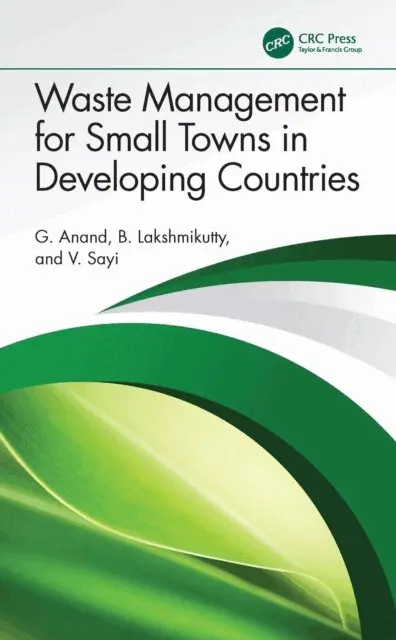
This book provides a comprehensive technical overview of waste management strategies tailored for small towns, emphasising innovative approaches to integrated waste management. It explores methods to transform various types of waste into value-added products, fostering circular economy practices at both micro and macro levels. The text examines the implementation of waste management solutions across different countries, addressing market development, pricing strategies, and financial viability to achieve sustainability goals. Key topics include municipal solid waste management, faecal sludge treatment, sewage treatment, and grey water management, supported by case studies and practical examples.Features:Reviews integrated waste management systems for small towns with a focus on circular economy principles.Highlights indigenous and sustainable waste management practices.Explores innovative techniques such as degradable waste segregation and manufacturing value-added products from waste components.Covers municipal solid waste management, faecal sludge treatment, sewage treatment, and grey water management, particularly in developing countries.Discusses project management aspects and financial implications of waste management initiatives.Includes numerical examples, practical problems, and case studies from various countries to illustrate real-world applications.This book is designed for students, researchers, and professionals in Environmental, Chemical, and Civil Engineering, Urban Planning, and related fields, as well as NGOs, administrators, and stakeholders in waste management.
Phenomenological and Mathematical Modeling of a High Pressure Steam Driven Jet Injector, Part 2
Häftad, Engelska, 2013
225 kr
Skickas inom 5-8 vardagar
606 kr
Skickas inom 10-15 vardagar
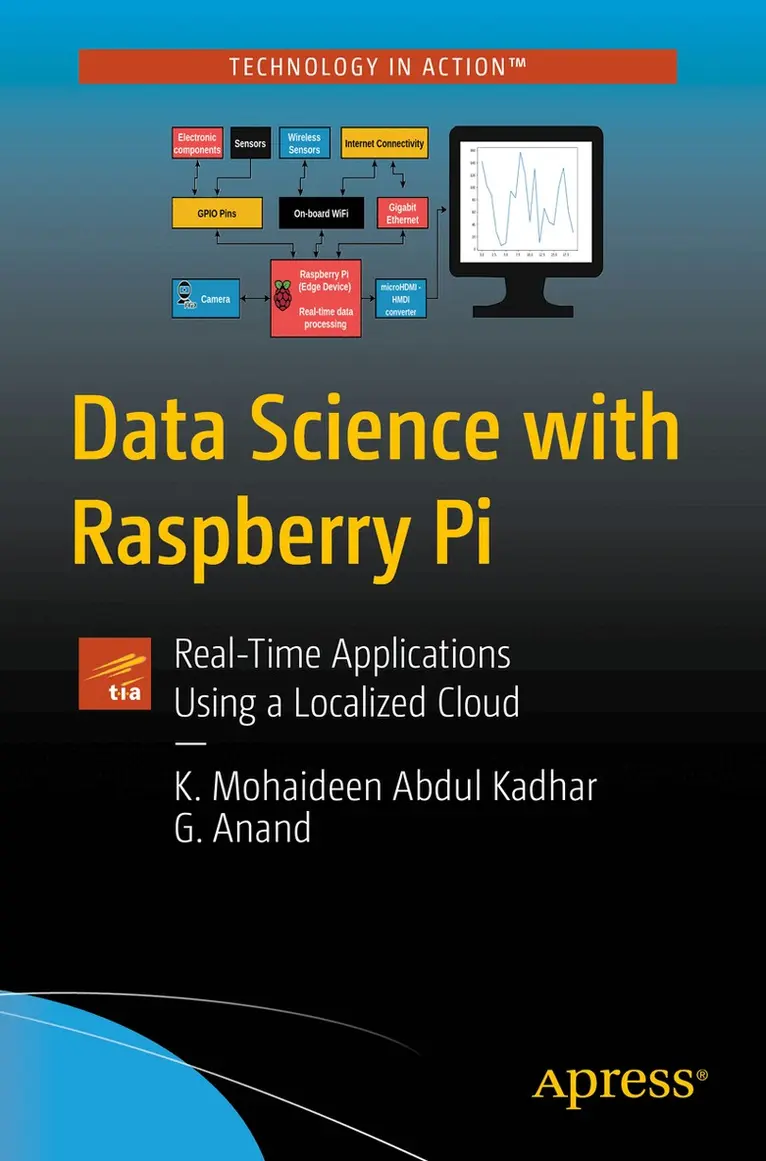
Implement real-time data processing applications on the Raspberry Pi. This book uniquely helps you work with data science concepts as part of real-time applications using the Raspberry Pi as a localized cloud. You’ll start with a brief introduction to data science followed by a dedicated look at the fundamental concepts of Python programming. Here you’ll install the software needed for Python programming on the Pi, and then review the various data types and modules available. The next steps are to set up your Pis for gathering real-time data and incorporate the basic operations of data science related to real-time applications. You’ll then combine all these new skills to work with machine learning concepts that will enable your Raspberry Pi to learn from the data it gathers. Case studies round out the book to give you an idea of the range of domains where these concepts can be applied. By the end of Data Science with the Raspberry Pi, you’ll understand that many applications are now dependent upon cloud computing. As Raspberry Pis are cheap, it is easy to use a number of them closer to the sensors gathering the data and restrict the analytics closer to the edge. You’ll find that not only is the Pi an easy entry point to data science, it also provides an elegant solution to cloud computing limitations through localized deployment.What You Will LearnInterface the Raspberry Pi with sensorsSet up the Raspberry Pi as a localized cloudTackle data science concepts with Python on the Pi Who This Book Is ForData scientists who are looking to implement real-time applications using the Raspberry Pi as an edge device and localized cloud. Readers should have a basic knowledge in mathematics, computers, and statistics. A working knowledge of Python and the Raspberry Pi is an added advantage.
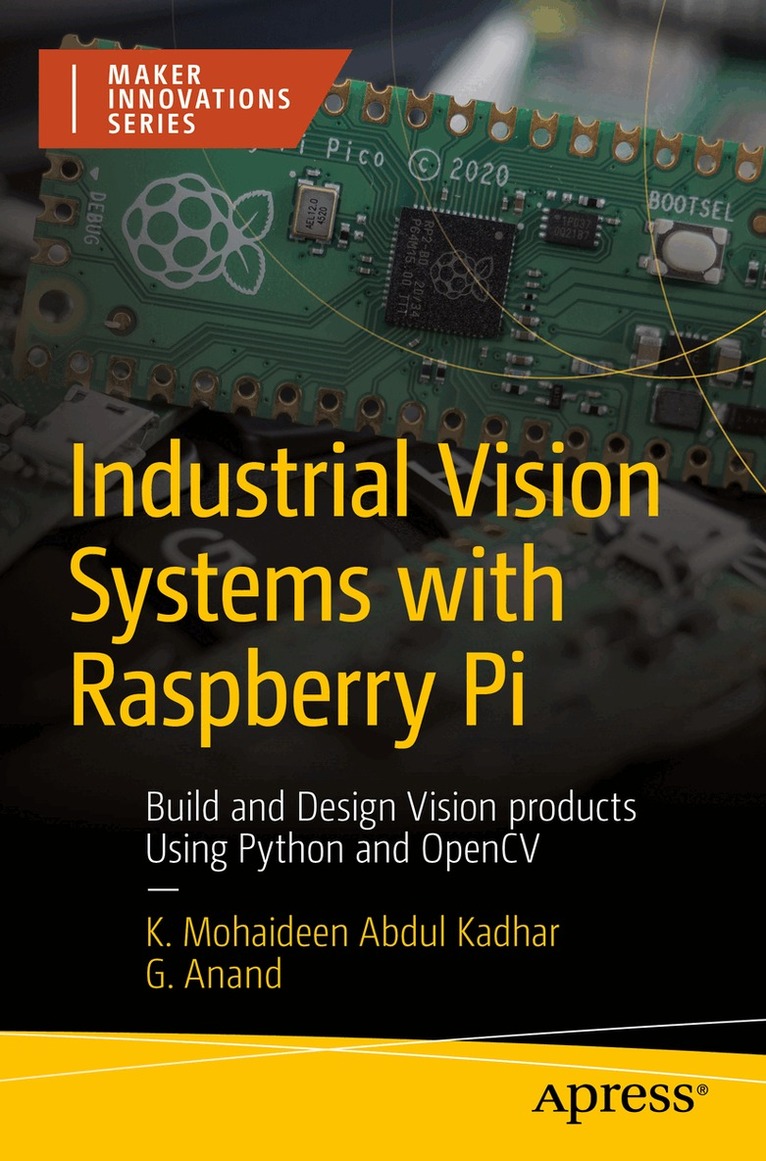
Industrial Vision Systems with Raspberry Pi
Build and Design Vision products Using Python and OpenCV
Häftad, Engelska, 2024
655 kr
Skickas
Today’s industries are faced with a growing demand for vision systems due to their non-invasive characteristics in inspecting product quality. These systems identify surface defects and faults, and verify components’ orientation and their measurements, etc. This book explores the vision techniques needed to design and develop your own industrial vision system with the help of Raspberry Pi.You’ll start by reviewing basic concepts and applications of machine vision systems, followed by the preliminaries of Python, OpenCV, required libraries, and installing OpenCV for Python on Raspberry Pi. These are used when implementing image processing for the system applications. You’ll then look at interfacing techniques and some of the challenges industrial vision systems encounter, such as lighting and camera angles. Algorithms and image processing techniques are also discussed, along with machine learning and deep learning techniques. Later chapters explain the use of GUI apps and real-time applications of Industrial vision systems. Each chapter concludes with examples and demo implementations to facilitate your knowledge of the concepts. By the end of the book, you’ll be able to build and deploy computer vision applications with Python, OpenCV, and Raspberry Pi.What You'll LearnBuild and deploy industrial vision system using Raspberry Pi and Python programmingExplore computer vision techniques using Raspberry Pi and OpenCVImplement popular vision techniques for industrial applications in real timeReview modern image processing techniques such as image segmentation, thresholding, and contoursWho This Book Is ForRaspberry Pi and Python enthusiasts interested in computer vision applications; educators, industrialists, and industrial solution providers who want to design vision-based testing products with the help of Raspberry Pi