G. Barbiroli – författare
Visar alla böcker från författaren G. Barbiroli. Handla med fri frakt och snabb leverans.
3 produkter
3 produkter
Inbunden, Engelska, 1997
1 671 kr
Skickas inom 10-15 vardagar
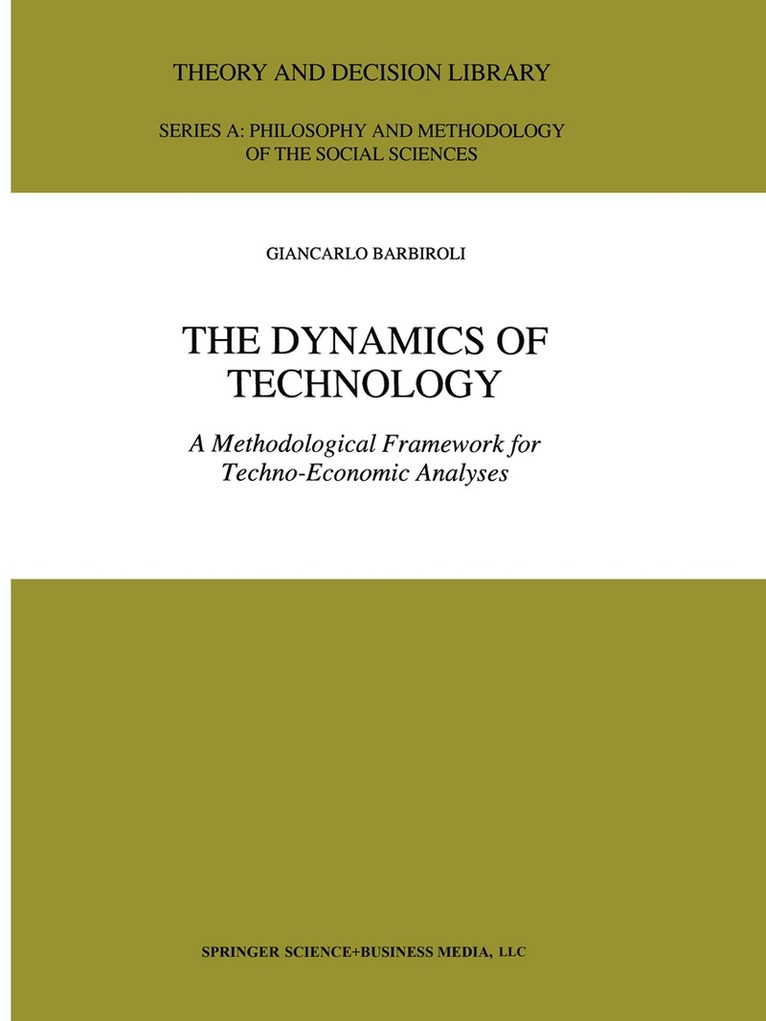
This volume intends to provide a methodological framework, capable of critically analyzing the multiple aspects related to technological dynamics, and to arrive - at times ex post, at times ex ante - at assessments regarding the economic results that can be achieved at all levels, with the innovation and diffusion of technologies in the manufacturing activities. For this purpose, this volume describes and critically evaluates conceptual and quantitative methods and models which seem capable of achieving this goal. This volume includes a number of distinctive features, the most important of which are the relationships between technological dynamics, knowledge, production systems and structures, quality, efficiency, natural resources, ecological systems and sustainable development. The approach used in organizing this volume has been an interdisciplinary one. Methods for analysis typical of various disciplines were used with the aim of arriving at economic conclusions, assessments and generalizations. In short, it may be defined as techno-economic.
Häftad, Engelska, 2010
1 671 kr
Skickas inom 10-15 vardagar
Technology is taking on an increasingly central and determining role in so ciety, and can provide contradictory results: wealth on the one hand, but also unemployment, environmental imbalances and other social problems on the other. Manufacturing techniques and production organization are chosen in every country based mainly on the specific needs of the companies, while the real needs of each population are often quite different. Already, in order to prevent all forms of technology from becoming in creasingly "invasive", towards both the natural supply of resources and the specific - though highly differentiated - needs of humanity, technological paths must be identified and followed which are capable of making the vari ous needs compatible, from the standpoint of sustainable development, the conservation and increase in value of natural resources, and the quality of development. This will become increasingly important in the future. This goal is undoubtedly ambitious and difficult to achieve; however, evi dence of the problems caused by generalized, uncontrolled use of technolo gy, all over the world, leads us to believe that intense efforts must be made to achieve this aim. If not, humankind runs the risk of an irreversible degra dation of the most important aspects of economic development and its quali ty. Within this framework, those companies that produce goods and services obviously occupy a central, active role, which they must play with a view both to competitiveness and overall qualification and to contributing to the objectives of sustainable development.
E-bok
PDF, Engelska, 20132 110 kr
Läs direkt efter köp
Technology is taking on an increasingly central and determining role in so ciety, and can provide contradictory results: wealth on the one hand, but also unemployment, environmental imbalances and other social problems on the other. Manufacturing techniques and production organization are chosen in every country based mainly on the specific needs of the companies, while the real needs of each population are often quite different. Already, in order to prevent all forms of technology from becoming in creasingly "invasive", towards both the natural supply of resources and the specific - though highly differentiated - needs of humanity, technological paths must be identified and followed which are capable of making the vari ous needs compatible, from the standpoint of sustainable development, the conservation and increase in value of natural resources, and the quality of development. This will become increasingly important in the future. This goal is undoubtedly ambitious and difficult to achieve; however, evi dence of the problems caused by generalized, uncontrolled use of technolo gy, all over the world, leads us to believe that intense efforts must be made to achieve this aim. If not, humankind runs the risk of an irreversible degra dation of the most important aspects of economic development and its quali ty. Within this framework, those companies that produce goods and services obviously occupy a central, active role, which they must play with a view both to competitiveness and overall qualification and to contributing to the objectives of sustainable development.