G. Haag - Böcker
Visar alla böcker från författaren G. Haag. Handla med fri frakt och snabb leverans.
3 produkter
3 produkter
Del 14 - Springer Series in Synergetics
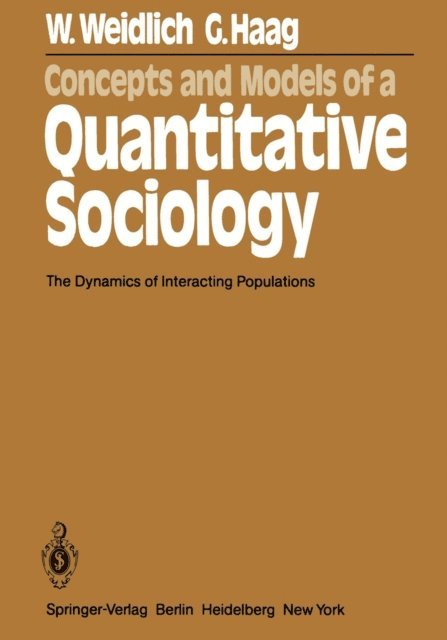
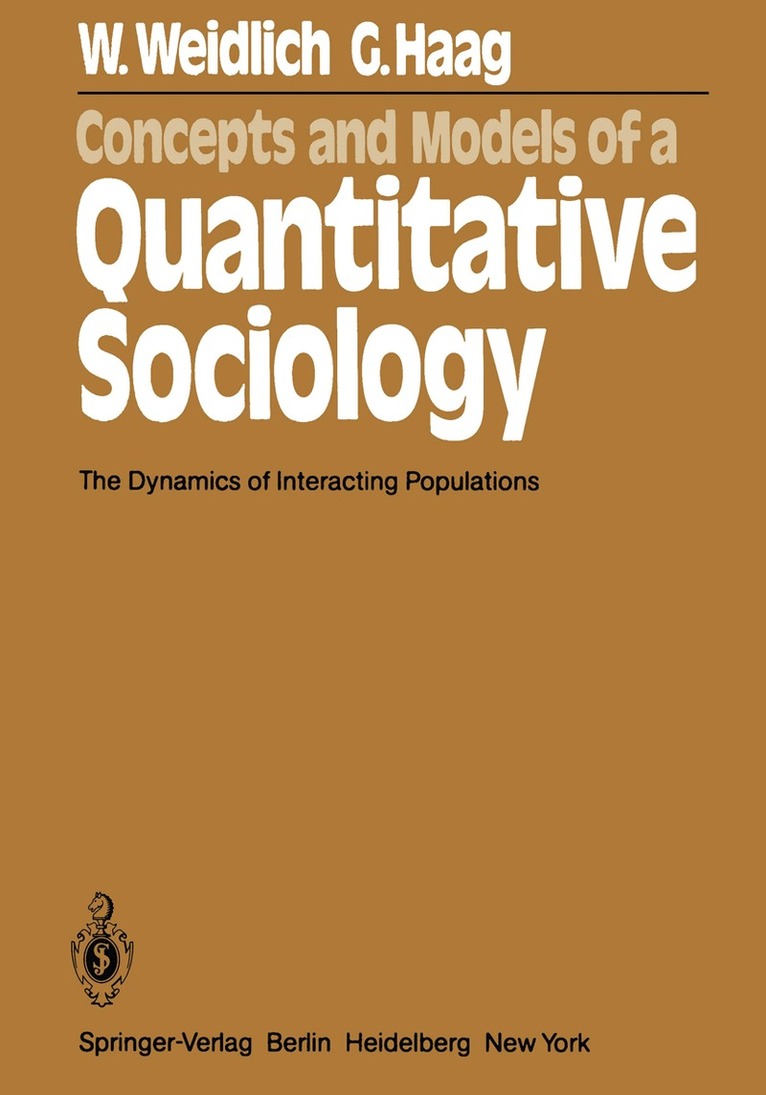
Concepts and Models of a Quantitative Sociology
The Dynamics of Interacting Populations
Häftad, Engelska, 2011
536 kr
Skickas inom 10-15 vardagar
While the volumes hitherto published in the Springer Series in Synergetics have been devoted almost exclusively to the self-organized formation of structures in physics, chemistry and biology, the present monograph by Weidlich and Haag deals with the formation of "structures" (or "patterns") in society. At first glance it would seem a daring enterprise to deal with the complex processes in society using concepts and methods first developed in physics. But over the past decade it has been shown that there is a large class of phenomena in a variety of fields to which unifying concepts can be applied. This is particulary true of situations in which a system composed of many parts or individuals acquires a new structure on macroscopic scales. Indeed, this is the definition of synergetics which I formulated more than a decade ago, and which formed the basis of my survey on the profound analogies in the behaviour of complex systems, includ ing those of sociology (H. Haken: Synergetics. An Introduction, Volume 1 of this series). As I have pointed out on many occasions, the universal validity of these concepts is neither accidental nor is it caused by a mere extension of physical rules to other fields, but is instead a consequence of deep-rooted struc tural properties of systems of interacting parts which are due to rigorous mathe maticallaws. Generally speaking, concepts and methods originally used in physics can be applied to sociological phenomena in two ways.
567 kr
Skickas inom 10-15 vardagar
Del 6 - Studies in Operational Regional Science
Dynamic Decision Theory
Applications to Urban and Regional Topics
Häftad, Engelska, 2011
536 kr
Skickas inom 10-15 vardagar
Choice processes appear in all spheres of society. Hitherto ruling paradigms in the modelling of choice problems have presumed a competitive general equi- librium which, however, proves insufficient for dynamic processes. This contribution aims at providing a general coherent and closed frame- work for the dynamic modelling of decision processes. It was one of my main interests to build a bridge between the pure model building concepts and their practical applications. Therefore all given examples are related to empirical work. Solution algorithms for the estimation of trend parameters as well as the numerical simulation in concrete applications therefore playa central role in this contribution. Friendly relations with a number of colleagues from many universities in Europe, and the U.S. have emerged during the different applications. I wish to thank all of them. The international cooperations were mainly initiated and supported by conferences and workshops organized and financed by the International Institute for Applied Systems Analysis (lIASA), the Istituto Ricerche Economico-Sociali Del Piemonte (I RES). the Institut National D 'Etudes De'mographiques (I NED), the Centre for Regional Science Research UmeJ.(CERUM) and the Projets de Cooperation et D'Echange avec France (Procop>' Special thanks go to the Volkswagen Stiftung for financial support of this work over the years. Thanks also go in particular to my friend and mentor Prof.W.Weidlich for his encouragement and for the many suggestions he made in fruitful discus- sions and common work that have taken place over the years.