G. Klir – författare
Visar alla böcker från författaren G. Klir. Handla med fri frakt och snabb leverans.
3 produkter
3 produkter
E-bok
PDF, Engelska, 20131 347 kr
Läs direkt efter köp
This volume consists of a selection of papers presented at the International Conference on Applied General Systems Research: Recent Developments and Trends which was held on the campus of the State University of New York at Binghamton in August 15-19, 1977, under the sponsorship of the Special Panel on Systems Science of the NATO Scientific Affairs Division. General systems research is a fairly new field which has been developing in the course of the last two or three decades. In my op~n10n, it can be best described as a movement which involves the study of all structural and context independent aspects of problem solving. As such, it is cross-disciplinary in nature and, in this sense, it might seem similar to mathematics. There is a consid erable difference, however, between the two. While pure mathe matics is basically oriented to the development of various axiomatic theories, regardless of whether or not they have any real world meaning, applied mathematics explores the applicability of some of these theories as potentially useful methodological tools in various problem areas. General systems research, in contrast with applied mathematics, is problem oriented rather than tool oriented. As such, it tries to develop genuine methods for solving systems problems, i. e. , structural type and context in dependent problems. The term "genuine method" is used here to refer to a method which adjusts to the problem rather than re quiring that the problem be adjusted to make the method applicable.
Häftad, Engelska, 2013
1 066 kr
Skickas inom 10-15 vardagar
This volume consists of a selection of papers presented at the International Conference on Applied General Systems Research: Recent Developments and Trends which was held on the campus of the State University of New York at Binghamton in August 15-19, 1977, under the sponsorship of the Special Panel on Systems Science of the NATO Scientific Affairs Division. General systems research is a fairly new field which has been developing in the course of the last two or three decades. In my op~n10n, it can be best described as a movement which involves the study of all structural and context independent aspects of problem solving. As such, it is cross-disciplinary in nature and, in this sense, it might seem similar to mathematics. There is a consid erable difference, however, between the two. While pure mathe matics is basically oriented to the development of various axiomatic theories, regardless of whether or not they have any real world meaning, applied mathematics explores the applicability of some of these theories as potentially useful methodological tools in various problem areas. General systems research, in contrast with applied mathematics, is problem oriented rather than tool oriented. As such, it tries to develop genuine methods for solving systems problems, i. e. , structural type and context in dependent problems. The term "genuine method" is used here to refer to a method which adjusts to the problem rather than re quiring that the problem be adjusted to make the method applicable.
E-bok
PDF, Engelska, 2013756 kr
Läs direkt efter köp
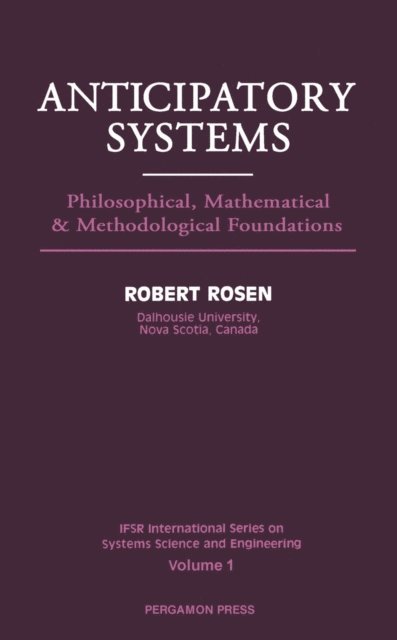
The first detailed study of this most important class of systems which contain internal predictive models of themselves and/or of their environments and whose predictions are utilized for purposes of present control. This book develops the basic concept of a predictive model, and shows how it can be embedded into a system of feedforward control. Includes many examples and stresses analogies between wired-in anticipatory control and processes of learning and adaption, at both individual and social levels. Shows how the basic theory of such systems throws a new light both on analytic problems (understanding what is going on in an organism or a social system) and synthetic ones (developing forecasting methods for making individual or collective decisions).