G. Schellong – författare
Visar alla böcker från författaren G. Schellong. Handla med fri frakt och snabb leverans.
4 produkter
4 produkter
E-bok
PDF, Engelska, 2012708 kr
Läs direkt efter köp
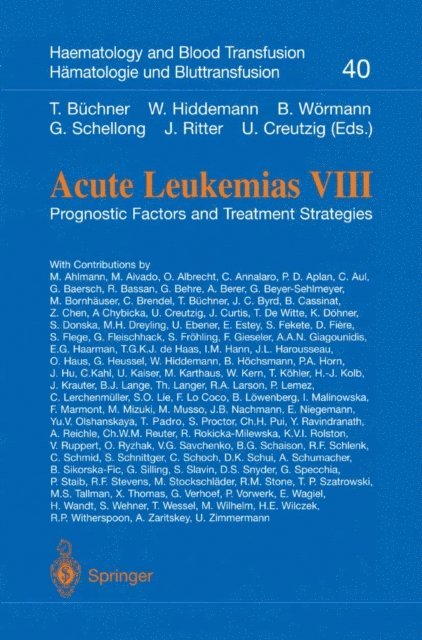
Since 1987 Acute Leukemias (AL) has regularly reported on the state of the art in the rapidly growing, successful and exciting field of biology and management of these diseases. In this volume large multicenter clinical trials again form the solid basis for the investigation of leukemic cell biology, the detection of biologic subgroups, their differential response to alternative treatment strategies and the further development of therapy. In particular, this volume addresses mechanisms of chromosomal translocations and transcription factors, risk-adapted treatment strategies, differentiation therapy, secondary AL, special aspects in older patients, and adoptive immunotherapy. Besides the antileukemic approaches, supportive treatment with new antimicrobial substances and growth factors is updated. As a forum of worldwide activities in the field of AL this volume contains both exhaustive overviews on major clinical issues and preliminary data and hypotheses not previously published.
Häftad, Engelska, 2012
561 kr
Skickas inom 10-15 vardagar
Since 1987 Acute Leukemias (AL) has regularly reported on the state of the art in the rapidly growing, successful and exciting field of biology and management of these diseases. In this volume large multicenter clinical trials again form the solid basis for the investigation of leukemic cell biology, the detection of biologic subgroups, their differential response to alternative treatment strategies and the further development of therapy. In particular, this volume addresses mechanisms of chromosomal translocations and transcription factors, risk-adapted treatment strategies, differentiation therapy, secondary AL, special aspects in older patients, and adoptive immunotherapy. Besides the antileukemic approaches, supportive treatment with new antimicrobial substances and growth factors is updated. As a forum of worldwide activities in the field of AL this volume contains both exhaustive overviews on major clinical issues and preliminary data and hypotheses not previously published.
E-bok
PDF, Engelska, 20121 420 kr
Läs direkt efter köp
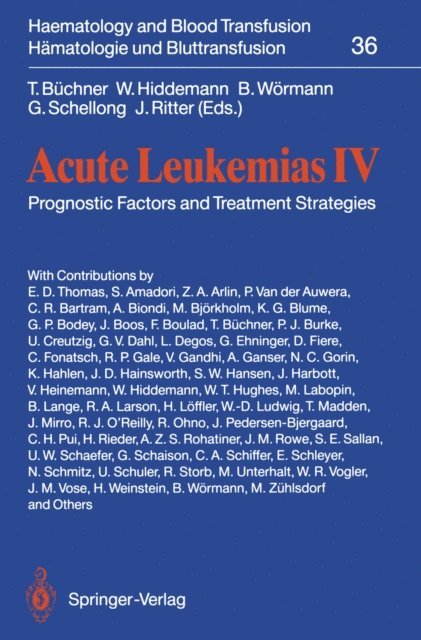
The rates of acute leukemia cure have gradually improved over the last decade. Clinical study results reflect the impact of chemotherapy intensity and duration, the role of prolonged maintenance, intensified consolidation or very early intensification. Further progress has also been achieved in bone marrow trans plantation, and recent prospective studies and meta-analyses have contributed comparisons of the high antileukemic efficacy of bone marrow transplantation to that of improved chemotherapy. This allows a more successful combining of the two forms of treatment. New prognostic factors have emerged from both cytogenetic and molecular genetic research. Thus, the Philadelphia chromosome translocation and the bcr/abl gene rearrangement have proven to be the dominating risk factor in acute lymphoblastic leukemia. Since the frequency increases with age, differences in prognosis between children and adults can be explained. Evaluation of molecular and immunologic leukemia cell markers has provided a better understanding of residual leukemia in clinical remission, as a prognostic factor and in monitoring the effectiveness of the antileukemic strategy. Recent work on leukemic cell biology has resulted in novel therapeutic approaches such as terminal differentiation by all-trans-retinoic acid, modulation of chemotherapy by hematopoietic growth factors such as GM-CSF and enhancement of immunologic control by cytokines such as interleukin 2. New antimicrobial drugs and the application of mostly empiric anti-infectious strategies have helped reducing the therapeutic risk. Thus, a number of recent achievements have provided us with new options in the management of patients with acute leukemias.
Häftad, Engelska, 2011
1 114 kr
Skickas inom 10-15 vardagar
Evaluation of molecular and immunologic leukemia cell markers has provided a better understanding of residual leukemia in clinical remission, as a prognostic factor and in monitoring the effectiveness of the antileukemic strategy.