G. Wittmann – författare
Visar alla böcker från författaren G. Wittmann. Handla med fri frakt och snabb leverans.
7 produkter
7 produkter
Inbunden, Engelska, 1989
1 671 kr
Skickas inom 10-15 vardagar
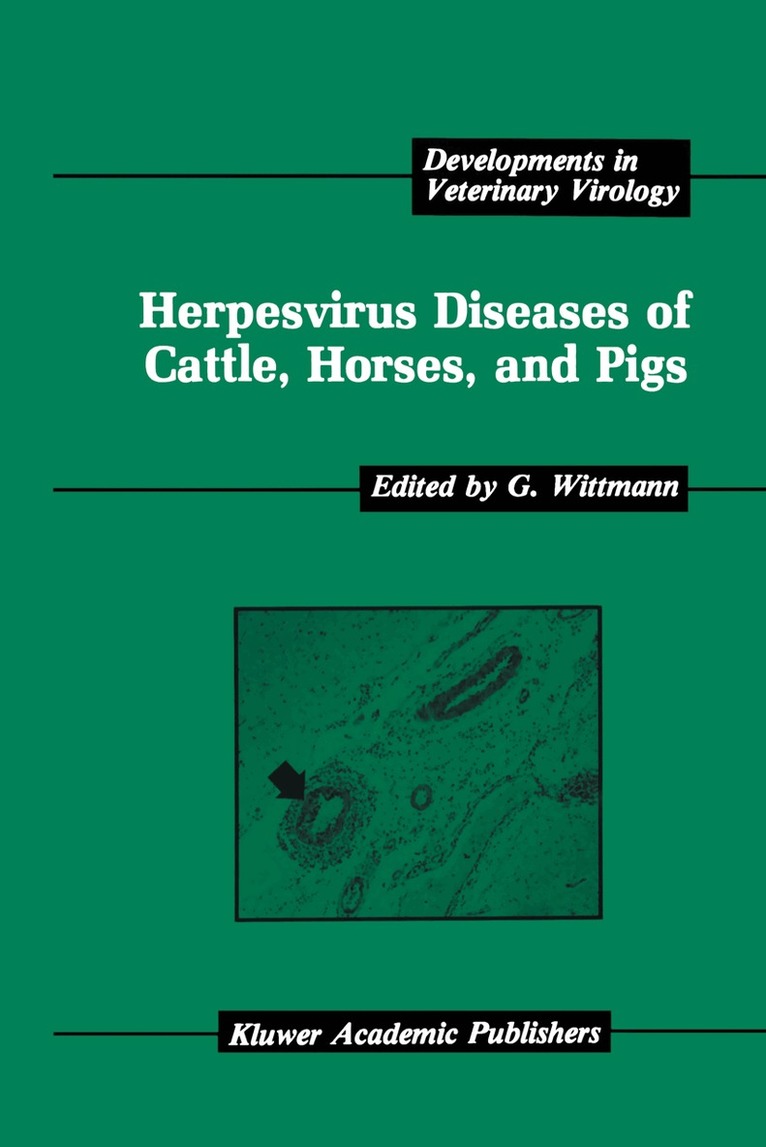
'!he present volune Herpesvirus Diseases of cattle, Horses and pigs in the series "Developnents in Veterinal:y Virology" gives a review on herpesvirus infections in (a) cattle by bovine herpesvirus I (lEV-I), lEV-2 and lEV-4, alcelaphine herpesvirus I (malignant catanbal. fever) and Aujeszky"s disease virus, (b) horses by equine herpesvirus I (EHV-1), EHV-2 and EHV-3 and (c) pigs by Aujeszky's disease virus and porcine cytomegalovirus. Some of these viruses also infect small ruminants, therefore sheep and goats are included in this review as far as they are concemed. The different chapters include the latest knowledge on the viruses and the resulting diseases. Bearing in m:irrl the rapid development of oolecular biology and genetechnology in the last years a comprehensive survey on the oolecular aspects of the viruses and genetically engineered vaccines is presented, as far as data have been available. However, the other fields have not been neglected. large space is given to the description of clinical synptams, pathology, pathogenesis, latent infection, physical, chemical and biological characteristics of the viruses, hmnoral and cell-mediated imnunity, vaccines and vaccination, epizootiology, control, eradication, economics considerations and future aspects.
Häftad, Engelska, 2011
1 671 kr
Skickas inom 10-15 vardagar
'!he present volune Herpesvirus Diseases of cattle, Horses and pigs in the series "Developnents in Veterinal:y Virology" gives a review on herpesvirus infections in (a) cattle by bovine herpesvirus I (lEV-I), lEV-2 and lEV-4, alcelaphine herpesvirus I (malignant catanbal. fever) and Aujeszky"s disease virus, (b) horses by equine herpesvirus I (EHV-1), EHV-2 and EHV-3 and (c) pigs by Aujeszky's disease virus and porcine cytomegalovirus. Some of these viruses also infect small ruminants, therefore sheep and goats are included in this review as far as they are concemed. The different chapters include the latest knowledge on the viruses and the resulting diseases. Bearing in m:irrl the rapid development of oolecular biology and genetechnology in the last years a comprehensive survey on the oolecular aspects of the viruses and genetically engineered vaccines is presented, as far as data have been available. However, the other fields have not been neglected. large space is given to the description of clinical synptams, pathology, pathogenesis, latent infection, physical, chemical and biological characteristics of the viruses, hmnoral and cell-mediated imnunity, vaccines and vaccination, epizootiology, control, eradication, economics considerations and future aspects.
E-bok
PDF, Engelska, 20122 110 kr
Läs direkt efter köp
E-bok
PDF, Engelska, 2012734 kr
Läs direkt efter köp
This seminar referred to latent herpes virus infections in veterinary medicine, with emphasis on the domestic animals. The phenomenon of latency is of particular importance in veterinary medicine because it can jeopardize the successful control and eradication of diseases such as Aujeszky''s disease and infectious bovine rhinotracheitis, diseases which are often the cause of great economic losses. For this reason, the Commission of the European Communities (CEC) realized the importance of summarizing the present state of knowledge on latent herpes virus infections in veterinary medicine. A seminar was therefore organized by the Federal Research Institute for Animal Virus Diseases in Ttibingen, Federal Republic of Germany, from September 21 to 23, 1982, as a part of the ''Animal Pathology Programme'' of the CEC. The seminar was attended by 50 participants not only from the countries of the CEC, and 38 papers were selected for presentation. In veterinary medicine, more intensive investigations on the latency of animal herpes viruses have only relatively recently been initiated. In contrast, great efforts have been made for many years to elucidate latency in human and primate herpes viruses, and consequently the most considerable advances have been made in this field. Some of the most experienced scientists working on both systems were therefore invited. As a result, this seminar was the first occasion on which scientists from different countries and faculties investigating herpes virus latency had the opportunity to present and exchange their latest results. The.
E-bok
PDF, Engelska, 2012734 kr
Läs direkt efter köp
Aujeszky''s disease (AD) is increasing in Europe and it has become a serious problem in some of the countries of the European Communities (EC). The control and eradication of the disease is very difficult since AD virus (ADV) evokes a persistant latent infection in its main host, the pig. Such latent infection can also occur when vaccinated pigs are exposed to the virus. In view of this, the Commission of the European Communities (CEC) thought it necessary to have a survey on the current state of knowledge on AD and ADV. Therefore, a seminar was organised by the Federal Research Institute for Animal Virus Diseases in Tubingen, Federal Republic of Germany, and held there on June 9 and 10, 1981. The seminar was a part of the ''Animal Pathology Programme'' of the CEC. The seminar was attended by 44 participants from the countries of the EC, and 29 papers were presented which covered a wide field of research on AD: properties of the virus, diagnostic procedures, immunity and pathogenesis, vaccination, latent infection, epidemiology, control and eradication. Scientists from differ ent institutes in the EC who have been working on AD thus had the oppor tunity to exchange their knowledge as well as to give and receive impetus for further scientific work. Furthermore, many details were given which are of interest for the veterinary authorities with regard to control and eradication of AD.
Del 17 - Current Topics in Veterinary Medicine
Aujeszky’s Disease
Häftad, Engelska, 2011
562 kr
Skickas inom 10-15 vardagar
Aujeszky's disease (AD) is increasing in Europe and it has become a serious problem in some of the countries of the European Communities (EC). The control and eradication of the disease is very difficult since AD virus (ADV) evokes a persistant latent infection in its main host, the pig. Such latent infection can also occur when vaccinated pigs are exposed to the virus. In view of this, the Commission of the European Communities (CEC) thought it necessary to have a survey on the current state of knowledge on AD and ADV. Therefore, a seminar was organised by the Federal Research Institute for Animal Virus Diseases in Tubingen, Federal Republic of Germany, and held there on June 9 and 10, 1981. The seminar was a part of the 'Animal Pathology Programme' of the CEC. The seminar was attended by 44 participants from the countries of the EC, and 29 papers were presented which covered a wide field of research on AD: properties of the virus, diagnostic procedures, immunity and pathogenesis, vaccination, latent infection, epidemiology, control and eradication. Scientists from differ ent institutes in the EC who have been working on AD thus had the oppor tunity to exchange their knowledge as well as to give and receive impetus for further scientific work. Furthermore, many details were given which are of interest for the veterinary authorities with regard to control and eradication of AD.
562 kr
Skickas inom 10-15 vardagar
This seminar referred to latent herpes virus infections in veterinary medicine, with emphasis on the domestic animals. The phenomenon of latency is of particular importance in veterinary medicine because it can jeopardize the successful control and eradication of diseases such as Aujeszky's disease and infectious bovine rhinotracheitis, diseases which are often the cause of great economic losses. For this reason, the Commission of the European Communities (CEC) realized the importance of summarizing the present state of knowledge on latent herpes virus infections in veterinary medicine. A seminar was therefore organized by the Federal Research Institute for Animal Virus Diseases in Ttibingen, Federal Republic of Germany, from September 21 to 23, 1982, as a part of the 'Animal Pathology Programme' of the CEC. The seminar was attended by 50 participants not only from the countries of the CEC, and 38 papers were selected for presentation. In veterinary medicine, more intensive investigations on the latency of animal herpes viruses have only relatively recently been initiated. In contrast, great efforts have been made for many years to elucidate latency in human and primate herpes viruses, and consequently the most considerable advances have been made in this field. Some of the most experienced scientists working on both systems were therefore invited. As a result, this seminar was the first occasion on which scientists from different countries and faculties investigating herpes virus latency had the opportunity to present and exchange their latest results. The.