G. Zelinger – författare
Visar alla böcker från författaren G. Zelinger. Handla med fri frakt och snabb leverans.
2 produkter
2 produkter
E-bok
PDF, Engelska, 2013344 kr
Läs direkt efter köp
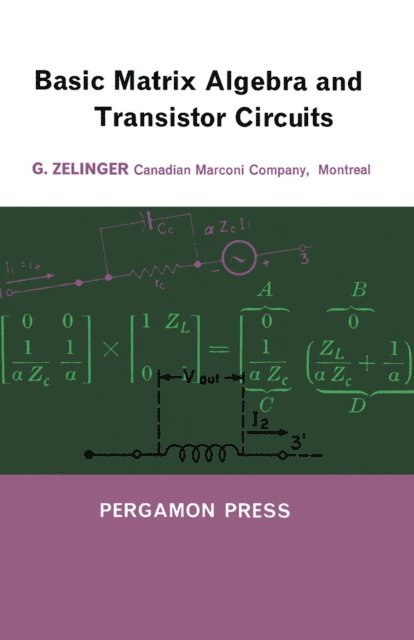
Basic Matrix Algebra and Transistor Circuits deals with mastering the techniques of matrix algebra for application in transistors. This book attempts to unify fundamental subjects, such as matrix algebra, four-terminal network theory, transistor equivalent circuits, and pertinent design matters. Part I of this book focuses on basic matrix algebra of four-terminal networks, with descriptions of the different systems of matrices. This part also discusses both simple and complex network configurations and their associated transmission. This discussion is followed by the alternative methods of deriving the transmission matrix using Kirchhoff''s law. Part II introduces matrix analysis of transistor circuits, and then shows in detail the three transistor configurations: common-base, common-emitter, and common collector. A step-by-step method of transmission matrices derivation for each transistor configuration is then explained. This book notes the significance of matrix algebra in dealing with amplifier problems in a variety of output network configurations. Part III focuses on several aspects of single-stage transistor ampler design. This part explains how matrix algebra can be used to derive the exact input, output impedances, and the reverse transfer properties of transistor amplifiers with full load and generator terminations. Through mathematical analysis, the book shows the accuracy of matrix analysis in transistor amplifier design. This book is suitable for design engineers, electrical engineers, and students and practitioners of applied mathematics.
E-bok
PDF, Engelska, 2014756 kr
Läs direkt efter köp
Electronics and Instrumentation, Volume 36: Basic Matrix Analysis and Synthesis presents the application of matrix methods to practical electronics problems. This book focuses on transistor applications. Organized into three parts, this volume begins with an overview of the fundamental theory of twoports and explains the mechanisms of matrix and determinant operations with applications to the study of twoport networks, both active and passive. This text then explains the concept of impedance transformation and image matching in the different matrix domains. This book presents as well the analysis and synthesis of active networks. The final part deals with the mathematical model concepts of transistors and vacuum tubes that are freely applied to a wide range of problems with an emphasis on practical applications such as conventional amplifiers, single-, and multi-stage transistor feedback amplifiers and oscillators. This book is a valuable resource for electronics engineers as well as for students with some grounding in mathematics and network theory.