Gabriele Morra – författare
Subduction Dynamics
From Mantle Flow to Mega Disasters
1 820 kr
Skickas inom 11-20 vardagar
2 025 kr
Läs direkt efter köp
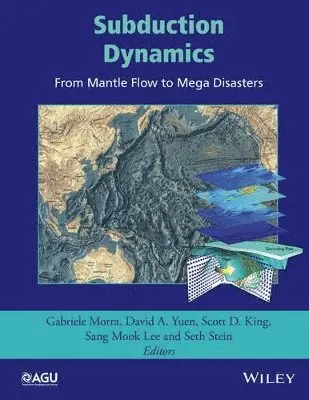
Subduction dynamics has been actively studied through seismology, mineral physics, and laboratory and numerical experiments. Understanding the dynamics of the subducting slab is critical to a better understanding of the primary societally relevant natural hazards emerging from our planetary interior, the megathrust earthquakes and consequent tsunamis.
Subduction Dynamics is the result of a meeting that was held between August 19 and 22, 2012 on Jeju island, South Korea, where about fifty researchers from East Asia, North America and Europe met. Chapters treat diverse topics ranging from the response of the ionosphere to earthquake and tsunamis, to the origin of mid-continental volcanism thousands kilometers distant from the subduction zone, from the mysterious deep earthquakes triggered in the interior of the descending slabs, to the detailed pattern of accretionary wedges in convergent zones, from the induced mantle flow in the deep mantle, to the nature of the paradigms of earthquake occurrence, showing that all of them ultimately are due to the subduction process.
Volume highlights include:
Multidisciplinary research involving geology, mineral physics, geophysics and geodynamics Extremely large-scale numerical models with sliate-of-the art high performance computing facilities Overview of exceptional three-dimensional dynamic representation of the evolution of the Earth interiors and of the earthquake and subsequent tsunami dynamics Global risk assessment strategies in predicting natural disastersThis volume is a valuable contribution in earth and environmental sciences that will assist with understanding the mechanisms behind plate tectonics and predicting and mitigating future natural hazards like earthquakes, volcanoes and tsunamis.
2 025 kr
Läs direkt efter köp
Subduction dynamics has been actively studied through seismology, mineral physics, and laboratory and numerical experiments. Understanding the dynamics of the subducting slab is critical to a better understanding of the primary societally relevant natural hazards emerging from our planetary interior, the megathrust earthquakes and consequent tsunamis.
Subduction Dynamics is the result of a meeting that was held between August 19 and 22, 2012 on Jeju island, South Korea, where about fifty researchers from East Asia, North America and Europe met. Chapters treat diverse topics ranging from the response of the ionosphere to earthquake and tsunamis, to the origin of mid-continental volcanism thousands kilometers distant from the subduction zone, from the mysterious deep earthquakes triggered in the interior of the descending slabs, to the detailed pattern of accretionary wedges in convergent zones, from the induced mantle flow in the deep mantle, to the nature of the paradigms of earthquake occurrence, showing that all of them ultimately are due to the subduction process.
Volume highlights include:
Multidisciplinary research involving geology, mineral physics, geophysics and geodynamics Extremely large-scale numerical models with sliate-of-the art high performance computing facilities Overview of exceptional three-dimensional dynamic representation of the evolution of the Earth interiors and of the earthquake and subsequent tsunami dynamics Global risk assessment strategies in predicting natural disastersThis volume is a valuable contribution in earth and environmental sciences that will assist with understanding the mechanisms behind plate tectonics and predicting and mitigating future natural hazards like earthquakes, volcanoes and tsunamis.
1 406 kr
Skickas inom 10-15 vardagar
1 258 kr
Läs direkt efter köp
This book addresses students and young researchers who want to learn to use numerical modeling to solve problems in geodynamics. Intended as an easy-to-use and self-learning guide, readers only need a basic background in calculus to approach most of the material. The book difficulty increases very gradually, through four distinct parts. The first is an introduction to the Python techniques necessary to visualize and run vectorial calculations. The second is an overview with several examples on classical Mechanics with examples taken from standard introductory physics books. The third part is a detailed description of how to write Lagrangian, Eulerian and Particles in Cell codes for solving linear and non-linear continuum mechanics problems. Finally the last one address advanced techniques like tree-codes, Boundary Elements, and illustrates several applications to Geodynamics. The entire book is organized around numerous examples in Python, aiming at encouraging the reader to le
arn by experimenting and experiencing, not by theory.975 kr
Skickas inom 10-15 vardagar