Gail Trimble – författare
Visar alla böcker från författaren Gail Trimble. Handla med fri frakt och snabb leverans.
6 produkter
6 produkter
E-bok
PDF, Engelska, 20201 521 kr
Läs direkt efter köp
''Metalepsis'' is a term from classical rhetoric, but in the twentieth century, it was re-framed more broadly as a crossing of the boundaries that separate distinct narrative worlds. This modern notion of metalepsis, introduced by Gérard Genette, has so far largely been theorized on the basis of examples from post-modern novels and films. Yet metalepsis has a much greater potential to address all sorts of transgressions between ''worlds'' or ''levels'', not only in post-modern but also pre-modern literature.This volume explores metalepsis in classical antiquity, considering questions such as: if metalepsis consists fundamentally in the breaking down of barriers, what sort of barriers and what sort of transgressions can the concept be fruitfully applied to? Can it be used within approaches other than narratology? Does metalepsis require recognisable levels of reality and fictionality, and if so, what role might be played by other planes, such as the past, the mythical or the divine? What form does metalepsis take in less obviously ''narrative'' genres, such as lyric poetry? And how should it be understood in visual media? Reflecting on these questions sheds new light on important dynamics in ancient texts, and advances literary theory by probing how explorations of ancient metalepsis might change, refine, or extend our understanding of the concept itself.
E-bok
Engelska, 20201 521 kr
Läs direkt efter köp
''Metalepsis'' is a term from classical rhetoric, but in the twentieth century, it was re-framed more broadly as a crossing of the boundaries that separate distinct narrative worlds. This modern notion of metalepsis, introduced by Gérard Genette, has so far largely been theorized on the basis of examples from post-modern novels and films. Yet metalepsis has a much greater potential to address all sorts of transgressions between ''worlds'' or ''levels'', not only in post-modern but also pre-modern literature.This volume explores metalepsis in classical antiquity, considering questions such as: if metalepsis consists fundamentally in the breaking down of barriers, what sort of barriers and what sort of transgressions can the concept be fruitfully applied to? Can it be used within approaches other than narratology? Does metalepsis require recognisable levels of reality and fictionality, and if so, what role might be played by other planes, such as the past, the mythical or the divine? What form does metalepsis take in less obviously ''narrative'' genres, such as lyric poetry? And how should it be understood in visual media? Reflecting on these questions sheds new light on important dynamics in ancient texts, and advances literary theory by probing how explorations of ancient metalepsis might change, refine, or extend our understanding of the concept itself.
Inbunden, Engelska, 2020
1 813 kr
Skickas inom 7-10 vardagar
'Metalepsis' is a term from classical rhetoric, but in the twentieth century, it was re-framed more broadly as a crossing of the boundaries that separate distinct narrative worlds. This modern notion of metalepsis, introduced by Gérard Genette, has so far largely been theorized on the basis of examples from post-modern novels and films. Yet metalepsis has a much greater potential to address all sorts of transgressions between 'worlds' or 'levels', not only in post-modern but also pre-modern literature.This volume explores metalepsis in classical antiquity, considering questions such as: if metalepsis consists fundamentally in the breaking down of barriers, what sort of barriers and what sort of transgressions can the concept be fruitfully applied to? Can it be used within approaches other than narratology? Does metalepsis require recognisable levels of reality and fictionality, and if so, what role might be played by other planes, such as the past, the mythical or the divine? What form does metalepsis take in less obviously 'narrative' genres, such as lyric poetry? And how should it be understood in visual media? Reflecting on these questions sheds new light on important dynamics in ancient texts, and advances literary theory by probing how explorations of ancient metalepsis might change, refine, or extend our understanding of the concept itself.
Del 66 - Cambridge Classical Texts and Commentaries
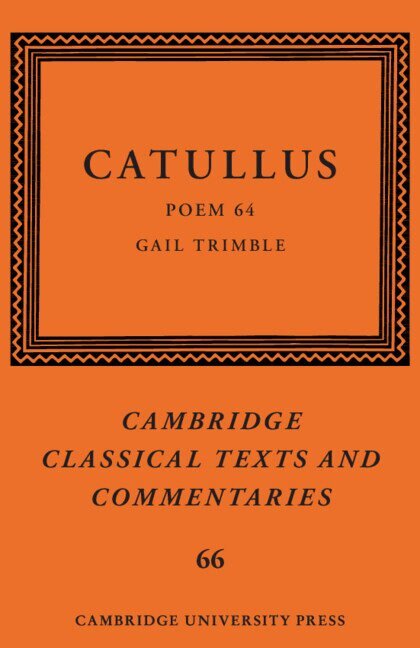
Catullus: Poem 64
Häftad, Engelska, 2026
541 kr
Kommande
Catullus' longest poem, a miniature epic or 'epyllion' that tells two apparently unrelated mythological stories, is a central text in the Roman literary tradition. Allusive, exquisite, and sometimes shocking, it offers a profound exploration of human connection and aesthetic response against a backdrop of universal history. This major new edition addresses the interpretative challenges of the poem on every level of detail. The corrupt text is newly edited, while a line-by-line commentary of unparalleled depth and range integrates discussion of textual and linguistic matters with sophisticated literary criticism and a thoroughgoing awareness both of the poem's cultural and intertextual background and of its subsequent influence and reception. The introduction sets Catullus 64 in context, and an innovative epilogue draws together the threads of an overall interpretation. This book is an essential resource for the study of Latin poetry, and will transform its readers' understanding and appreciation of Catullus 64.
E-bok
PDF, Engelska, 20252 634 kr
Läs direkt efter köp
Del 66 - Cambridge Classical Texts and Commentaries
Catullus: Poem 64
Inbunden, Engelska, 2025
2 333 kr
Skickas inom 7-10 vardagar
Catullus' longest poem, a miniature epic or 'epyllion' that tells two apparently unrelated mythological stories, is a central text in the Roman literary tradition. Allusive, exquisite, and sometimes shocking, it offers a profound exploration of human connection and aesthetic response against a backdrop of universal history. This major new edition addresses the interpretative challenges of the poem on every level of detail. The corrupt text is newly edited, while a line-by-line commentary of unparalleled depth and range integrates discussion of textual and linguistic matters with sophisticated literary criticism and a thoroughgoing awareness both of the poem's cultural and intertextual background and of its subsequent influence and reception. The introduction sets Catullus 64 in context, and an innovative epilogue draws together the threads of an overall interpretation. This book is an essential resource for the study of Latin poetry, and will transform its readers' understanding and appreciation of Catullus 64.