Gao-Feng Zhao – författare
Visar alla böcker från författaren Gao-Feng Zhao. Handla med fri frakt och snabb leverans.
3 produkter
3 produkter
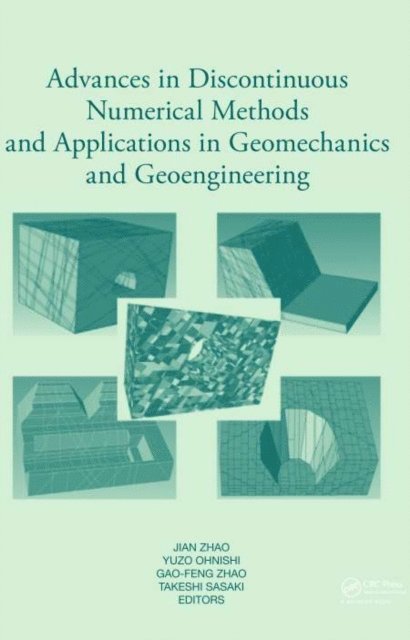
Advances in Discontinuous Numerical Methods and Applications in Geomechanics and Geoengineering
Inbunden, Engelska, 2012
2 441 kr
Skickas inom 7-10 vardagar
Rocks and soils can behave as discontinuous materials, both physically and mechanically, and for such discontinuous nature and behaviour there remain challenges in numerical modelling methods and techniques. Some of the main discontinuum based numerical methods, for example the distinct element method (DEM) and the discontinuous deformation analysis (DDA), are associated with geomechanics and geoengineering. Discontinuous numerical methods have been widely applied in geoengineering related to civil, mining, hydropower and petroleum engineering. There are many good examples of the use of UDEC/3DEC and DDA in design and forensic of geoengineering projects, in dams, slopes, tunnels, caverns and mines. The discontinuous numerical methods provide good tools to capture the true physical and mechanical behaviours of the geomaterials, and provide the scientific insights enabling for better engineering. Discontinuous numerical methods are indeed very much research and engineering tools of the present, and certainly more in the future. Advances in Discontinuous Numerical Methods and Applications in Geomechanics and Geoengineering is a collection of 55 technical papers presented at the 10th International Conference on Analysis of Discontinuous Deformation (ICADD-10), held 6-8 December 2011, Honolulu, USA. The papers cover a wide scope of discontinuous numerical methods from algorithms and mechanics, to modelling techniques and applications, including the key block theory, the discontinuous deformation analysis, the numerical manifold method, the distinct element method, coupled discontinuum and continuum methods, multi-scale and multi-physics in modelling, applications and case studies of engineering projects.
High Performance Computing and the Discrete Element Model
Opportunity and Challenge
Inbunden, Engelska, 2015
1 105 kr
Skickas inom 7-10 vardagar
This book addresses the high performance computing of the Discrete Element Model (DEM). It is a comprehensive presentation of parallel implementation of the DEM on three popular parallel computing platforms; the multi-core PC, the GPU computer, and the cluster supercomputer. Featuring accompanying MatLab source this book helps you implement the DEM model for use with high performing technology, for particular implementation of the dynamic failure of solids, granular flow and stress wave propagation through solids.
Features both Pre-processor, Solver, and Post-processor for the DEM Covers the parallel implementation of DEM on the cluster, multi-core PC, GPU PC Full of examples of dynamic fracturing, granular flow and stress wave propagation using high performance DEM Source codes and data files available for hands-on practice532 kr
Skickas inom 7-10 vardagar
This open access book provides insights into research topics related to geotechnical engineering simulations. With the development of computing power and artificial intelligence, research methods in geotechnical engineering are gradually shifting from field surveys and physical experiments toward simulation and prediction. Through simulations, it is possible to infer the impact of engineering structures on soil and rock masses, as well as their response to natural disasters such as earthquakes, landslides, and debris flows, allowing for early planning of mitigation measures.Inside, readers will find cutting-edge studies on microbial soil stabilization, finite element simulations, centrifuge modeling, and machine learning applications. Topics include advanced material characterization, predictive modeling of tunnels and slopes, AI-enhanced monitoring systems, and risk mitigation strategies for deep excavations and mining subsidence. These contributions illustrate how intelligent systems are optimizing both design and safety across a wide range of geotechnical scenarios.This volume is an essential resource for researchers, engineers, and graduate students seeking to leverage intelligent technologies for more efficient, accurate, and resilient geotechnical solutions. With its integration of theory, experimentation, and smart modeling, it offers a forward-looking perspective on the future of infrastructure in a rapidly evolving technological landscape.