Gardner Read - Böcker
Visar alla böcker från författaren Gardner Read. Handla med fri frakt och snabb leverans.
6 produkter
6 produkter
684 kr
Skickas inom 3-6 vardagar
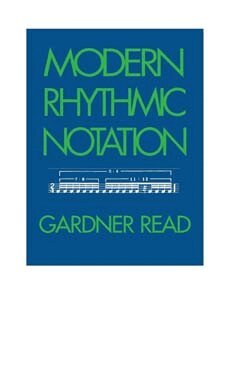
Twentieth-century music has significantly advanced the role of rhythm. The many variants of rhythmic notation, standard and experimental alike, encountered in contemporary music frequently demand explanation and interpretation. This book catalogs and clarifies the numerous ways of notating syncopation and alternative standard rhythmic figures, new time signatures, irrational rhythmic groupings within regular and irregular meters, experimental metrical concepts and techniques, analogs, and, finally, polymeters. Read compares traditional and present-day methods of delineating the same musical expressions, from fairly simple combinations to extremely complicated patterns.
901 kr
Skickas inom 10-15 vardagar
This is the first book to examine comprehensively the major systems of musical notation proposed during the past three centuries. Illustrating the many attempts to improve upon or replace the traditional system, this important work chronologically lists, describes, and critically analyzes the majority of the proposed reforms that have appeared over the years. No other book now available covers the subject in such depth or detail. It is not only a repository of suggested improvements in notation, but also a historical survey of the efforts made to simplify the standard practices.
1 245 kr
Skickas inom 10-15 vardagar
No other book has covered the subject of 20th-century microtonal notation in such depth as this comprehensive guide book. 20th-Century Microtonal Notation surveys the many attempts to notate various microtonal divisions of the octave in our western music. The concerts, festivals, and journals devoted exclusively to microtonal composition evince the widespread interest and involvement in microtonal music today. Activity in the specialized field of microtonalism is also supported by the design and construction of a number of novel instruments capable of producing various fractional pitches in the octave, including the digital synthesizer. However, despite the developing interest and activity, no consensus has yet been reached about the clearest and most logical notation for each degree of microtonal division of the half and whole step. This lack of an essential consensus on a suitable, standardized notation system has, in some cases, hampered the complete integration of microtonalism into western music.Bringing considerable expertise to bear, Read divides the volume into five sections, each addressing the notation of specific microtones. This volume is a comprehensive repository of the many attempts to find a logical notation for all degrees of microtonality. It represents an invaluable resource to anyone interested in studying the history and development of music notation, or in evaluating the many forms of microtonal notation in terms of their potential for contemporary notation. 20th-Century Microtonal Notation will be an important addition to the library collections of colleges and universities and will be of interest to composers, theorists, performers, and musicologists.
1 177 kr
Skickas inom 10-15 vardagar
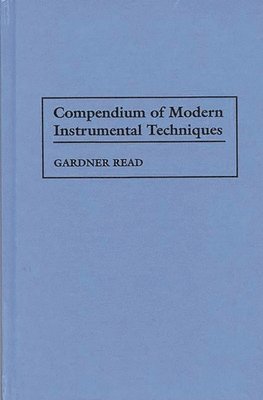
An important characteristic of contemporary art music has been the use of conventional instruments in unconventional ways, achieving effects undreamed of or thought impossible in the early twentieth century. This compendium codifies these techniques, explains their production and effects, cites representative scores, and provides numerous example from an international selection of composers. Part One considers techniques and procedures that apply to all instruments; Part Two takes up idiomatic techniques with specific instruments in all orchestral categories. This monumental survey is essential for any music library or serious musician.An important characteristic of contemporary art music has been the use of conventional instruments in unconventional ways, achieving effects undreamed of or thought impossible in the early twentieth century. Yet many of these techniques remain poorly understood with respect to both the physical procedures involved and the results in sound output. This compendium codifies these techniques, explains their production in terms of idiomatic peculiarity and limitations, and cites representative scores in which the new devices form an integral part of the composer's sonoric concepts. Citations and numerous printed examples are taken from an international selection of works by the most advanced and significant composers. Part One considers techniques and procedures that, with only slight modification, apply to all instruments: extended ranges, muting, glissandi, harmonics, percussive effects, microtones, amplification, and extramusical devices. Part Two is devoted to idiomatic techniques with specific instruments in the categories of woodwinds and brasses, percussion, harp and other plucked instruments, keyboard instruments, and strings. While demonstrating recent and radical innovations, references are made to historical beginnings of such devices in our classical music heritage.An earlier version of this volume, Contemporary Instrumental Techniques (1976), was widely acclaimed by musicians and educators, recognized as a significant achievement in cataloging and organization and as an invaluable reference tool. Now extensively expanded, with additional techniques, new and revised explanations, and hundreds of recent citations and examples, this monumental survey is essential for any music library or serious musician. An indispensable guide for composers and orchestrators, it will also be valuable as a sourcebook for performers and teachers and as a textbook for courses in composition.
764 kr
Skickas inom 10-15 vardagar
This text provides the first comprehensive examination of pictographic notation. Pictographic musical notation represents the relevant instruments themselves rendered visually rather than verbally. Used most extensively in contemporary publications between the 1950s and 1980s, its popularity has waned in recent years. This expertly researched work displays the resourcefulness and inventiveness of 20th century orchestrators.Providing a detailed examination of pictographic score notation, this unique book passes over 60 years of contemporary composition and score publications. Divided into three sections, this work describes instrumental pictographs, stage diagrams, and pictographic performance directives. In addition to the thoroughly researched information and extensive technique illustrations, commentary on individual examples and frequent cross-referencing of related examples, differentiate this work from other journal articles and notation texts.
1 520 kr
Skickas inom 10-15 vardagar