Gareth Haslinger – författare
Visar alla böcker från författaren Gareth Haslinger. Handla med fri frakt och snabb leverans.
2 produkter
2 produkter
Del 2165 - Lecture Notes in Mathematics
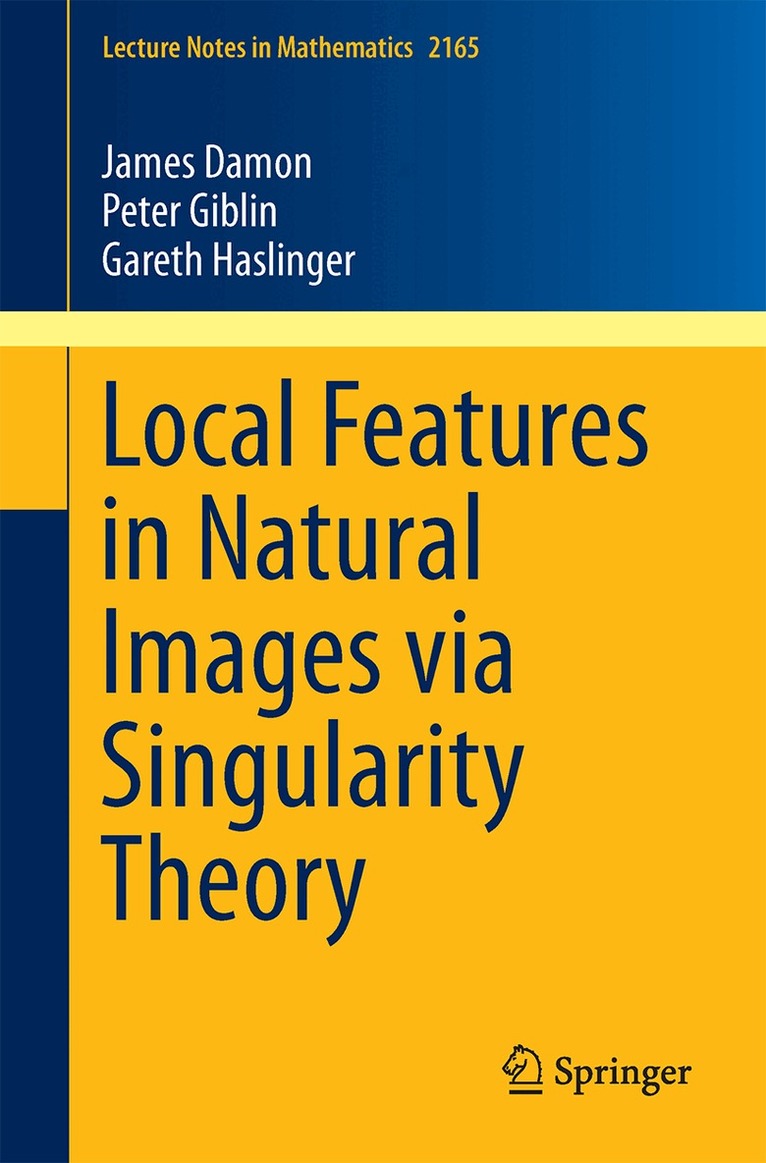
Local Features in Natural Images via Singularity Theory
Häftad, Engelska, 2016
549 kr
Skickas inom 10-15 vardagar
This monograph considers a basic problem in the computer analysis of natural images, which are images of scenes involving multiple objects that are obtained by a camera lens or a viewer’s eye. The goal is to detect geometric features of objects in the image and to separate regions of the objects with distinct visual properties. When the scene is illuminated by a single principal light source, we further include the visual clues resulting from the interaction of the geometric features of objects, the shade/shadow regions on the objects, and the “apparent contours”. We do so by a mathematical analysis using a repertoire of methods in singularity theory. This is applied for generic light directions of both the “stable configurations” for these interactions, whose features remain unchanged under small viewer movement, and the generic changes which occur under changes of view directions. These may then be used to differentiate between objects and determine their shapes and positions.
E-bok
PDF, Engelska, 2016687 kr
Läs direkt efter köp
This monograph considers a basic problem in the computer analysis of natural images, which are images of scenes involving multiple objects that are obtained by a camera lens or a viewer’s eye. The goal is to detect geometric features of objects in the image and to separate regions of the objects with distinct visual properties. When the scene is illuminated by a single principal light source, we further include the visual clues resulting from the interaction of the geometric features of objects, the shade/shadow regions on the objects, and the “apparent contours”. We do so by a mathematical analysis using a repertoire of methods in singularity theory. This is applied for generic light directions of both the “stable configurations” for these interactions, whose features remain unchanged under small viewer movement, and the generic changes which occur under changes of view directions. These may then be used to differentiate between objects and determine their shapes and positions.