Garrett Hardin – författare
Visar alla böcker från författaren Garrett Hardin. Handla med fri frakt och snabb leverans.
12 produkter
12 produkter
Häftad, Engelska, 1986
288 kr
Skickas inom 5-8 vardagar
Häftad, Engelska, 1995
213 kr
Skickas inom 5-8 vardagar
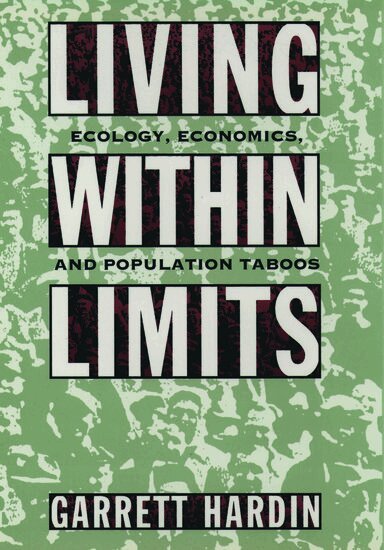
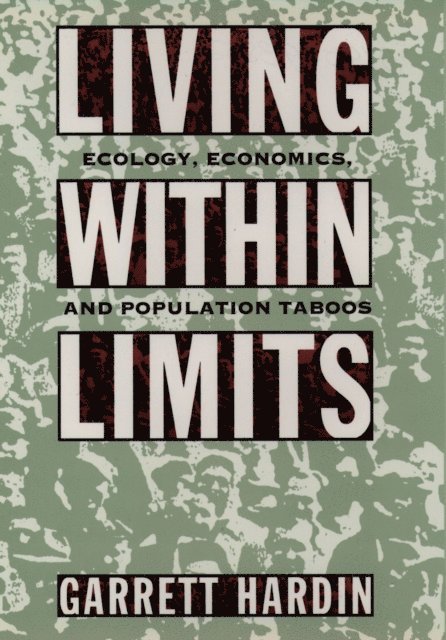
Population is a prominent topic of debate following the world conference at the end of last year. This book tackles the problem of overpopulation with an honesty and fearlessness that is unrivalled, and makes a forceful case for dramatically changing the way we live in, and manage, our world. Hardin suggests radical approaches to overpopulation and points out that the choices are hard, but we must not be afraid to carry out forceful solutions in order to better our world in the future.
Inbunden, Engelska, 1999
477 kr
Skickas inom 5-8 vardagar
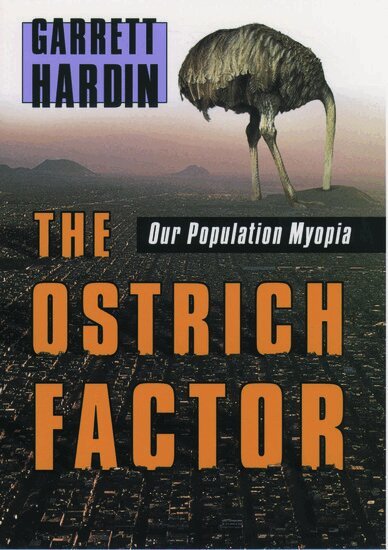
Garrett Hardin, one of the leading thinkers on the problem of overpopulation, addresses the arguments of economists about continued 'sustainable growth'. He discusses issues that are frequently avoided in most short-term considerations of population levels. This book builds upon the success of Hardin's earlier book, Living Within Limits, and seeks to lay out the practical steps that humankind must take now to ensure the long-term survival of civilization.
E-bok
PDF, Engelska, 1999535 kr
Läs direkt efter köp
Garrett Hardin, one of our leading thinkers on problems of human overpopulation, here assails the recklessness and basic ecological ignorance of economists and others who champion the idea of unbounded growth. Hardin delivers an uncompromising critique of mainstream economic thinking. Science has long understood the limits of our environment, he notes, and yet economists consistently turn a blind eye to one feature we share with all of our planet''s inhabitants--the potential for irreversible environmental damage through overcrowding. And as humankind draws ever closer to its goal of conquering our final natural enemy--disease--the fallacy of sustainable unchecked population growth becomes more and more dangerous. Moreover, Hardin argues, rampant growth will soon force us to face many issues that we will find quite unpalatable--most notably, that since volunteer population control will not work, we will have to turn to "democratic coercion" or "mutual coercion, mutually agreed upon" to limit growth, a policy that directly threatens long cherished personal rights. Challenging an array of powerful taboos, Hardin takes aim at sacred cows on both sides of the political fence--affirmative action, multiculturalism, current immigration policies, and the greed and excess of big business and "growth intoxicated industrialists." Hardin''s forceful and cogent argument for the union of ecology and economics is a must for anyone concerned with the goal of a bountiful, yet sustainable world. Sure to spark controversy, this book underscores the urgency of our situation and reveals practical steps we must take to ensure the long term survival of humankind.
E-bok
PDF, Engelska, 1995220 kr
Läs direkt efter köp
"We fail to mandate economic sanity," writes Garrett Hardin, "because our brains are addled by...compassion." With such startling assertions, Hardin has cut a swathe through the field of ecology for decades, winning a reputation as a fearless and original thinker. A prominent biologist, ecological philosopher, and keen student of human population control, Hardin now offers the finest summation of his work to date, with an eloquent argument for accepting the limits of the earth''s resources--and the hard choices we must make to live within them. In Living Within Limits, Hardin focuses on the neglected problem of overpopulation, making a forceful case for dramatically changing the way we live in and manage our world. Our world itself, he writes, is in the dilemma of the lifeboat: it can only hold a certain number of people before it sinks--not everyone can be saved. The old idea of progress and limitless growth misses the point that the earth (and each part of it) has a limited carrying capacity; sentimentality should not cloud our ability to take necessary steps to limit population. But Hardin refutes the notion that goodwill and voluntary restraints will be enough. Instead, nations where population is growing must suffer the consequences alone. Too often, he writes, we operate on the faulty principle of shared costs matched with private profits. In Hardin''s famous essay, "The Tragedy of the Commons," he showed how a village common pasture suffers from overgrazing because each villager puts as many cattle on it as possible--since the costs of grazing are shared by everyone, but the profits go to the individual. The metaphor applies to global ecology, he argues, making a powerful case for closed borders and an end to immigration from poor nations to rich ones. "The production of human beings is the result of very localized human actions; corrective action must be local....Globalizing the ''population problem'' would only ensure that it would never be solved." Hardin does not shrink from the startling implications of his argument, as he criticizes the shipment of food to overpopulated regions and asserts that coercion in population control is inevitable. But he also proposes a free flow of information across boundaries, to allow each state to help itself. "The time-honored practice of pollute and move on is no longer acceptable," Hardin tells us. We now fill the globe, and we have no where else to go. In this powerful book, one of our leading ecological philosophers points out the hard choices we must make--and the solutions we have been afraid to consider.

E-bok
Engelska, 1993214 kr
Läs direkt efter köp
"We fail to mandate economic sanity," writes Garrett Hardin, "because our brains are addled by...compassion." With such startling assertions, Hardin has cut a swathe through the field of ecology for decades, winning a reputation as a fearless and original thinker. A prominent biologist, ecological philosopher, and keen student of human population control, Hardin now offers the finest summation of his work to date, with an eloquent argument for accepting the limits of the earth''s resources--and the hard choices we must make to live within them. In Living Within Limits, Hardin focuses on the neglected problem of overpopulation, making a forceful case for dramatically changing the way we live in and manage our world. Our world itself, he writes, is in the dilemma of the lifeboat: it can only hold a certain number of people before it sinks--not everyone can be saved. The old idea of progress and limitless growth misses the point that the earth (and each part of it) has a limited carrying capacity; sentimentality should not cloud our ability to take necessary steps to limit population. But Hardin refutes the notion that goodwill and voluntary restraints will be enough. Instead, nations where population is growing must suffer the consequences alone. Too often, he writes, we operate on the faulty principle of shared costs matched with private profits. In Hardin''s famous essay, "The Tragedy of the Commons," he showed how a village common pasture suffers from overgrazing because each villager puts as many cattle on it as possible--since the costs of grazing are shared by everyone, but the profits go to the individual. The metaphor applies to global ecology, he argues, making a powerful case for closed borders and an end to immigration from poor nations to rich ones. "The production of human beings is the result of very localized human actions; corrective action must be local....Globalizing the ''population problem'' would only ensure that it would never be solved." Hardin does not shrink from the startling implications of his argument, as he criticizes the shipment of food to overpopulated regions and asserts that coercion in population control is inevitable. But he also proposes a free flow of information across boundaries, to allow each state to help itself. "The time-honored practice of pollute and move on is no longer acceptable," Hardin tells us. We now fill the globe, and we have no where else to go. In this powerful book, one of our leading ecological philosophers points out the hard choices we must make--and the solutions we have been afraid to consider.

Häftad, Engelska, 1999
693 kr
Skickas inom 10-15 vardagar
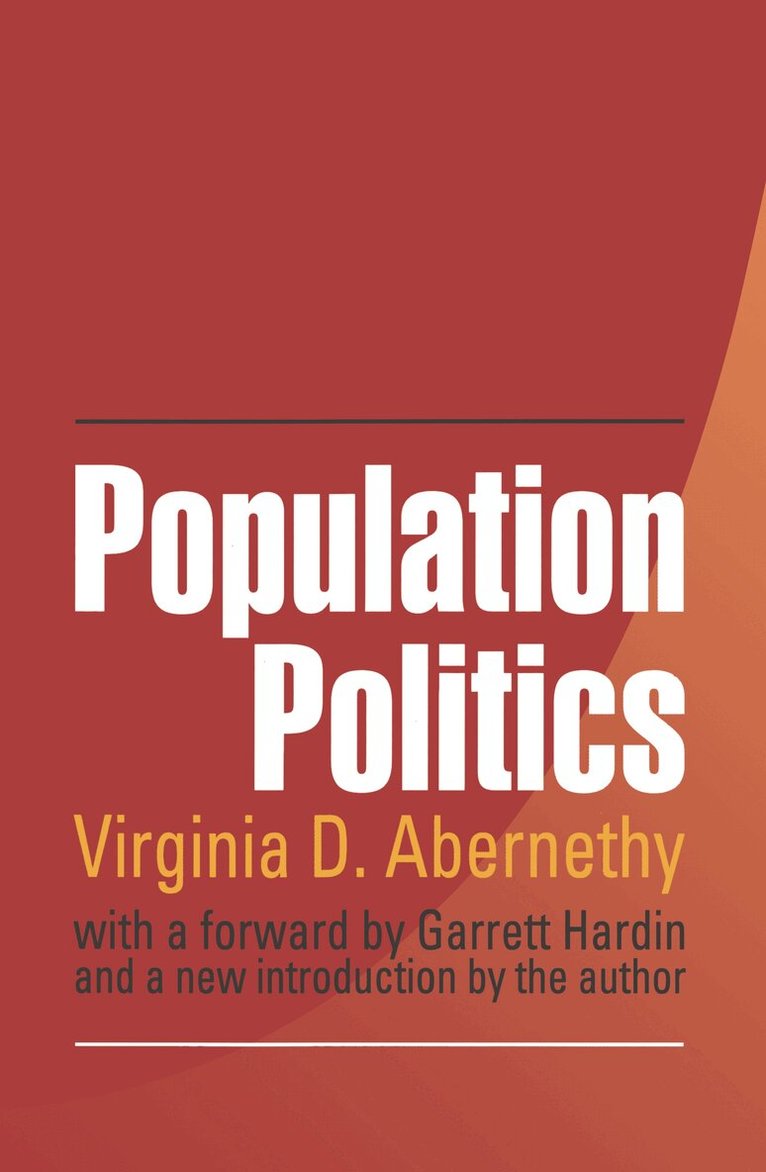
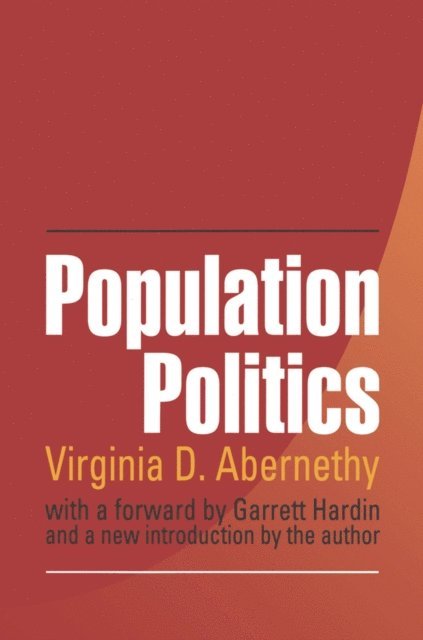
International efforts to regulate fertility rates so that populations do not grow beyond the earth's capacity have included technical assistance and capital; improved health care conditions to lower the risk of infant mortality; increased opportunities to develop literacy; the democratization of governments; and several decades of liberal immigration and refugee policies favoring third world nations. The persistence of high fertility despite international efforts confounds demographers. 'Population Politics' brilliantly dissects the paradigm responsible for the counterproductive efforts of nations and international agencies. Abernethy, a renowned anthropologist, shows why policies hamper the shift to lower fertility. Ireland, Indonesia, Cuba, China, Turkey and Egypt are but a few of the countries Abernethy examines, showing how economic, sociocultural, and agricultural factors that have caused population growth can be harnessed to stabilize population size. 'Population Politics' is a provocative examination of the influence of aid and liberal immigration policies on world population growth, and often counterproductive to the role of the United States as an industrial power. This volume's uniquely interdisciplinary perspective will enlighten the lay reader, as well as demographers and epidemiologists, conservationists, reproduction and family specialists, agricultural economists, and public health personnel. Virginia D. Abernethy is professor emeritus of psychiatry (anthropology) at Vanderbilt Medical School and was for 11 years the editor of the scholarly journal 'Population and Environment. Garrett Hardin is emeritus professor of human ecology in the Department of Biological Sciences and the University of California, Santa Barbara.
Inbunden, Engelska, 2018
2 179 kr
Skickas inom 10-15 vardagar
International efforts to regulate fertility rates so that populations do not grow beyond the earth's capacity have included technical assistance and capital; improved health care conditions to lower the risk of infant mortality; increased opportunities to develop literacy; the democratization of governments; and several decades of liberal immigration and refugee policies favoring third world nations. The persistence of high fertility despite international efforts confounds demographers. 'Population Politics' brilliantly dissects the paradigm responsible for the counterproductive efforts of nations and international agencies. Abernethy, a renowned anthropologist, shows why policies hamper the shift to lower fertility. Ireland, Indonesia, Cuba, China, Turkey and Egypt are but a few of the countries Abernethy examines, showing how economic, sociocultural, and agricultural factors that have caused population growth can be harnessed to stabilize population size. 'Population Politics' is a provocative examination of the influence of aid and liberal immigration policies on world population growth, and often counterproductive to the role of the United States as an industrial power. This volume's uniquely interdisciplinary perspective will enlighten the lay reader, as well as demographers and epidemiologists, conservationists, reproduction and family specialists, agricultural economists, and public health personnel. Virginia D. Abernethy is professor emeritus of psychiatry (anthropology) at Vanderbilt Medical School and was for 11 years the editor of the scholarly journal 'Population and Environment. Garrett Hardin is emeritus professor of human ecology in the Department of Biological Sciences and the University of California, Santa Barbara.
Inbunden, Engelska
759 kr
Skickas inom 3-6 vardagar
E-bok
Engelska, 2018795 kr
Läs direkt efter köp
International efforts to regulate fertility rates so that populations do not grow beyond the earth''s capacity have included technical assistance and capital; improved health care conditions to lower the risk of infant mortality; increased opportunities to develop literacy; the democratization of governments; and several decades of liberal immigration and refugee policies favoring third world nations. The persistence of high fertility despite international efforts confounds demographers. ''Population Politics'' brilliantly dissects the paradigm responsible for the counterproductive efforts of nations and international agencies. Abernethy, a renowned anthropologist, shows why policies hamper the shift to lower fertility. Ireland, Indonesia, Cuba, China, Turkey and Egypt are but a few of the countries Abernethy examines, showing how economic, sociocultural, and agricultural factors that have caused population growth can be harnessed to stabilize population size. ''Population Politics'' is a provocative examination of the influence of aid and liberal immigration policies on world population growth, and often counterproductive to the role of the United States as an industrial power. This volume''s uniquely interdisciplinary perspective will enlighten the lay reader, as well as demographers and epidemiologists, conservationists, reproduction and family specialists, agricultural economists, and public health personnel. Virginia D. Abernethy is professor emeritus of psychiatry (anthropology) at Vanderbilt Medical School and was for 11 years the editor of the scholarly journal ''Population and Environment. Garrett Hardin is emeritus professor of human ecology in the Department of Biological Sciences and the University of California, Santa Barbara.
E-bok
PDF, Engelska, 2018795 kr
Läs direkt efter köp
International efforts to regulate fertility rates so that populations do not grow beyond the earth''s capacity have included technical assistance and capital; improved health care conditions to lower the risk of infant mortality; increased opportunities to develop literacy; the democratization of governments; and several decades of liberal immigration and refugee policies favoring third world nations. The persistence of high fertility despite international efforts confounds demographers. ''Population Politics'' brilliantly dissects the paradigm responsible for the counterproductive efforts of nations and international agencies. Abernethy, a renowned anthropologist, shows why policies hamper the shift to lower fertility. Ireland, Indonesia, Cuba, China, Turkey and Egypt are but a few of the countries Abernethy examines, showing how economic, sociocultural, and agricultural factors that have caused population growth can be harnessed to stabilize population size. ''Population Politics'' is a provocative examination of the influence of aid and liberal immigration policies on world population growth, and often counterproductive to the role of the United States as an industrial power. This volume''s uniquely interdisciplinary perspective will enlighten the lay reader, as well as demographers and epidemiologists, conservationists, reproduction and family specialists, agricultural economists, and public health personnel. Virginia D. Abernethy is professor emeritus of psychiatry (anthropology) at Vanderbilt Medical School and was for 11 years the editor of the scholarly journal ''Population and Environment. Garrett Hardin is emeritus professor of human ecology in the Department of Biological Sciences and the University of California, Santa Barbara.
Häftad, Engelska
568 kr
Skickas inom 3-6 vardagar