Gary J. Long - Böcker
Visar alla böcker från författaren Gary J. Long. Handla med fri frakt och snabb leverans.
3 produkter
3 produkter
2 101 kr
Skickas inom 10-15 vardagar
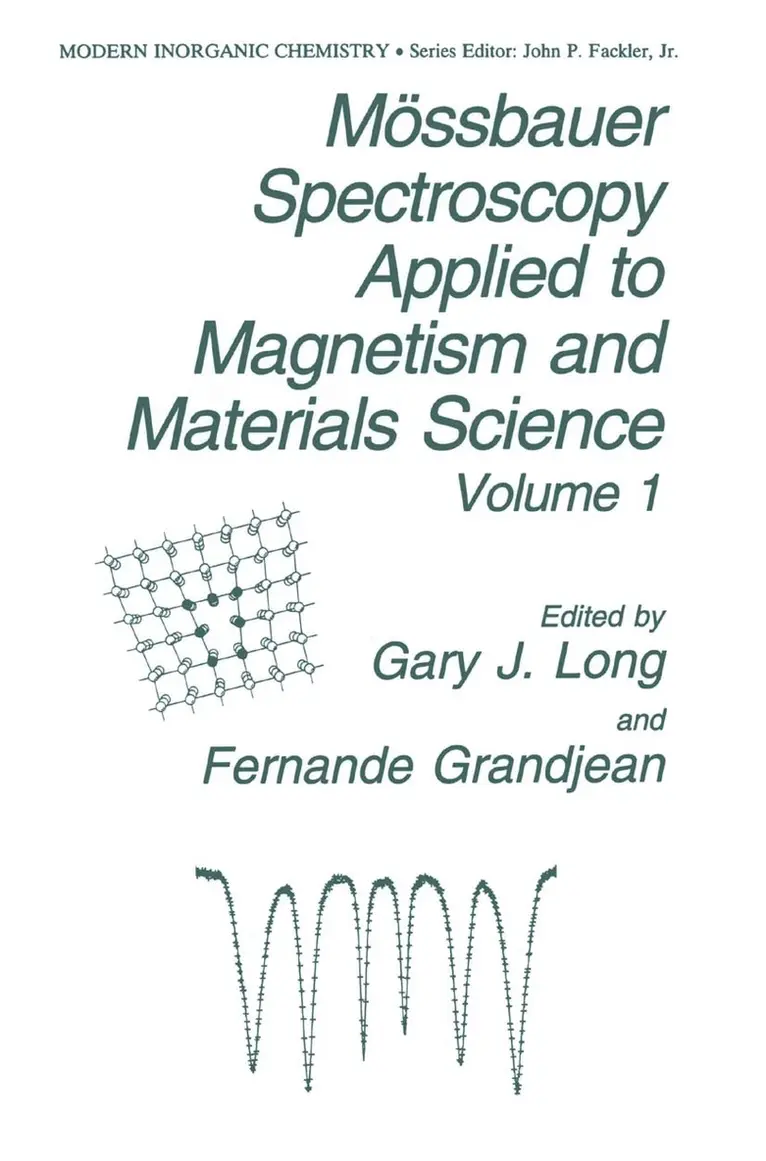
During the past 30 years materials science has developed into a full-fledged field for basic and applied scientific enquiry. Indeed, materials scientists have devoted their efforts to creating new materials with improved electronic, magnetic, thermal, mechanical, and optical properties. Often unnoticed, these new materials are rapidly invading our homes and automobiles, and may be found in our utensils, electronic equipment, textiles, home appliances, and electric motors. Even though they may go unnoticed, these new materials have either improved the efficiency and lifetime of these items or have reduced their weight or cost. In particular, magnetically ordered materials are useful in various applications, such as motors, magnetic imaging, magnetic recording, and magnetic levitation. Hence, much effort has been devoted to the development of better hard magnetic materials, magnetic thin films, and molecular magnets. During the same period of time, Mossbauer-effect spectroscopy has grown from a laboratory curiosity to a mature spectroscopic technique, a technique that probes solid-state materials at specific atomic sites and yields microscopic information on the magnetic and electronic properties of these materials. Iron-57 is the most commonly and easily used Mossbauer-effect isotope and, of course, is particularly relevant for the study of magnetic materials. Various applications of Mossbauer spectroscopy to magnetic materials are discussed in the first six chapters of this volume. Other isotopes such as zinc-67 and gadolinium-ISS have recently been used to study the electronic properties of zinc compounds and the electronic and magnetic properties of rare-earth transition metal compounds.
Del 2 - Modern Inorganic Chemistry
Mössbauer Spectroscopy Applied to Magnetism and Materials Science
Inbunden, Engelska, 1996
1 578 kr
Skickas inom 10-15 vardagar
This book represents Volume 2 in a series on the use of Mossbauer spectroscopy in the study of magnetism and materials. However, the perceptive reader will notice some differences from Volume 1. Specifically, in order to market the book at a more affordable price for most universities and research laboratories, the book has been prepared in camera ready format The editors and the authors agreed to do this because there is a demand for such a book in the Mossbauer community. This format has placed an extra burden on the editors and the authors and we hope we have overcome all the difficulties generated by the transfer of files between different computers. In order to make the book more attractive to materials scientists who are not experts in Mossbauer spectroscopy, this volume is particularly oriented towards the study of materials by Mossbauer spectroscopy and related complementary techniques, such as neutron scattering and a variety of surface scattering techniques. The authors of this volume can be proud of the high quality professional effort they have devoted to clearly presenting their specific topics. As a result we very much enjoyed working with the authors on this volume. We hope that their effort will help to educate the next generation of Mossbauer effect spectroscopists, a generation which will face the challenge of maintaining equally high scientific and professional standards in their research work.
High Density Digital Recording
Proceedings of the NATO Advanced Study Institute, Il Ciocco, Castelvecchio-Pascoli, Italy, June 7-19, 1992
Inbunden, Engelska, 1992
852 kr
Skickas inom 10-15 vardagar
This book deals with many aspects of high density digital recording. It begins with very basic concepts in magnetism and magneto-optics, then continues with the synthesis and physical properties of recording media, thin films and particulate media. More technological aspects of recording heads and their contact with the recording media are also discussed in subsequent chapters. The second part of the book is devoted to the magneto-optical properties of various recording media and to the engineering of magneto-optical recording.