Gary Libben - Böcker
Visar alla böcker från författaren Gary Libben. Handla med fri frakt och snabb leverans.
5 produkter
5 produkter
1 628 kr
Skickas inom 5-8 vardagar
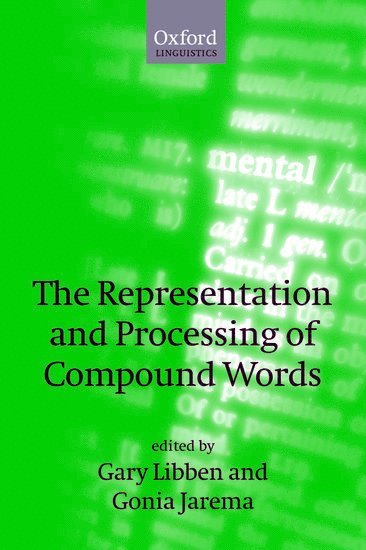
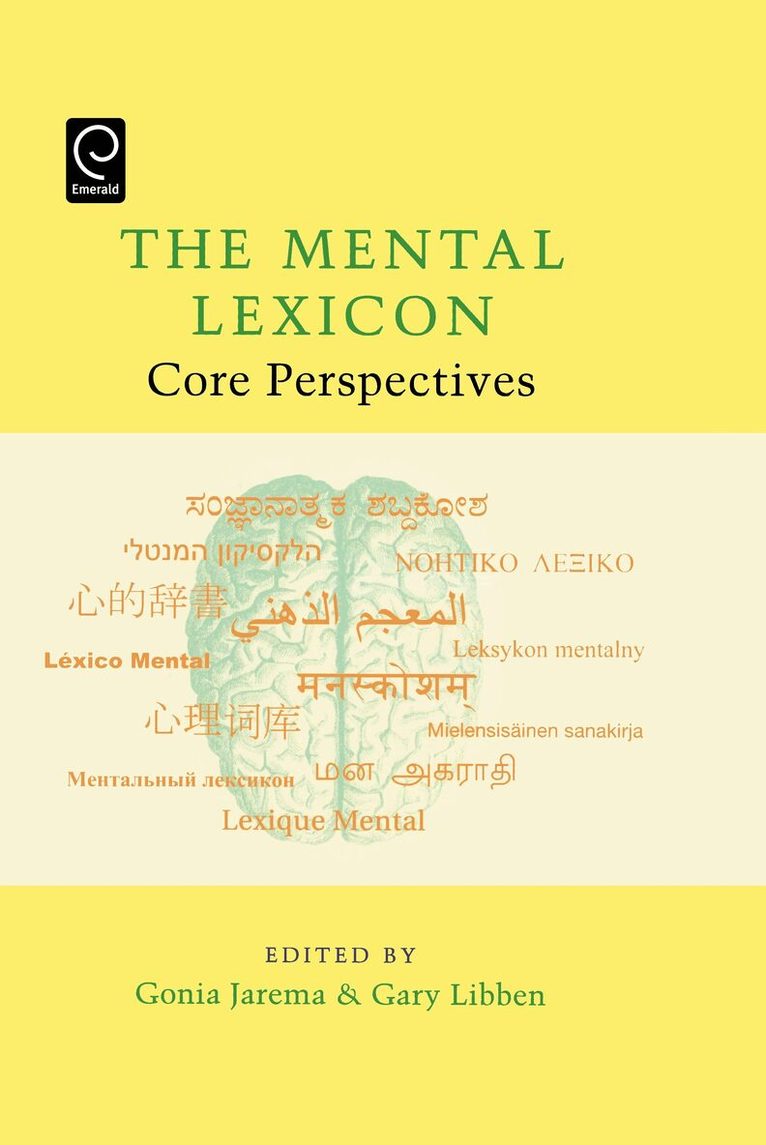
This volume reflects a consensus that the investigation of words in the mind offers a unique opportunity to understand both human language ability and general human cognition. It brings together key perspectives on the fundamental nature of the representation and processing of words in the mind. This thematic volume covers a wide range of views on the fundamental nature of representation and processing of words in the mind and a range of views on the investigative techniques that are most likely to reveal that nature. It provides an overview of issues and developments in the field. It uncovers the processes of word recognition. It develops new models of lexical processing.
655 kr
Skickas inom 7-10 vardagar
This book presents new work on the psycholinguistics and neurolinguistics of compound words. It shows the insights this work offers on natural language processing and the relation between language, mind, and memory. Compounding is an easy and effective way to create and transfer meanings. By building new lexical items based on the meanings of existing items, compounds can usually be understood on first presentation, though - as, for example, breadboard, cardboard, cupboard, and sandwich-board show - the rules governing the relations between the components' meanings are not always straightforward. Compound words may be segmentable into their constituent morphemes in much the same way as sentences can be divided into their constituent words: children and adults would not otherwise find them interpretable. But compound sequences may also be independent lexical items that can be retrieved for production as single entities and whose idiosyncratic meanings are stored in the mind. Compound words reflect the properties both of linguistic representation in the mind and of grammatical processing. They thus offer opportunities for investigating key aspects of the mental operations involved in language: for example, the interplay between storage and computation; the manner in which morphological and semantic factors impact on the nature of storage; and the way the mind's computational processes serve on-line language comprehension and production. This book explores the nature of these opportunities, assesses what is known, and considers what may yet be discovered and how.
2 554 kr
Skickas inom 5-8 vardagar
This book presents new work on the psycholinguistics and neurolinguistics of compound words. It shows the insights this work offers on natural language processing and the relation between language, mind, and memory. Compounding is an easy and effective way to create and transfer meanings. By building new lexical items based on the meanings of existing items, compounds can usually be understood on first presentation, though - as, say, breadboard, cardboard, cupboard, and sandwich-board show - the rules governing the relations between the components' meanings are not always straightforward. Compound words are segmentable into their constituent morphemes in much the same way as sentences can be divided into their constituent words: children and adults would not otherwise find them interpretable. But compound sequences may also be independent lexical items that can be retrieved for production as single entities and whose idiosyncratic meanings are stored in the mind. Compound words reflect the properties both of linguistic representation in the mind and of grammatical processing. They thus offer opportunities for investigating key aspects of the mental operations involved in language: for example, the interplay between storage and computation; the manner in which morphological and semantic factors impact on the nature of storage; and the way the mind's computational processes serve on-line language comprehension and production. This book explores the nature of these opportunities, assesses what is known, and considers what may yet be discovered and how.
388 kr
Skickas inom 7-10 vardagar
A student-friendly introduction to the field of psycholinguistics, offering an exciting overview of the cognitive processes behind language processingNature of Language: Psycholinguistic Perspectives on Words presents an accessibleoverview of the dynamic field of psycholinguistics. Requiring no previous background in linguistics or psychology, this student-friendly textbook emphasizes the integrated nature of language processing and highlights the complex interactions between comprehension and production in human language. Clear, easy-to-read chapters define and explain all concepts with an engaging narrative style—providing students with the intellectual foundation necessary to explore the cognitive processes of language behavior, consider new linguistic phenomena, and think critically about unsolved problems. Throughout the text, students engage with overarching questions about the nature of language as they learn how psycholinguistics uses data to translate conceptual questions into specific research questions. Explores how traditional linguistic notions both help and hinder understanding of how people do languageInvestigates social and cultural aspects of psycholinguistics, such as how people use language to influence othersDescribes the nineteenth-century foundations of psycholinguistics and neurolinguisticsOffers new perspectives about the future of words and the future of languageFeatures helpful pedagogical tools including numerous images, charts, diagrams, and boxed sections designed to enhance the reading experience and provide context for key concepts and developmentsNature of Language is an excellent primary textbook for undergraduate courses in psycholinguistics and psychology of language, and a valuable supplement for students of cognitive science, applied linguistics, and speech language pathology. It is also an informative resource for anyone interested in the mysteries of words, language, and the mind.
2 150 kr
Skickas inom 10-15 vardagar
The Bilingual Aphasia Test is a comprehensive language test designed to assess the differential loss or sparing of various language functions in previously bilingual individuals. The individual is tested, separately, in each language he or she previously used, and then in the two languages simultaneously. The testing is multimodal -- sampling hearing, speaking, reading, and writing; and multidimensional -- testing various linguistic levels (phonological, morphological, syntactic, lexical, and semantic), tasks (comprehension, repetition, judgment, lexical access and propositionizing), and units (words, sentences, and paragraphs). The BAT is structured as follows: * To test a bilingual aphasic, you will need the following testing elements: the stimulus books for each of the languages in which the individual was formerly fluent, the single-language tests for each of these languages, as well as the bilingual test that links them. For example, if you are testing an English-French bilingual aphasic, you will need an English stimulus book, a French stimulus book, an English single-language test, a French single-language test, and an English-French bilingual test. * The BAT can also be used to test monolingual aphasics. To test for monolingual aphasia, you will need the stimulus book and the single-language test in the language in which the individual was formerly fluent. * Professor Paradis' book, The Assessment of Bilingual Aphasia, provides the background material and serves as the manual for the test. The BAT is available in dozens of languages and language pairs. There are now 106 bilingual pairs available. Additional single-language and bilingual tests are being prepared continuously. If the language (or language pair) you need is not listed, please call LEA to find out if and when it will be available. Single-language materials are now available in: Amharic Arabic (Jordanian) Arab